Is California a Harbinger of the AI Job Disruption?
Membership required
Membership is now required to use this feature. To learn more:
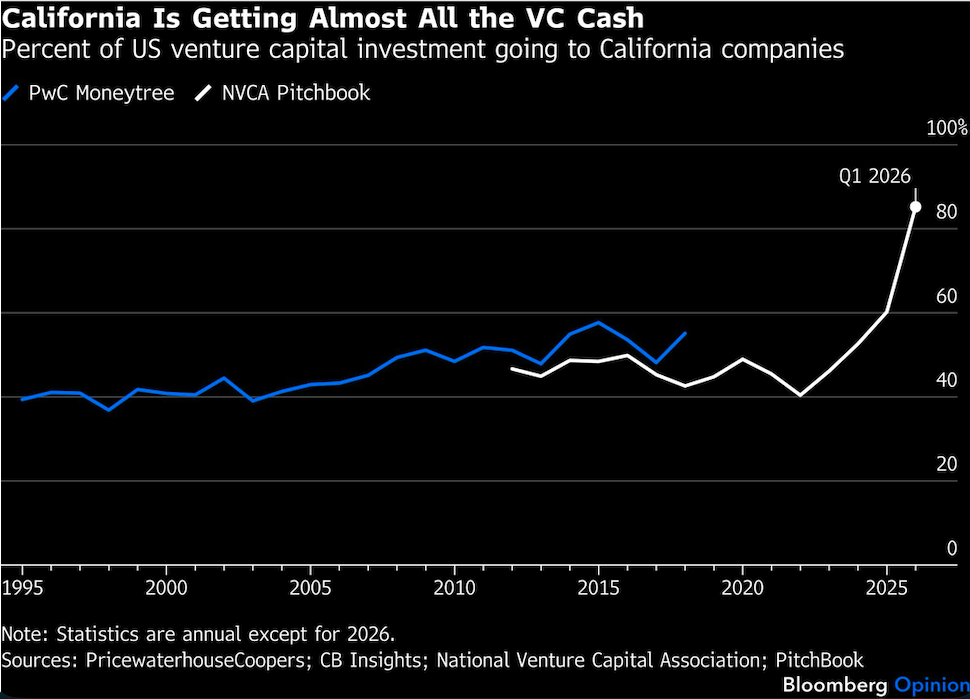
View Membership BenefitsIf venture capital investment is a measure of the economic future, California would seem to have locked things up. In the first quarter of this year — by far the biggest quarter for US VC investment ever — an unheard-of 85% of the money went to California companies, according to the PitchBook-NVCA Venture Monitor. For all of 2025, California’s share was an also-unprecedented 60%.
But employment in the industries toward which all this investment is flowing — technology, broadly defined — has been headed mostly in the opposite direction. California has shed 107,900 jobs since August 2022, an 11% decline, in the six sectors tracked in monthly Bureau of Labor Statistics payroll data that can most reasonably be classified as tech. The state’s share of national tech employment started falling in 2020 and is, depending how you measure it, either near an all-time low (consistent employment statistics for these narrow industry categories start in 1990) or back to the levels of the early 2010s.
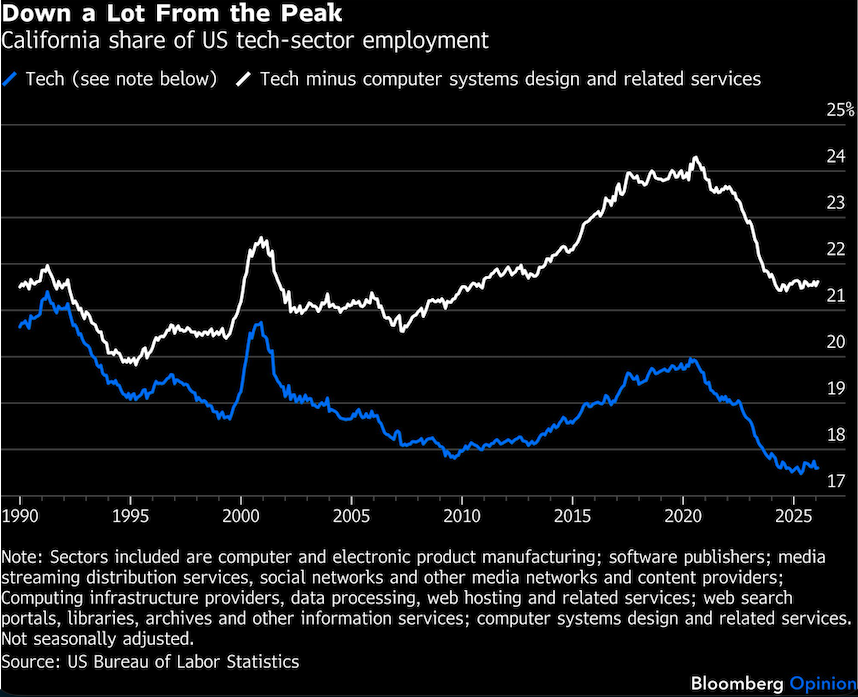
Computer systems design and related services is what firms such as Accenture, Infosys and Capgemini do, which is mostly helping non-tech companies and other entities better utilize information technology. The fact that employment in this sector has become more geographically dispersed is less a sign of the waning importance of California than an indication of how far and wide the technologies developed there have spread. Exclude computer systems design and related services, and California’s share of tech employment remains perfectly respectable, historically speaking, even if it has fallen a lot since 2020. It also shows signs of a modest comeback that wasn’t apparent late last year — in part because the annual benchmark revisions that reduced national nonfarm employment by 0.6% left California’s nonfarm total basically unchanged.
In the decades-old debate over whether California’s high real estate prices, high taxes, traffic congestion and other problems are finally going to end the state’s tech dominance — a debate that has flared up this year in response to a tentative state proposal to tax billionaires’ wealth — the VC and jobs data together seem to be saying “not yet.”
But maybe that’s the wrong debate to be focusing on. Last month, Gad Levanon, chief economist at labor-market think tank Burning Glass Institute, sliced California’s employment numbers differently to make the point that the state may be hemorrhaging white-collar jobs precisely because it’s on the leading edge of technological change. The post-benchmark-revision state jobs data shows a bit of a California revival here, too, but this doesn’t necessarily negate Levanon’s story. California’s undisputed leadership in artificial intelligence is driving investment in its AI companies — more than half of the state’s $228 billion first-quarter VC haul went to OpenAI and Anthropic — and creating jobs there even as it supplants them elsewhere.
Levanon’s proxy for white-collar employment is jobs in the three broad sectors of (1) finance and insurance, (2) information and (3) professional and business services. Information is where most of the tech sectors in the above charts reside, along with legacy publishing, broadcast and movie-making as well as telecommunications companies. Professional and business services encompasses computer systems design and related services along with lawyers, management consultants, engineering firms and lots of others.
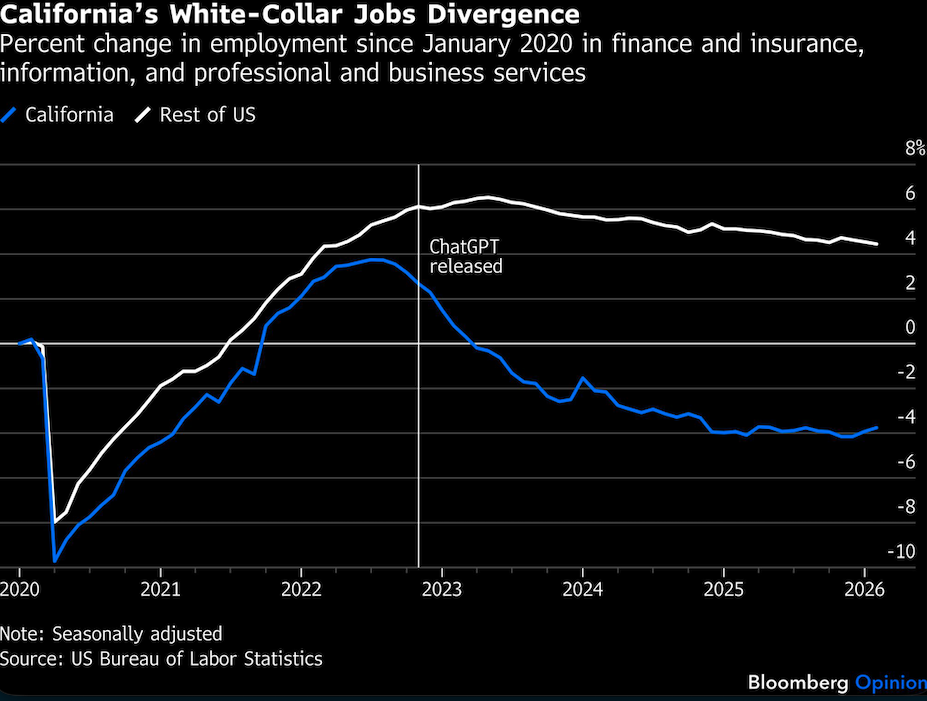
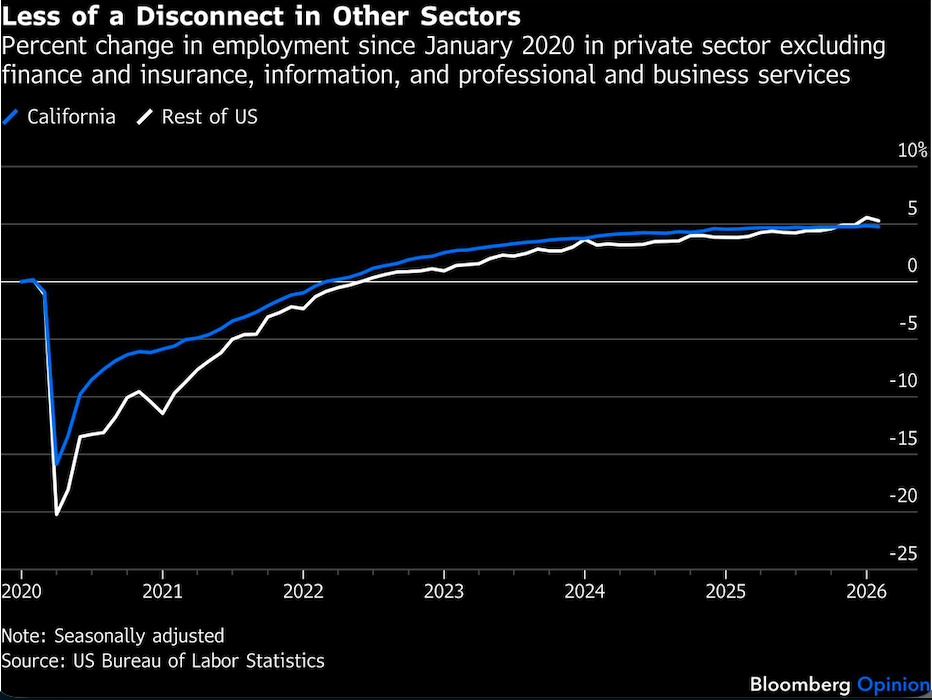
The November 2022 release date of OpenAI’s ChatGPT has frequently been used as a before-and-after dividing line for measuring the impact of AI, but it has its limitations. It’s unlikely that companies were already reworking business processes around AI during ChatGPT’s first few months on the market, plus California’s white-collar jobs decline started before November 2022. In information, the headcount reduction was partly just a reaction to the hiring boom that preceded it in 2021 and the first half of 2022. But California’s divergence from the rest of the country in overall white-collar employment really is striking, especially because there’s no such pattern for the rest of the private sector.
None of this is will be news to people in the counties around the San Francisco Bay where the tech industry is concentrated (I’ve used data for the entire state because BLS payroll employment statistics for metropolitan areas don’t offer the same level of detail). Layoff announcements by established tech companies have become a regular occurrence, with Facebook and Instagram parent Meta Platforms Inc. telling employees last week that it will cut 10% of its workforce in part to offset its spending on AI.
The range of possible employment outcomes as the use of large-language models and other AI technologies spreads is so wide as to make forecasting seem a little pointless. A focus on the state where things are furthest along at least gives us something tangible to measure. “California is an outlier today,” Levanon wrote. “But outliers in structural transitions often turn out to be early movers.” The fact that white-collar employment has stopped falling there over the past year is at least a little bit encouraging. But keep watching.
A message from Advisor Perspectives and VettaFi: Discover something new! Click here to register for our upcoming webcasts.
Bloomberg News provided this article. For more articles like this please visit bloomberg.com.
Membership required
Membership is now required to use this feature. To learn more:
View Membership BenefitsSponsored Content
Upcoming Virtual Events View All