Eli Lilly & Co. surprised Wall Street by raising its annual sales and profit forecast, as demand for obesity medications soared and thousands of patients started taking its new weight-loss pill before advertising for the drug had even begun.
The drugmaker now sees 2026 sales rising to as much as $85 billion, up from its earlier guidance of up to $83 billion, it said in a statement Thursday. The company forecast 2026 profits in the range of $35.50 a share to $37 a share, higher than its earlier guidance of $33.50 a share to $35 a share.
In recent months, some analysts had started to question Lilly’s ability to continue growing at such a rapid pace amid falling prices. Its stock slid 23% from a late November high. Yet demand for Lilly’s best-selling diabetes drug Mounjaro blew past all analyst expectations during the period, while its weight-loss shot Zepbound topped estimates.
Lilly Chief Executive Officer Dave Ricks said in a CNBC interview the company has more room to run. About 20,000 patients are taking a new weight-loss pill it launched last month, and the drugmaker has yet to start a large promotion campaign for the drug, he said. The large sales and profit forecast raises are likely to put to rest concerns about Lilly’s growth potential for now.
“Expect a relief rally today,” Mizuho healthcare specialist Jared Holz wrote in a note.
Lilly shares jumped 6.4% as at 8:45 a.m. in New York, before the start of regular trading.

Lilly and rival Novo Nordisk A/S have been locked in a fierce battle for the weight loss market, which analysts predict could reach $100 billion by the end of the decade. But over the past year, the two companies’ fortunes have diverged. While Novo predicted sales could drop as much as 13% this year due to intensifying competition and pricing pressures, Lilly forecast double-digit sales growth.
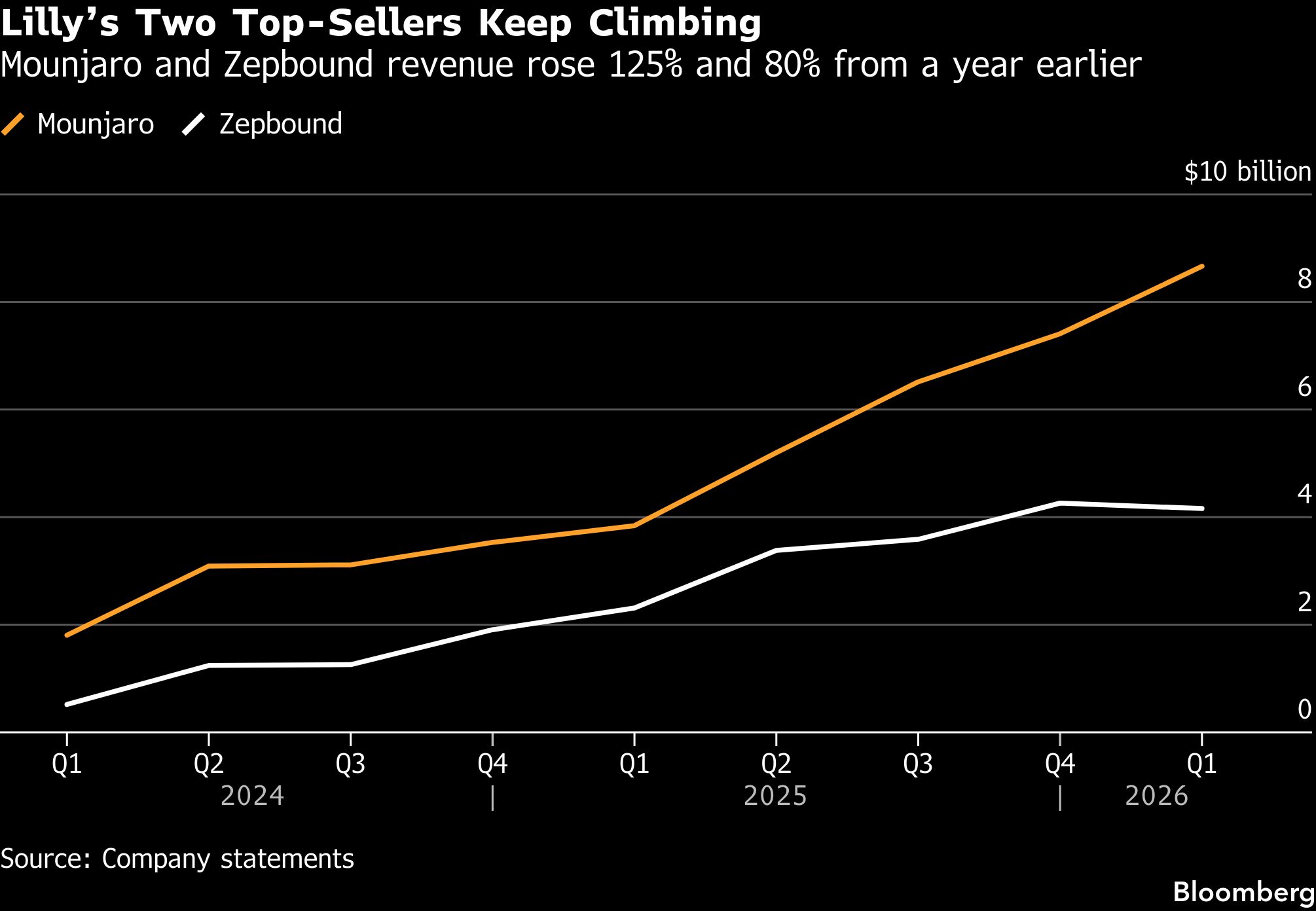
Sales of Lilly’s best-selling diabetes shot Mounjaro soared to $8.7 billion in the first quarter, compared to estimates of $7.2 billion. Growth has been especially strong outside of the US, Lilly said. Revenues from blockbuster obesity shot Zepbound jumped to $4.2 billion, compared to estimates of $4 billion.
The drugmaker didn’t provide sales figures for its weight-loss pill, Foundayo, but said in an investor presentation it was off to a “strong start.” Ricks said about 1,000 new patients a day are starting Foundayo.
“We’re not yet on TV and advertising our product,” Ricks said. “So what we’re seeing now is basically organic demand, which is pretty strong to us.”
Lilly’s blowout results overshadowed strong performances from Merck & Co. and Bristol Myers Squibb Co., who went through their own rockstar moments a dozen years ago when they launched novel drugs that changed the face of cancer care. Now both are counting on new formulations of those medicines – Keytruda and Opdivo – that could extend their patent lives and fuel future earnings.
Eventually, Lilly and Novo could face the same type of pressure Merck and Bristol are under. There are already cheaper generic versions of Novo’s best-selling drugs Ozempic and Wegovy approved in both India and Canada. While Lilly still has another decade of patent life left on its drugs Mounjaro and Zepbound, the availability of cheaper alternatives could present a challenge to demand of Lilly’s medications.
Both Novo and Lilly also agreed with the Trump administration to lower prices on their weight loss medications, in exchange for a promised expansion of Medicare coverage for the therapies.
There are still questions about how well Foundayo will fare in the market. Novo and Lilly both developed oral weight-loss drugs to reach more patients, many of whom prefer a cheaper and needle-free alternative.
Novo’s pill presents tough competition. It’s been enormously popular from the start, with analysts calling it one of the most successful drug launches ever. That could in part be due to patients’ and doctors’ familiarity with the main ingredient in Novo’s pill, semaglutide, which also powers its shots Ozempic and Wegovy.
Lilly’s pill, on the other hand, is a completely new drug. While no head-to-head comparison studies have been conducted yet, Novo’s pill appears to be slightly more effective based on the company’s trials. Ricks, in the interview with CNBC, said that Lilly is working to educate doctors and the public about Foundayo.
“Doctors aren’t going to write for a medicine they’ve they’ve never heard of,” Ricks said. “We have to go out and educate them. It’s going to take some time. Access needs to kick in. And, of course, we need to build consumer awareness.”
Over a dozen major telehealth platforms are already offering Foundayo, Lilly said, accounting for about 35% of prescriptions at launch. The majority of those are patients who are taking a weight-loss drug for the first time.
Lilly has another highly effective experimental medicine waiting in the wings, called retatrutide. In a study earlier this year, it helped diabetic patients lose more weight than any drug currently on the market, underscoring its potential in the increasingly crowded race for next-generation therapies.
Beyond obesity, Lilly is looking to bolster its pipeline through a spate of recent acquisitions. In the past two months, the company forged deals worth up to $7.8 billion for sleep drugmaker Centessa Pharmaceuticals Plc and up to $7 billion for cancer drug developer Kelonia Therapeutics — two of its most expensive transactions ever.
Ricks said investors should expect to see more acquisitions like these going forward — a slight departure from Lilly’s historically more conservative dealmaking strategy.
Another $2.3 billion deal for cancer drugmaker Ajax Therapeutics Inc., announced on Monday, was further evidence of Lilly’s “intent to aggressively reinvest obesity cash flows to enhance its pipeline,” Leerink Partners analyst David Risinger said in a note.
A message from Advisor Perspectives and VettaFi: Discover something new! Click here to register for our upcoming webcasts.
Bloomberg News provided this article. For more articles like this please visit
bloomberg.com.
Read more articles by Madison Muller