As investors begin to wonder if a torrid rise in US equities is running out of steam, one of the market’s most important buyers shows its unwavering support remains.
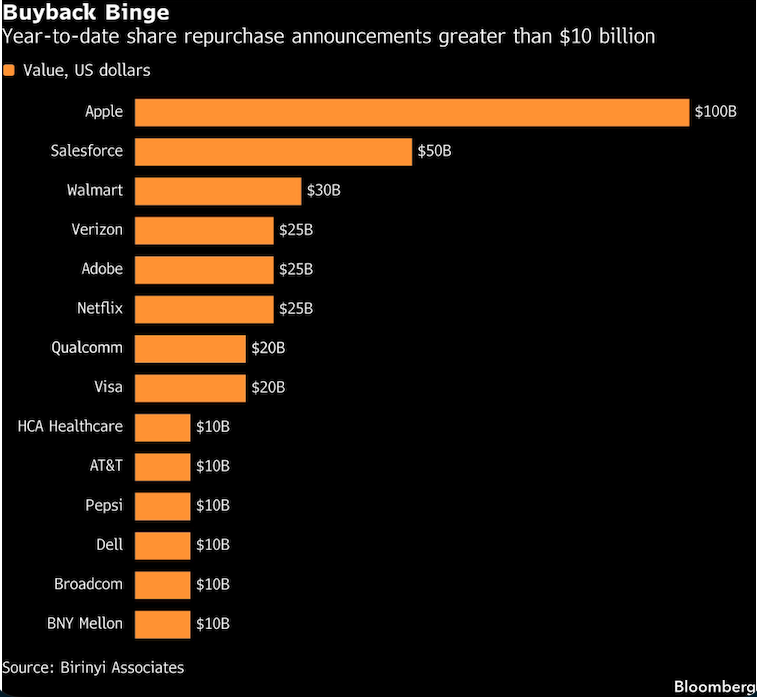
Corporate America announced plans to buy back $665 billion worth of shares in S&P 500 Index companies in the four months through April, the most ever to start a year, according to data from Birinyi Associates. Apple Inc. was the latest heavyweight to greenlight a $100 billion share-repurchase plan on Thursday to reassure investors during its leadership transition.
And the momentum is expected to continue. Authorized repurchases are estimated to reach $1.55 trillion in 2026, a figure that would eclipse last year’s record. That’s a crucial vote of confidence in corporate fundamentals at a time when valuation multiples appear rich and uncertainty around the long-term impact of rising oil prices lingers.
“The size and breadth of companies announcing buybacks is a signal from board rooms that they are firing on all cylinders,” said Jeff Rubin, president of Birinyi Associates. “The unprecedented level of commitments from Corporate America to continue buying their own stock indicates the confidence they have in their earnings, revenue, and cash flow.”
Support from companies themselves is a welcome sign for equity bulls after the S&P 500 posted a 10% jump in April, its best month since 2020. The massive gain last month stoked worries the rally will lose energy as a ceasefire in Iran remains fragile and the market confronts challenging seasonality in May.
Since 1928, May has been the third-worst month for the S&P 500 and prompted the age-old “sell in May and go away” adage that warns of imminent underperformance through October. Corporate buybacks provide a steady source of demand regardless of price, helping to cushion any potential market pullbacks.
Stock buybacks have been a dominant source of demand for US equities since the aftermath of the financial crisis. They reduce the supply of outstanding stock, boosting profits for each remaining share as a result.
The practice isn’t without its critics, who argue that a share buyback is a cosmetic move that doesn’t impact the overall pool of earnings and masks a lack of opportunities to deploy cash elsewhere. In January, US President Donald Trump issued an executive order that limits stock buybacks and dividends for certain defense contractors.
As the uncertainty around the war in Iran is starting to weigh on Wall Street investors, share buybacks offer a boost to US firms’ earnings revisions, according to Andrew Greenebaum, senior vice president of equity research product management at Jefferies LLC.
“Many market participants expect the conflict to bias earnings estimates for stocks broadly lower,” Greenebaum said. Buybacks may “contribute to lessening any eventual impact” to earnings from the war, he added.
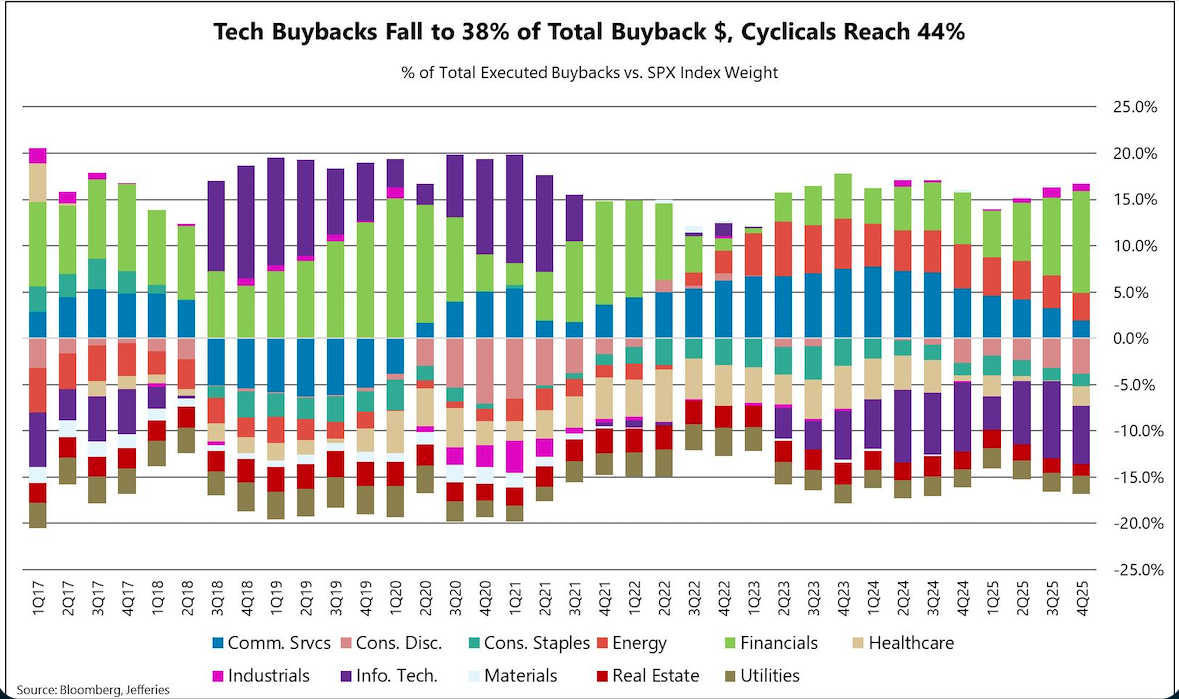
Moreover, according to his data, share repurchases have skewed away from the technology sector, a dynamic that “could very well help the market return to broadening out.”
While tech and communication services represent more than 45% of the S&P 500 by market cap, they were responsible for only 38% of share repurchases, based on the latest completed execution data as of late December. In the meantime, cyclical stocks in the energy, financials, industrials and materials sectors accounted for 44% of the dollar value of buybacks, despite making up only about a quarter of the index.
“Several of the more traditional cyclical sectors have a heavier buyback contribution versus their index weight,” Greenebaum said. “This means that the buyback-created earnings boost should incrementally favor these sectors, all else being equal.”
As the first-quarter reporting season winds down, companies are emerging from an earnings-related blackout. About 40% of corporates are currently in the so-called open buyback window, which is expected to remain open until June 12, according to Goldman Sachs’s buyback desk.
“We hear a lot about individual investors being the dip-buyer, but the ultimate dip-buyers are the corporations themselves,” Birinyi’s Rubin said.
A message from Advisor Perspectives and VettaFi: Discover something new! Click here to register for our upcoming webcasts.
Bloomberg News provided this article. For more articles like this please visit
bloomberg.com.