Elon Musk’s SpaceX estimated a chip factory it plans to build along with Tesla Inc. will cost at least $55 billion, with total investment potentially exceeding the amount the rocket maker aims to raise from a record initial public offering.
The “next-generation, vertically integrated semiconductor manufacturing and advanced computing fabrication facility” may be located in Grimes County, Texas, according to a public notice. The estimated total capital investment could rise to $119 billion if additional phases of the project are completed.
SpaceX is looking to raise around $75 billion from an IPO that would value the company at more than $2 trillion, Bloomberg has reported.
Musk first detailed plans for the SpaceX-Tesla Terafab project in March, emphasizing the need to begin manufacturing chips for his robotics, space and artificial intelligence projects. He said the joint venture was essential because the semiconductor industry was moving too slowly to keep up with the amount of chips needed for his initiatives and the broader tech industry.
“We either build the Terafab or we don’t have the chips, and we need the chips, so we build the Terafab,” he said.
In response to social media posts about the Grimes County public hearing notice, Musk wrote on X that it is “one of several locations under consideration” for the chip project. SpaceX and Tesla representatives didn’t immediately respond to requests for comment.
Musk has said the project would one day support a terawatt of computing power per year, the amount he expects the companies to eventually use as he ramps up investments in AI and robotics. The facility would aim to produce 2 nanometer chips, at the cutting edge of current technology.
Immediately after Musk outlined his plans, there was skepticism about his proposal. Building and running advanced chip fabs is a complex, competitive business where he has no track record. The billionaire’s ambition is to take on leaders like Taiwan Semiconductor Manufacturing Co. and do so at volumes far beyond the industry’s current capacity.
But Musk’s lieutenants quickly reached out to chip equipment makers including Applied Materials Inc., Tokyo Electron Ltd. and Lam Research Corp. to get price quotes and delivery times for the gear necessary to make semiconductors, Bloomberg reported in April.
Musk also struck a partnership with Intel Corp., the US chipmaker with decades of experience in crafting advanced semiconductors. Under that agreement, Tesla plans to spend roughly $3 billion on a research chip facility in Texas, and Intel signed on to support the effort with contributions of its chip design, fabrication and packaging expertise.
Tesla will take the lead on the research facility where the companies can experiment with new technologies and processes, while SpaceX will take charge of the early phases of the Terafab project, he said at the time.
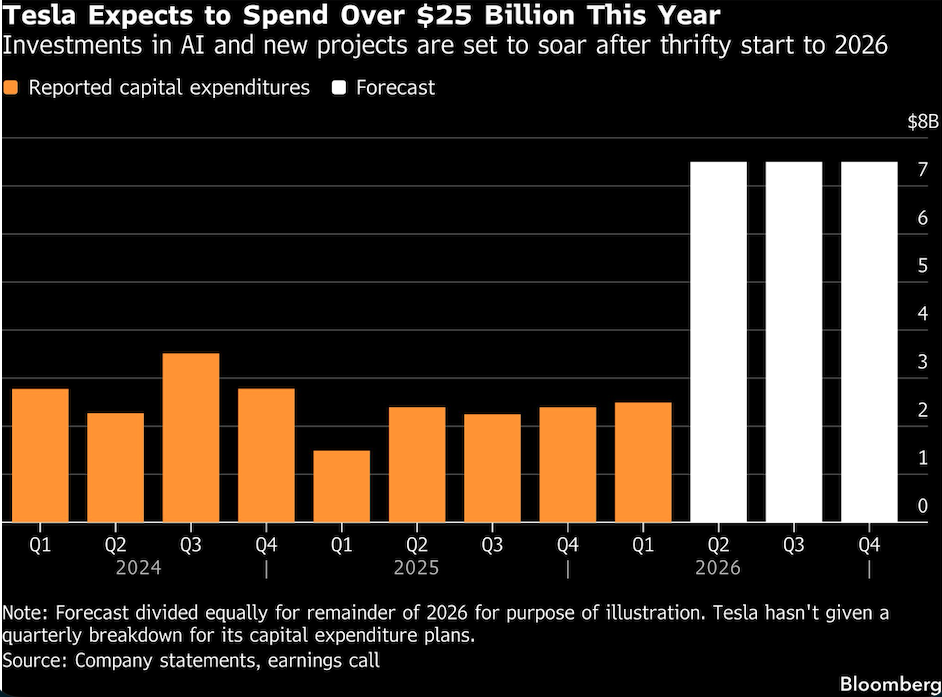
Investors have grown wary of escalating capital spending at Tesla, the pioneering electric vehicle maker now looking to expand into humanoid robots. The company said in April that capital expenditures in 2026 will exceed $25 billion, up from a prior forecast of around $20 billion and roughly three times last year’s outlay. Tesla shares have fallen more than 20% from a record high in mid-December.

SpaceX also is ramping up its spending. The company said in April it’s struck an agreement for the right to acquire artificial intelligence startup Cursor for $60 billion later this year, or to pay $10 billion for the companies’ work together.
The Grimes County information was posted as notice of a public hearing scheduled for June 3. It said that SpaceX, formally Space Exploration Technologies Corp., plans to use a property near the Gibbons Creek Reservoir and surrounding areas.
The SpaceX chip facility “would represent a transformative investment in domestic semiconductor manufacturing capacity,” the notice says.
A message from Advisor Perspectives and VettaFi: Discover something new! Click here to register for our upcoming webcasts.
Bloomberg News provided this article. For more articles like this please visit
bloomberg.com.
Read more articles by Debby Wu