For a bunch of unremarkable warehouses, they’re generating a lot of controversy. Data centers — low-slung facilities that house the server racks and energy systems that underpin the digital economy — have become a heated issue on the campaign trail. Politicians from both parties are pushing bills to restrict them. Some want a nationwide “moratorium.” That would be a historic mistake.
About 4,000 data centers now dot the US, according to one estimate, with 3,000 more on the way. Global capital expenditure exceeded $450 billion in 2024. Such facilities sustain much of modern life: cloud computing for communications, finance and health care; consumer services such as YouTube, TikTok and Zoom; and, increasingly, the training, fine-tuning and inference processes used by artificial intelligence models.
For the areas hosting them, these centers can be a boon. For one thing, they lure tax dollars without consuming much in services; in Virginia’s Loudoun County, they generate nearly half of total revenue, funding schools, tax cuts and more. To support them, utilities often expand substations, add transmission capacity and build out new fiber, all of which benefits locals. Construction may be a pain, but it typically leads to better roads, waterworks, renewable capacity and much else.
More crucially, data centers increase growth and productivity economywide. One study found that they contributed $727 billion to US gross domestic product in 2023, with each industry job supporting 6 1/2 elsewhere. They’ll only get more important with the advance of AI — which is highly dependent on centralized computing clusters and which may itself boost GDP by 1.5% by 2035.
That said, data centers have drawbacks. They can be large, loud and ugly. They can consume a lot of water and electricity. They’ve also become something of a stand-in for broader anxieties about AI. As a result, many are facing protests or lawsuits, while about a dozen states are considering bills to restrict them. By one estimate, such opposition has impeded at least $156 billion in potential investment.
So what should be done?
First, do no harm. A national moratorium — as several lawmakers have proposed — would only slow growth, hinder innovation and erode America’s lead in the AI race. Better to reap the benefits of data centers while mitigating the downsides.
Take water use. Many data centers use liquid-based cooling to alleviate the intense heat produced by high-energy chips. In some areas, this may stress already-constrained water supplies. Yet this challenge shouldn’t be exaggerated: One analysis found that the water footprint of xAI Corp.’s Colossus 2 facility in Memphis — one of the largest data centers in the world — is equivalent to about 2 1/2 fast-food restaurants.
The objective, then, shouldn’t be obstructionism. Policymakers should instead require transparency about water use while encouraging data centers to use recycled wastewater, build on-site storage, experiment with “closed loop” designs and take other remedial steps. They should also prioritize infrastructure investments and replenishment schemes to offset consumption.
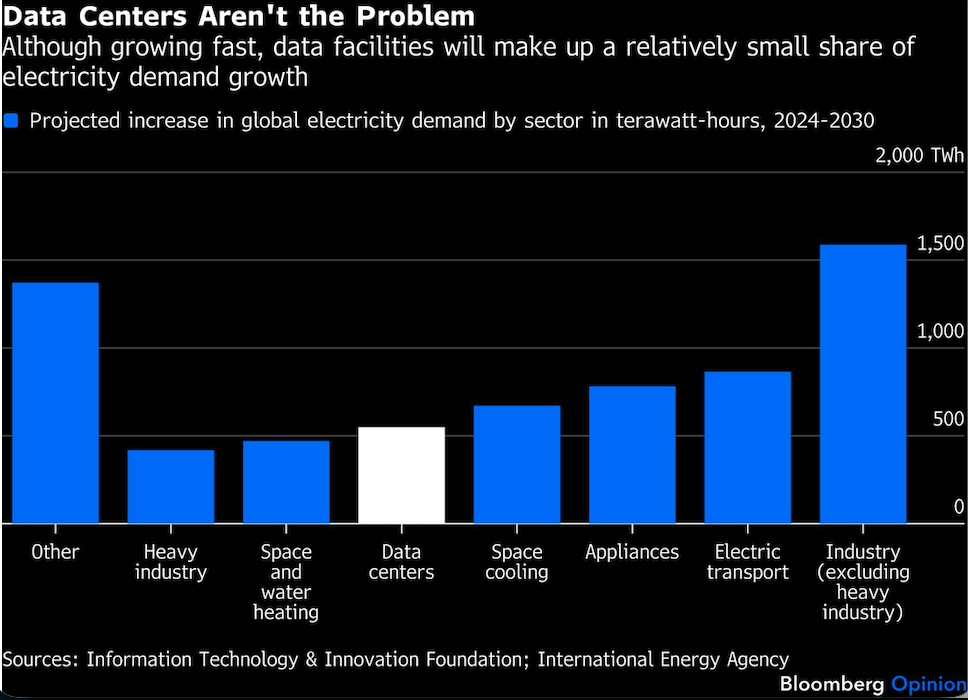
Another reasonable worry is energy. Global electricity demand from data centers rose 17% in 2025, with AI-focused ones increasing fastest. Consumption could double by 2030. Meanwhile, supply is so constrained in some areas that big new facilities may need to wait seven years for a power hookup. Again, though, fearmongering isn’t necessary. Meeting America’s power needs will be a long-term project — and AI companies are well-positioned to help.
For policymakers, a few goals should be clear. They should require that companies building data centers pay for related infrastructure upgrades. They should ease the process of connecting to the grid, thereby allowing companies to generate more of their own power, and ensure that pricing reflects fluctuating demand. Not least: They should accelerate permitting reform, invest in transmission capacity and streamline regulation, to the benefit of the broader economy.
Easier said than done, of course. But in time, as tech companies’ goals align with those of the broader public, more people should see the obvious: Data centers aren’t the enemy. They’re the future.
A message from Advisor Perspectives and VettaFi: Discover something new! Click here to register for our upcoming webcasts.
Bloomberg News provided this article. For more articles like this please visit
bloomberg.com.