A Dyson Sphere is a theoretical structure built around a star to tap all of its energy. It’s pure science fiction. But our Big Tech overlords seem determined to build a Dollar-Store Dyson Sphere around Earth, surrounding it with enough orbiting solar panels and data centers to blot out the stars.
In theory, a Dyson Sphere is evidence of a highly advanced civilization. In our reality, the Dollar-Store Dyson Sphere suggests our civilization might be making too many expensive, complicated solutions for problems that don’t really exist.
Meta Platforms Inc. last week announced a deal with Virginia-based startup Overview Energy to someday buy up to 1 gigawatt of power generated by Overview’s also-theoretical space-based solar energy technology. This would involve 1,000 satellites at geosynchronous orbit (GEO) collecting the sun’s energy and then zapping it in infrared beams to panels on the ground 22,000 miles below. Easy-peasy.
The thinking behind space solar makes some sense: The sun doesn’t always shine on Earth, which means solar panels on the ground aren’t always gathering energy. There are no clouds to block the sun in space, so aside from a couple of times per year around the equinoxes, panels in GEO are constantly bombarded with solar rays.
And ... that’s about as far as the technology makes sense right now. That’s because, to put it bluntly, batteries exist. And there are massive technological hurdles that must be cleared to make space solar truly compete with them.
The economic justification for these systems depends heavily on how much it costs to get them into space. When drawing up their base-case scenarios, space-solar companies typically see a day when such launches will be dirt cheap. They argue this will make the cost of their energy competitive with, or even cheaper than, any terrestrial source, including utility-scale solar with battery storage.
On its website, Overview Energy charts launch costs against energy costs. If a launch costs $1,000 per kilogram, then the cost of energy is about $135 per megawatt-hour, according to this chart. Energy and launch costs drop neatly in tandem, so that a launch costing just $200 per kilogram leads to an energy cost of about $40 per megawatt-hour, which would make it cheaper than any large-scale energy source currently available, according to Lazard Inc.’s latest Levelized Cost of Energy report.
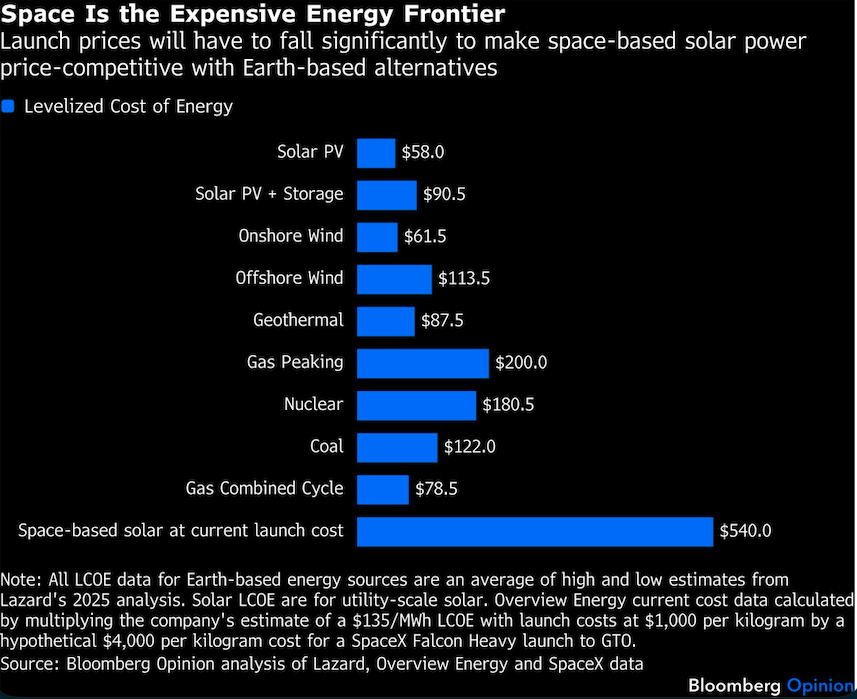
Launches are nowhere near that cheap yet. The most recent payload (for which we have disclosed pricing) that SpaceX’s Falcon Heavy system took to geostationary transfer orbit (GTO), where spacecraft go to reach GEO, was the GOES-19 weather satellite in June 2024. That trip cost $152.5 million, or $30,500 per kilogram.1 At that rate, Overview Energy’s space-solar system would cost more than $4,100 per megawatt-hour, roughly 45 times as much as solar and storage on the ground.
But let’s say Elon Musk, now 158 billion theoretical dollars richer, gets generous and prices a Falcon Heavy ride to GTO at $4,000 per kilogram.2 That still leaves space solar’s energy cost at $540 per megawatt-hour, about six times as expensive as earthbound solar and battery storage. Many space-solar companies seem to bank on SpaceX’s still-in-development Starship as the key to much lower launch costs. But at its current pace, it seems years away from making discount milk runs.
Which brings us to space solar’s next disadvantage: time. If you’re the CEO of Resource Hog Inc. and need power for your data center yesterday, then your best bet is ground-based solar or wind, which are the cheapest and quickest to build, as Lazard notes. Overview Energy, meanwhile, doesn’t expect to test its ability to zap energy from even low Earth orbit (LEO) until 2028. It may not be able to give Meta that gigawatt of energy for another decade.
Sure, by 2040, launches will probably be cheaper. A recent study by Fraser-Nash Consultancy, Space Solar Engineering Ltd, and Imperial College London predicted launch costs would fall 30% between 2030 and 2040 to between $747 and $1,046 per kilogram. That would make space solar cheaper than, say, nuclear power, but still not a match for boring old terrestrial renewables.
And while we wait for launches to get cheaper, those renewables will also be getting cheaper. That should include batteries, which will also have more than a decade of efficiency improvements by that time. Many, many more solar arrays and batteries will already be on the ground by 2040. How will that affect the case for shooting thousands more into space?
And there’s still no evidence any space-solar company has yet mastered the daunting engineering issues involved in building and maintaining massive solar arrays in an orbit more than 22,000 miles from Earth, at least 18 times more distant than Starlink and other LEO satellites. Space Solar, co-author of that study about launch prices, plans to build a system taller than the Empire State Building and nearly a mile wide. Nothing close to it has ever been built in space before; the International Space Station would be like a tool shed compared with the Taj Mahal in contrast. Then you must transmit all the energy these panels generate to Earth, often in high-density microwaves, to be collected by miles-wide receiving antennas, losing energy at every step in the process.
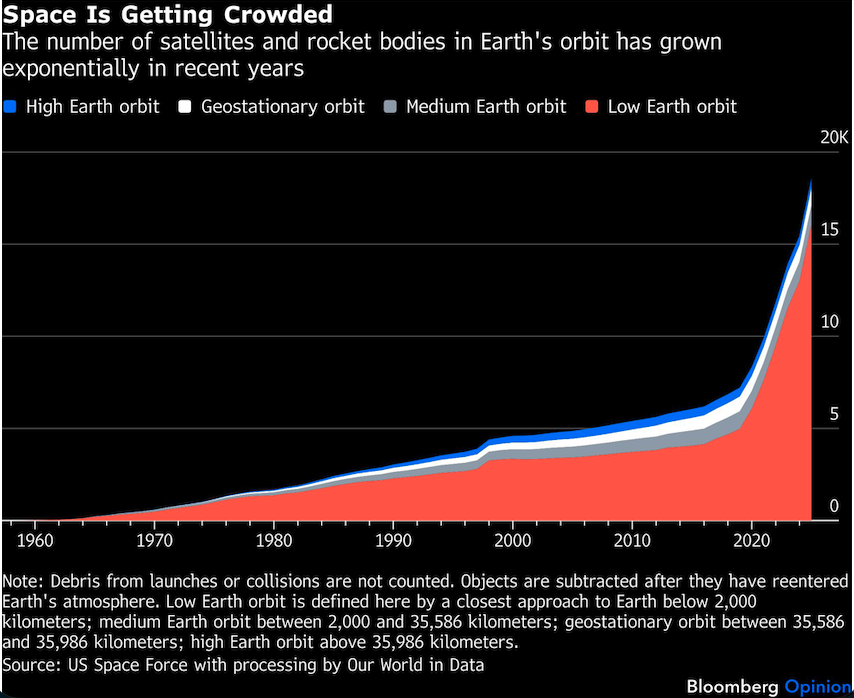
Even if you solve cost and engineering, there will still be one inescapable downside: All these satellites will be exposed to and exponentially worsen the problem of space junk. Nearly 1,000 objects are in GEO now, according to Space Force data. Overview Energy’s 1,000 satellites alone would double that amount. LEO is even more crowded, with 28,000 objects zipping around, including more than 11,000 pieces of debris.
And Overview Energy is far from the only group itching to put solar panels in orbit. SpaceX recently asked for government permission to launch 1 million satellites for floating, solar-powered data centers. Its rival Blue Origin, founded by Amazon.com Inc.’s Jeff Bezos, has asked to put 50,000 satellites up there for its own space-data project. A startup called Starcloud wants 88,000. Alphabet Inc. is working on something called Project Suncatcher. China has plans for a solar-powered Space Cloud. And so on.
The more crowded space gets, the greater the risk of collisions and the dreaded Kessler Syndrome, when crashes spiral out of control and orbit becomes an unusable shooting gallery. The heating of the planet because of the greenhouse-gas effect also thins the lower atmosphere, potentially cutting the amount of junk low-Earth orbit can safely host by 50% to 66%, according to a study last year in the journal Nature Sustainability.
None of the tech overlords spending hundreds of billions of dollars on an AI future have yet made a convincing case for why we need to turn the planet into a giant battery for robots. In contrast, global heating truly is a problem, and solar power really is one solution. Given that humans on land increasingly don’t want solar farms near them, often for dubious reasons, putting them and data centers where they’ll only bother astronomers may sound like a good idea.
But you don’t need a telescope to see the many downsides; a calculator will do. Making the case for keeping renewables on Earth is far simpler and easier than making science-fiction dreams reality.
1. Falcon Heavy took the ViaSat-3 F3 satellite to GTO on April 29, 2026, a payload of 6,400 kg. The cost of that flight was undisclosed. The current base price for a Falcon Heavy trip is $97 million, resulting in a cost per kg of at least $15,156.25.
2. This is very back-of-napkin math, based on SpaceX's 2022 $97 million price for a Falcon Heavy launch to GTO with a maximum capacity of 26,700 kg. I boosted the price 10% to about $107 million to adjust for inflation, giving a 2026 estimated cost per kilogram of about $4,000.
A message from Advisor Perspectives and VettaFi: Discover something new! Click here to register for our upcoming webcasts.
Bloomberg News provided this article. For more articles like this please visit
bloomberg.com.