Wall Street banks are getting ready to raise billions of dollars taking data center companies public, even after IPO investors have already piled into anything that looks like a bet on artificial intelligence spending.
The initial public offering for a Blackstone Inc. data-center acquisition vehicle next week is set to fire the starting gun on a host of activity over the coming 18 months, and together with Singapore-based DayOne Data Centers Ltd. may raise close to $7 billion in aggregate, Bloomberg News has reported. Brookfield Infrastructure Partners-backed CSquare has filed confidentially, and a half dozen others are also circling US IPOs, according to people familiar with the matter.
Money managers have been clamoring for more ways to play the industry that is expected to spend hundreds of billions of dollars on AI infrastructure, and companies in everything from ventilation to nuclear power are touting their proximity to the sector as they go public. Data center companies are set to find out just how much exposure the market needs.
“We haven’t seen data center IPOs come en masse yet, but that will certainly be a theme this year, next year and into 2028. It’s coming,” said Eddie Molloy, co-head of global equity capital markets at Morgan Stanley.
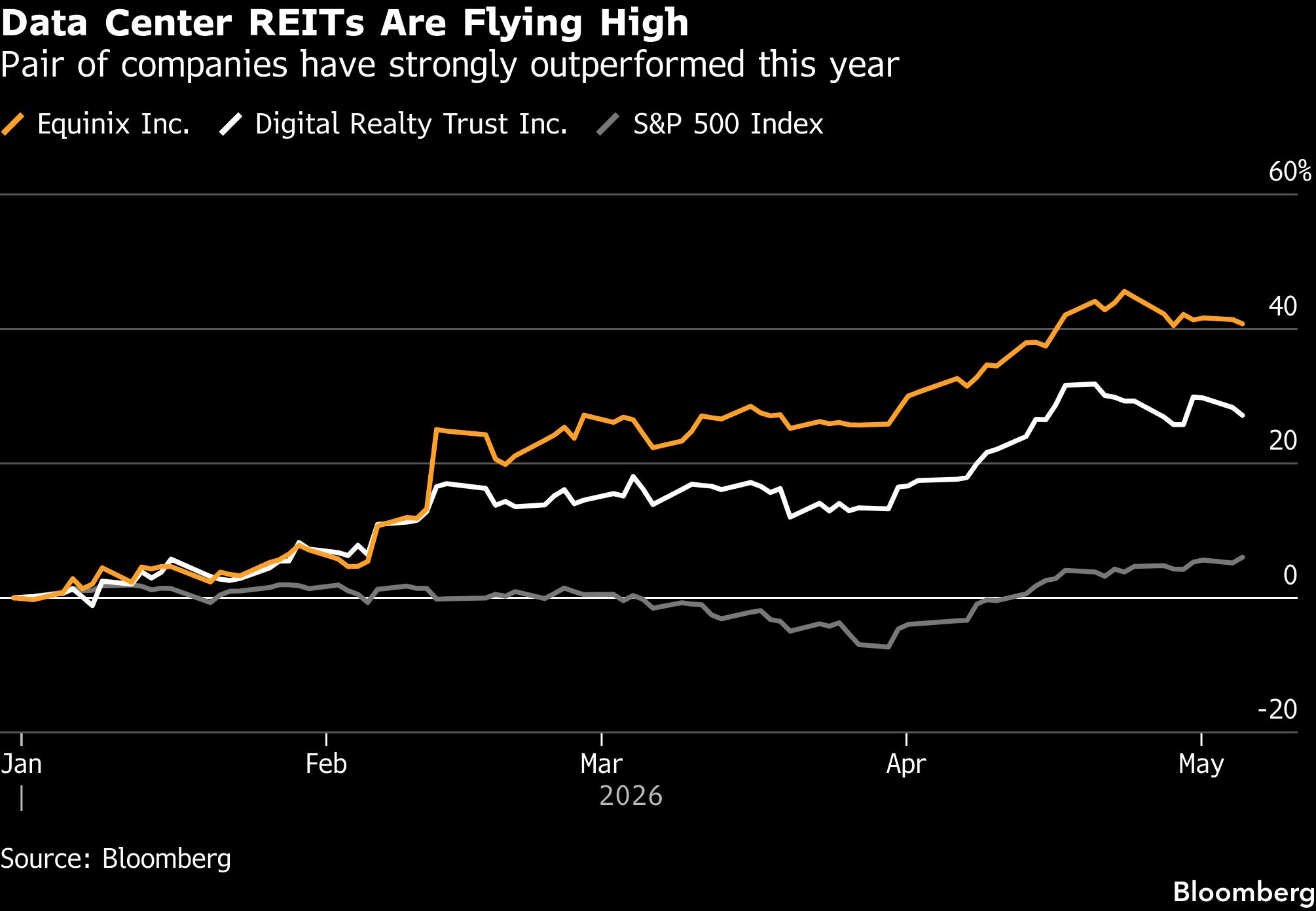
Soaring share prices for Equinix Inc. and Digital Realty Trust Inc., two data center REITs that are already publicly-listed, have sopped up plenty of demand. Shares of each are near record highs, with returns outpacing the benchmark S&P 500 Index by more than 20% this year.
Three of this year’s five biggest US listings are AI-adjacent companies. Ventilation firm Madison Air Solutions Corp. and electrical equipment maker Forgent Power Solutions Inc. both touted their revenue from data center customers in their filings. Their stocks have soared 46% and 55% respectively since their debuts.
“Stepping back, data centers are way underrepresented in the public markets and that will change,” said Molloy. He expects others to optimize their portfolios of offerings as well as think through leverage or tenant concentration before tapping public investors.
The debt attached to data center firms could cause some indigestion for investors when the companies finally go public.
“The market is still working out the right leverage for some businesses,” said Edward Byun, global head of technology ECM at JPMorgan Chase & Co. “Given how quickly many of these companies are growing and how differently their debt is structured, leverage will be a point of investor diligence and views will continue to evolve.”
Given the sector’s large capital needs, tapping investors who mostly don’t have access to private-market investments — where much of the data center financing has recently been raised — may have been inevitable.
“They need the capital, there’s not enough capital out there to fund all of this without going to the public markets,” said Greg Kuhl, global property equity portfolio manager at Janus Henderson.
Kuhl is keen to dive into each company’s growth potential, residual value and location, he said in an interview. The universe of potential buyers can range from traditional REIT investors to money managers looking to buy growth stocks, as well as those who buy industrials or infrastructure companies.
“Positioning as a technology company can support higher valuation multiples, while still attracting crossover investors who traditionally allocate to REITs,” said West Riggs, head of ECM for Truist Financial Corp.
Wall Street and big tech firms are spending big on data center infrastructure, which will require as much as $3 trillion of investment by 2030, according to JLL.
“Fundamentally with AI inference and agentic AI all coming online, the market opportunity for data centers is expanding materially and we expect levels of growth that the market will see as very durable and attractive,” said JPMorgan’s Byun.
The appetite from public investors is expected to help with a thorny issue. As the operators of these data centers grow their portfolios, a limited pool of investors can buy up their properties. Going public helps lower the cost of the capital they need to build more data centers.
“It’s an absolutely enormous market in terms of dollar value, and there’s just more and more of it being built,” said Kuhl. “That’s where these developers and sponsors of these vehicles need to replenish their capital somehow, they need to offload some of these assets so they can have more capital for development or investing.”
A message from Advisor Perspectives and VettaFi: Discover something new! Click here to register for our upcoming webcasts.
Bloomberg News provided this article. For more articles like this please visit
bloomberg.com.