JPMorgan Chase & Co. spent hundreds of millions of dollars over the course of more than a decade developing systems using blockchain, a novel technology that was supposed to radically upend financial markets, but has yet to become a game-changer.
In at least one area, though, the bank and the technology are beginning to make progress: repo.
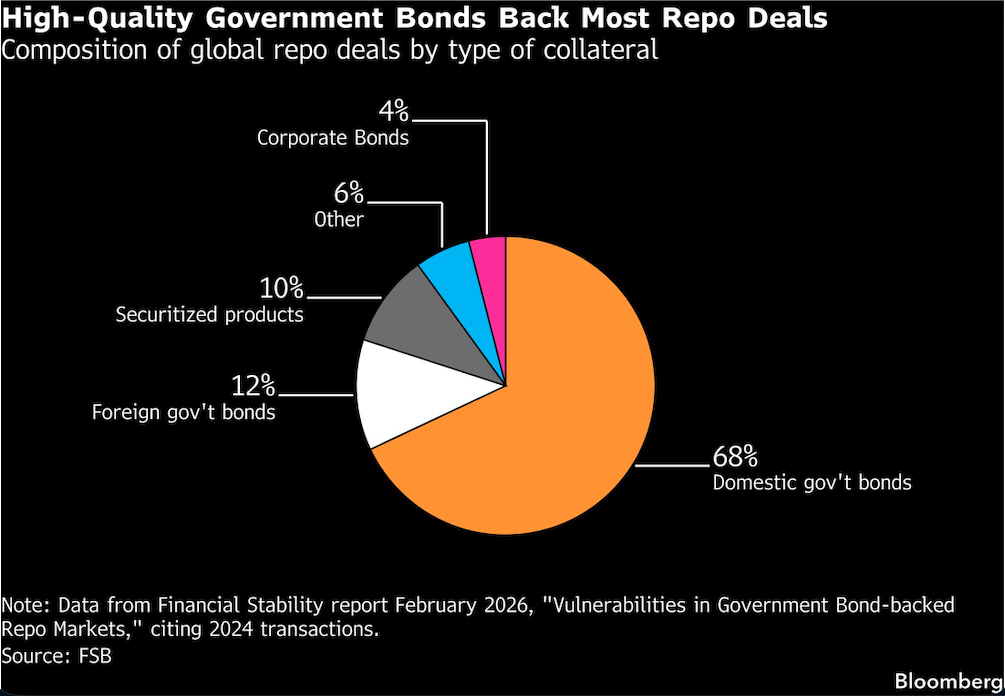
The nearly $13 trillion market isn’t the flashiest outpost on Wall Street, but it’s the vital plumbing that keeps the money flowing. Through repurchase agreements, or repos, firms exchange Treasuries for cash — typically overnight — providing the short‑term funding that underpins trading, settlement and market‑making across the financial system.
What JPMorgan and its and peers on Wall Street are finding is that blockchain — the digital technology underlying crypto — works well with repo, allowing for precise, customizable transactions that let cash and collateral move faster and more flexibly. This frees up capital for traders to use more profitably, or to hedge against risks.
“This is one of the applications where a blockchain-based solution makes sense,” said Eddie Wen, global head of digital markets at JPMorgan, among the the largest banks in repo. It’s a product used every day by clients, Wen added.
JPMorgan launched its blockchain-based financing product six years ago. Since then, it’s handled around $3 trillion worth of repo transactions on the platform.
Today, it’s typically processing hundreds of millions of dollars of client repo financing needs each day, and $5 billion between JPMorgan entities, according to the bank. While that’s a drop in the bucket for a firm whose daily activity in the traditional repo market runs into the hundreds of billions of dollars, it represents a key step in embracing the technology from the market’s leader.
Piling In
Elsewhere, banks like HSBC Holdings Plc, alongside market makers DRW Holdings and Virtu Financial Inc. and infrastructure providers like Broadridge Financial Solutions Inc., and Tradeweb Markets Inc., are part of a growing push into tokenized repo. Across blockchain-based platforms, transactions now total hundreds of billions of dollars daily. While the degree and frequency of activity varies among firms, more and more see a reason to be involved.
To be clear, no one expects an overnight transformation, and the amount of blockchain transactions still pales beside those of the conventional market.
Rolling out the technology on a bigger scale would require an even wider range of banks, dealers and market infrastructure providers to adopt compatible systems. Market participants are also dealing with other pressing issues, including moves toward mandated central clearing of repo, which will keep many busy adapting their existing processes for now.
But even at this relatively nascent stage, there is momentum. Firms’ blockchain efforts in repo far exceed most other similar applications in mainstream capital markets, where activity has largely been limited to one-off transactions or tests. That makes tokenized repo one of the most tangible and potentially consequential use cases of blockchain in traditional finance.
“This is real,” said Elisabeth Kirby, head of market structure at Tradeweb, which launched a blockchain-based repo platform late last year. “It is very much not a proof-of-concept, or a ‘let’s revisit this in a couple of years’” scenario, she said. “We see this as a growth area.”
Why Now?
Activity has accelerated in the past year or so, with industry participants citing multiple converging factors that all seemed to gel at the same time.
As blockchain networks moved from testing to real transactions, regulators became more amenable to the idea of moving repo onto a new system — which is important because of how involved government agencies like the Federal Reserve can become when the market is disrupted. A more digital asset-friendly environment under President Donald Trump also helped drive activity from Wall Street.
And, as more customers became aware of the benefits, the reputation of blockchain shifted: no longer a side channel used by crypto buffs, but an accessible tool to improve trading and cut costs.
“The biggest change is that this is no longer a question of whether the technology works. It’s now focused on how quickly it can scale,” said Yuval Rooz, chief executive of Digital Asset Holdings. The firm, backed by large banks including JPMorgan and Goldman Sachs Group Inc. as well as DRW, Citadel Securities and Virtu, is behind a blockchain called Canton Network, now among the most popular in traditional finance.
The latest set of repo transactions on Canton in February used tokenized gilts as collateral in cross-border trades. Its technology is also used to power Broadridge’s Distributed Ledger Repo Platform, whose clients include UBS Group AG, HSBC and Societe Generale SA.
Bloomberg LP, the parent company of Bloomberg News, recently partnered with data provider Kaiko to develop a way for its data to be used onchain for tokenized US Treasuries and repo transactions on Canton.
How It Works
Models vary, but the key difference between traditional repo and the tokenized form has to do with how the cash and securities move between parties.
In the current structure, the market opens, there are fixed windows for putting in orders, things are closed overnight and on weekends. Most activity is routed through intermediaries, which manage collateral and settlement but add operational steps and fees. There can be phone calls asking for last-minute changes. Cross-border transactions can be particularly difficult due to time zones and holiday mismatches. Excess money can be tied up for hours, and trades can get disrupted or canceled for missed deadlines, collateral shortfalls or system outages.

Blockchain-based systems ease many of those pain points. A borrower can request funding through a digital interface, and once a lender agrees, the cash and collateral are represented as tokens. After both sides approve, the transaction is recorded on a blockchain, a shared and auditable record, for as long as the terms are set. Crucially, trades can be made at any time of the day, including outside traditional business hours.
“Blockchain as a technology can sort of lessen the distributional friction of capital,” said Sonali Das Theisen, global head of fixed-income, currencies and commodities e-trading and markets strategic investments at Bank of America Corp. “It’s healthy that we’re going in this direction.”
Real Money
For repo-market heavyweights, there are financial benefits, too. That is especially true for banks like JPMorgan that are not just saving on fees and transaction time, but on the amount of capital that heavily regulated firms must hold against trades.
A recent analysis sponsored by Broadridge showed that big banks could reduce their day-to-day “liquidity buffers” by 8% to 17% by putting 15% of their repo activity onto the blockchain. A lot depends on the size, location, business mix and risk appetite of the lender, but it has the potential to free up idle cash.
The Broadridge study cites one large, unnamed European bank, which estimates it holds about €1.1 billion ($1.3 billion) to meet intraday liquidity needs. Cutting that buffer by 15% would free up roughly €175 million for other uses or to reduce external funding, the analysis found.
It’s “orders of magnitudes of capital benefits,” said Horacio Barakat, a Broadridge executive who oversees global digital innovation. “Even small benefits can add up to tens of millions of dollars of savings a year.” The platform processed an average of $368 billion in daily repo transactions during April, with monthly volumes totaling nearly $8 trillion. The daily average is a 268% increase from a year earlier.
Industry efforts are also starting to converge. Late last year, the Depository Trust & Clearing Corp. — Wall Street’s main clearing house — said it will begin tokenizing some highly liquid assets it custodies, including Treasuries, Russell 1000 equities and exchange-traded funds.
That would widen the pool of eligible collateral for tokenized repo and, in turn, make it easier for firms to plug in and transact, with assets held at their existing custodian readily usable on distributed ledgers.
Round the Clock
New funding models like these will be needed to support a shift toward round-the-clock trading in traditional assets, now in the works, executives said. Nasdaq has outlined plans for 24-hour trading, while the New York Stock Exchange is developing a tokenized platform for continuous trading.
“As markets go 24/7, you really need that ability to get cash at any time,” said DRW founder Don Wilson. “Onchain repo is a really powerful thing to be able to facilitate that.”
DRW – which was an early Digital Asset backer – has been involved in a number of tokenized transactions on the network over the past year.
As with any new technology, there are still hurdles to clear in using blockchain for repo at scale. While Canton is popular, there are other systems that aren’t connected to one another. That means firms have to be set up to transact on a variety of systems, making it time-consuming and resource-intensive, with volumes spread across platforms.
The system is also untested at scale and through various cycles. Unlike the traditional market, which has had several stressful periods since the 2008 financial crisis — notably episodes of strain in 2019 and 2020 — blockchain systems have not been tried under similar real-world conditions, especially disruptions at odd hours.
Then there’s the familiarity factor. The current system may be inefficient, but traders have gotten used to the way it works. There are rules and expectations in place for when things change or go wrong. On blockchain, there is no such flexibility.
“I lost a lot of cushions — there is no fudging,” said Sandy Kaul, head of innovation at investment giant Franklin Templeton. “It’s written into the code. I can’t call someone up and say I need five more minutes.”
Still, for Kaul and many others in the market, these are issues to be managed — not reasons to revert to the status quo. “We are at a very important inflection point. This is the opening bell.”
A message from Advisor Perspectives and VettaFi: Discover something new! Click here to register for our upcoming webcasts.
Bloomberg News provided this article. For more articles like this please visit
bloomberg.com.
Read more articles by Anna Irrera