While US stocks have been going from one record to the next, global asset allocators haven’t quite kept up. And that may keep the market’s upward momentum intact as fund managers try to catch up.
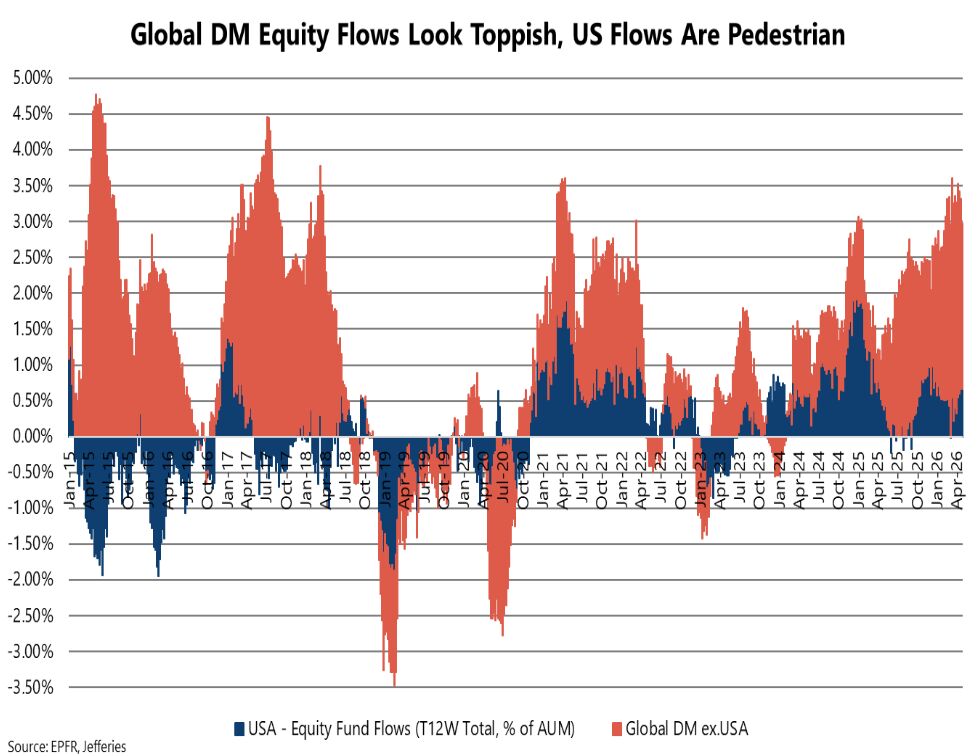
Global investors poured $14 billion into US equity funds, on average, in each of the past 12 weeks, EPFR Global data analyzed by Jefferies show. That’s only about half of what was seen when inflows to US equity funds last peaked in December 2024. Adjusted for the share-price rally since then, the reading drops to about one-third.
This may offer peace of mind to investors wondering if the massive rally in the S&P 500 Index since late March has gone too far, too fast. While worries about the war in Iran and hot inflation at home linger, the fund-flow analysis suggests investors have more money to put to work to lift the market.
“That would still represent a strong tailwind for US stocks if it began to come back,” said Andrew Grenebaum, the senior vice president of equity research product management Jefferies who analyzed the data.

The S&P 500 has surged 18% from its March low, while the tech-heavy Nasdaq 100 has gained 28%, clocking 13 records along the way. The advance came as investors grew more optimistic about a ceasefire in Iran and Corporate America delivered stronger than expected quarterly results.
That’s partly explained the recent rotation back into the US and away from global developed market equity funds. Another reason behind the setup, according to Greenebaum: “The trade out of the US was getting quite long in the tooth.”
Inflows into US equity funds had been slowing before the war in Iran started as investors appeared to focus on global markets. By mid-March, flows into US equity funds, when viewed as a share of assets under management on a rolling basis, hovered near zero. Eventually though, the ex-US trade became crowded and rising geopolitical tensions triggered a renewed flight back into US equity funds.
Another set of data that combines computer-based and discretionary positioning suggests US stock exposure remains far from euphoric levels, according to strategists at Deutsche Bank. The firm’s gauge of equity exposure is sitting in the 60th percentile of readings, and is slightly above neutral.
“Equity positioning is still well below levels implied by booming earnings growth,” the bank’s strategists including Parag Thatte said in a recent note to clients. “Survey measures suggest investor sentiment has shifted from bearish to neutral but is not yet bullish.”
Fundamental and technical indicators reinforce the positive backdrop.
Corporate earnings have remained resilient despite persistent macro concerns. First-quarter S&P 500 profits likely grew about 27% from a year ago, marking a sixth consecutive quarter of double-digit expansion, data compiled by Bloomberg Intelligence show. For the full year, earnings are now expected to grow 22%, according to BI, up from 14% in March.
Strong corporate results and a resilient economy have helped offset concerns that elevated energy prices could prolong inflationary pressures and weigh on confidence.
One of the sharpest shifts over the past six weeks has also come from the options market. Dealer gamma positioning — a closely watched measure of market-maker exposure that can amplify or dampen volatility — swung from deeply negative territory in late March to one of the strongest positive readings on record.
On March 27, dealer gamma positioning hit negative $7.24 billion, the second-most negative reading ever recorded after January 2022, according to data compiled by Goldman Sachs Group Inc.’s trading desk. By last Friday, positioning had flipped to positive $21.3 billion, the eighth-highest positive gamma reading on record.
“The options market is effectively telling you sentiment has gone from ‘hard landing/ geopolitical shock/ de-risk everything’ in late March to ‘growth re-acceleration/AI capex supercycle/vol suppression’ in just over a month,” Goldman Sachs strategist Lee Coppersmith wrote in a note.
A message from Advisor Perspectives and VettaFi: Discover something new! Click here to register for our upcoming webcasts.
Bloomberg News provided this article. For more articles like this please visit
bloomberg.com.
Read more articles by Natalia Kniazhevich