Wall Street strategists are warning the honeymoon period for stocks following a blockbuster earnings season is over and that a harsh macro-economic reality now threatens this year’s rally.
With more than 90% of S&P 500 Index members having reported earnings, investors’ focus is flipping back to the challenges in front of newly installed Federal Reserve Chair Kevin Warsh. Those include oil prices stubbornly above $100 a barrel and back-to-back hot consumer- and producer-price readings last week that have traders now pricing in the potential for interest rate hikes instead of cuts this year.
“Equity investors are focused on the micro – they’re looking at earnings, and they are great,” Adam Turnquist, chief technical strategist at LPL Financial, said by phone. “The macro environment is certainly not as optimistic as the equity market. I think you need to be paying attention.”
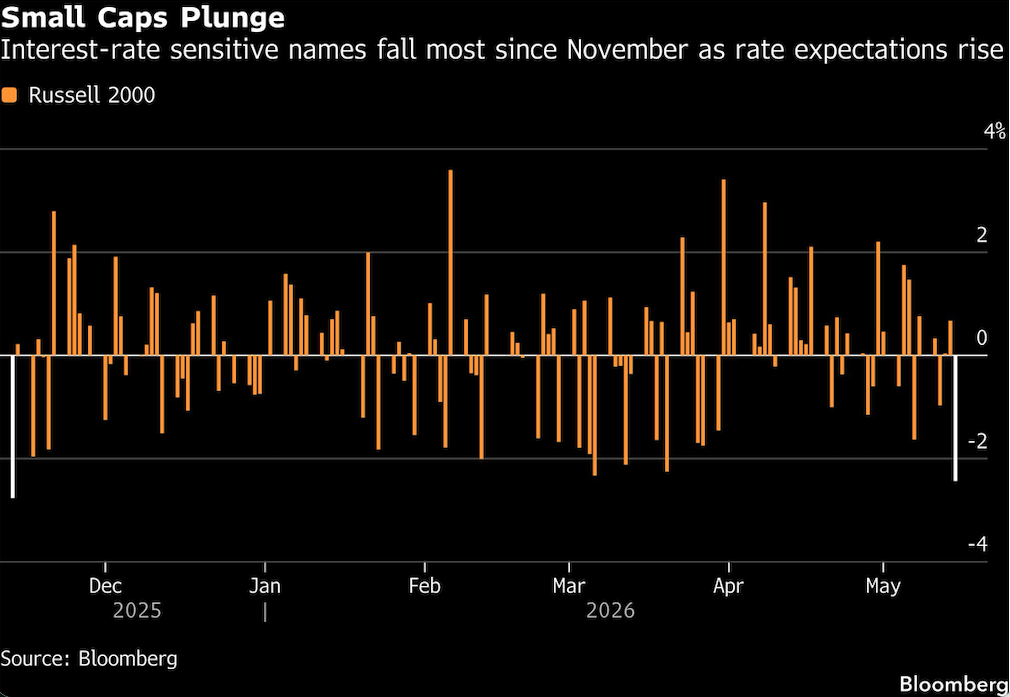
Investors were forced to pay attention Friday, when the most interest-rate sensitive corners of the market saw big plunges in an ugly market selloff. The small-cap Russell 2000 Index dropped 2.4% for the biggest single-day decline since November. A Morgan Stanley basket of unprofitable members of the index fell even further, declining 4.3%. Goldman Sachs’ thematics team suggested at the time to short non-profitable technology and low-quality names as interest rates have climbed.
Morgan Stanley strategists weighed in before the start of trading for the week, writing that equities are at risk of a significant pullback as the global bond selloff threatens to derail the artificial intelligence-driven rally. If the bond market becomes more volatile and long-term interest rates keep rising, “we would expect the first meaningful correction in equity prices since markets bottomed at the end of March,” the team led by Mike Wilson wrote in a note. Still, the strategists stayed with their longer-term bullish call for equities after they raised their 12-month target for the US benchmark to 8,300 last week.
“If inflation pressures continue to build up, in three or more months, the odds of a rate hike would increase and that could be a surprise to the markets that were anticipating a fairly dovish Fed Chair Warsh in the early days of his term,” Ed Clissold, chief US strategist at Ned Davis Research, said by phone.
Clissold added inflation to his list of reasons to be cautious on stocks in a May 13 note, saying the rate of change in CPI had climbed high enough above its six-month average to trigger a bear signal. A string of hot inflation readings “can no longer be dismissed as a short-term spike,” he said. The indicator, then moving in the opposite direction, correctly predicted the equity market bottom in 2022.
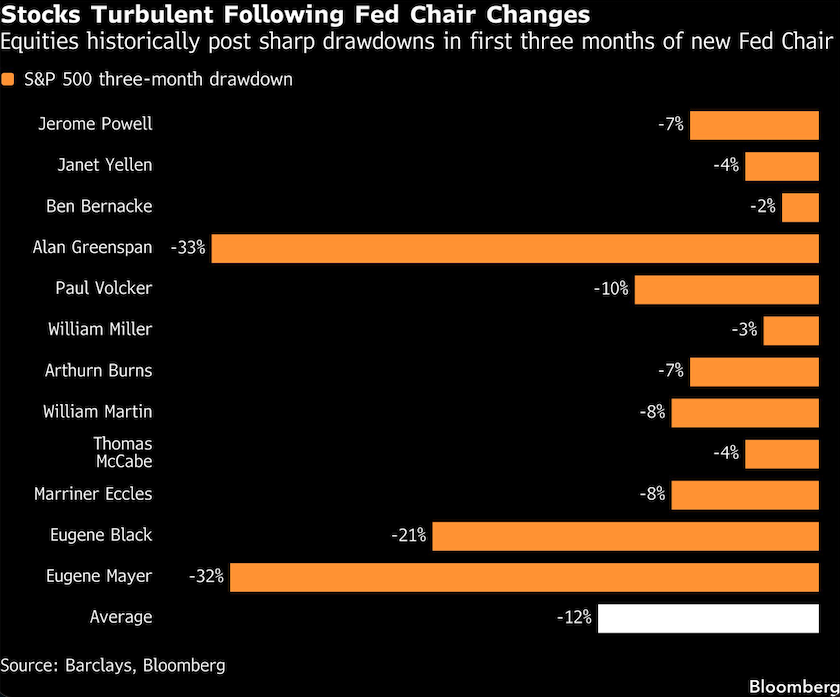
Even without the uptick in CPI and PPI, the S&P 500 has historically faced challenges following changes in leadership at the Federal Reserve. Since 1930, the US stocks benchmark has seen an average 12% drawdown in the first three months after a new Fed Chair is installed, according to an analysis by Barclays Plc. Those declines don’t always hold, however, with the S&P 500 typically just 1% lower three months after a new chair is installed.
“Historically, new Fed Chairs have been tested by equity markets following their appointment into office,” Barclays strategists led by Alexander Altmann wrote in a Friday note.
Across Wall Street, strategists are warning of softness following a sharp run in stocks. The S&P 500 has climbed 13% so far this quarter. Scott Chronert, head of US equity strategy at Citigroup Global Markets Inc., warned of a “post-earnings hangover” at a time when 10-year yields have climbed, inflation concerns have risen and “new Fed Chair Warsh may have his hands full.”
Traders will get a better sense of the central bank’s reasoning for holding interest rates steady this month with the Federal Open Market Committee meeting minutes release on Wednesday. University of Michigan inflation expectations are also due to be released Friday.
To be sure, Nvidia Corp., the largest company in the S&P 500 and a darling of the AI trade, has yet to report earnings. That report could add to bullish bets on the data-center buildout when it releases results Wednesday afternoon. First-quarter earnings for S&P 500 companies so far have trounced analyst expectations by more than 17%.
Still, strategists see macro rather than micro developments having a greater influence on the market’s direction in the coming months.
“Earnings beats have been fueling the bull market lately, but we’re now toward the tail-end of earnings season. Geopolitical headlines and economic anxieties are likely to push markets around now,” said Brian Jacobsen, chief economic strategist at Annex Wealth Management.
A message from Advisor Perspectives and VettaFi: Discover something new! Click here to register for our upcoming webcasts.
Bloomberg News provided this article. For more articles like this please visit
bloomberg.com.