Advisor Perspectives welcomes guest contributions. The views presented here do not necessarily represent those of Advisor Perspectives.
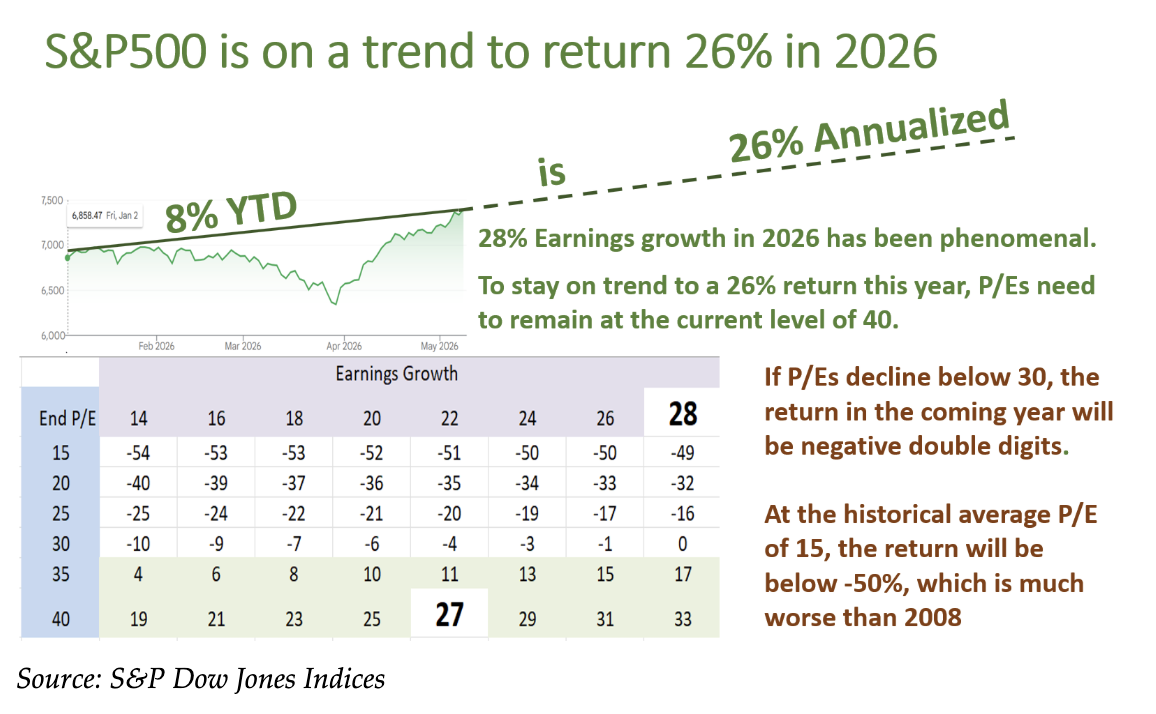
The S&P 500’s current trajectory suggests a potential 27% to 33% return in 2026 if earnings growth and price/earnings (P/E) multiples remain elevated. Earnings are growing 28% currently, which should have reduced P/Es, but it hasn’t. P/Es have expanded to an unprecedented level of 40, raising valuation concerns. If P/Es return to their historic norm of 15, stock prices will halve. If valuations bring the P/E below 30, double-digit losses will result.
In January, I wrote an article that displayed the ranges of returns that might be earned in 2026, depending on earnings growth during the year and the P/E ratio at the end of the year. The formula I use to construct the table is:
Return = Dividend Yield + (1 + Earnings Growth) X (1 + P/E expansion/contraction) – 1
Now, one-third of the 2026 return puzzle is in the books. The S&P 500 has returned 8% so far this year, so the trendline points to a 27% return for the entire year 2026 – a very good return. We can use the formula above to solve for the combination of ending P/E and earnings growth that will deliver a 27% return for this year. It’s a P/E that remains near the current level of 40 and earnings growth above 22%.
But earnings are currently growing faster than 22%. So far this year, they are growing 28%, which — if it continues and P/Es stay at their current level of 40 — will lead to a 33% return in 2026.
So, an optimistic outlook sees today’s stock market returning 25% to 35% this year, which is phenomenal, especially since it follows three other very good years.
The Other Side of the Performance Puzzle
But what if P/Es regress back toward their historic average of 15? If the U.S. stock market reaches a P/E level of 15 over the next year, it will lose more than 50%. Any decline below 30 will result in double digit losses, regardless of earnings growth.
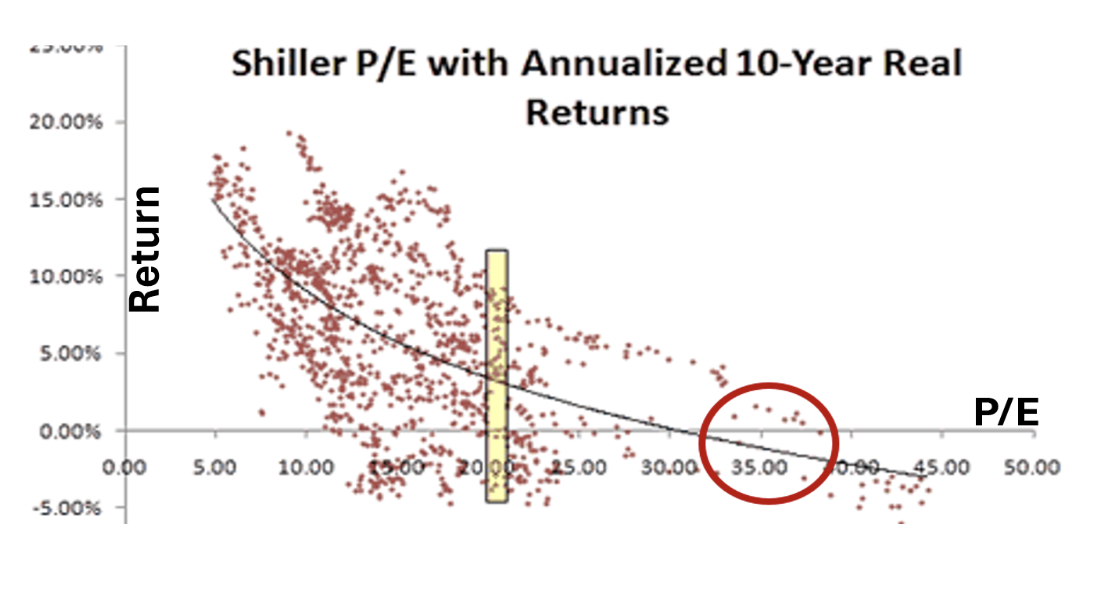
The following relationship between the current P/E and subsequent return reinforces the current risk.
Conclusion
The current strong earnings growth is cause for celebration, and you’d think that it would bring down the market P/E because the “E” in that ratio is growing, but it hasn’t. P/Es continue to expand, well into uncharted territory. The U.S. stock market is extremely expensive. In the past, stock markets have not remained expensive for long. Is it because of artificial intelligence? Perhaps, but a similar argument was made during the dot-com bubble.
At the current level of expensiveness, investor demand for lower stock prices will tend to drive the stock market down, reducing P/E. Increasing the “E” hasn’t done it, but decreasing the “P” will. If P/Es reach their historic norm, stocks will lose half their current value. Watch out!
More articles by Ron Surz:
Ron Surz is president of Target Date Solutions, developer of the patented Safe Landing Glide Path and Soteria personalized target date accounts. He is also co-host of the Baby Boomer Investing Show. Surz’s passion is helping his fellow baby boomers at this critical time in their lives when they are relying on their lifetime savings to support a retirement with dignity, so he wrote a book, “Baby Boomer Investing in the Perilous 2020s,” and he provides a financial educational curriculum.
For anyone who relies on TDFs — or advises those who do — Surz’s new book is a must-read guide to understanding the risks, solutions, and future of a secure retirement.
A message from Advisor Perspectives and VettaFi: Discover something new! Click here to register for our upcoming webcasts.
Read more articles by Ron Surz
 Advisor Perspectives welcomes guest contributions. The views presented here do not necessarily represent those of Advisor Perspectives.