Vanguard’s World Stock Market ETF: Is the Whole Better than the Parts?
 Advisor Perspectives welcomes guest contributions. The views presented here do not necessarily represent those of Advisor Perspectives.
Vanguard’s Total World Stock ETF (ticker VT) is an elegant product: a single fund that gives you cap-weighted exposure to the entire global equity market. For investors who want simplicity, it’s hard to beat. But is simplicity costing you money? We’re often asked by DIY investors whether they’d be better off replicating VT’s exposure using two separate Vanguard ETFs — the Vanguard Total US Stock Market ETF (VTI) and the Vanguard Total International Stock ETF (VXUS) — held in the same weights. The answer, it turns out, is yes, and by a meaningful margin.
Every Basis Point Matters
The table below lays out the numbers. Owning VTI and VXUS results in a blended expense ratio 0.03% per annum lower than the all-in-one ETF. For investors who have enough assets in their taxable accounts to accommodate their VXUS holding, an even bigger benefit of the two-ETF strategy is that VXUS passes through 0.23% in the form of a foreign tax credit, which the all-in-one VT does not. This is a consequence of the IRS rule that says if a fund has less than 50% of its assets in foreign stocks at the end of each quarter, it cannot pass through the foreign tax credit to its shareholders. VT fails this test, with under 40% of its assets in foreign stocks.1
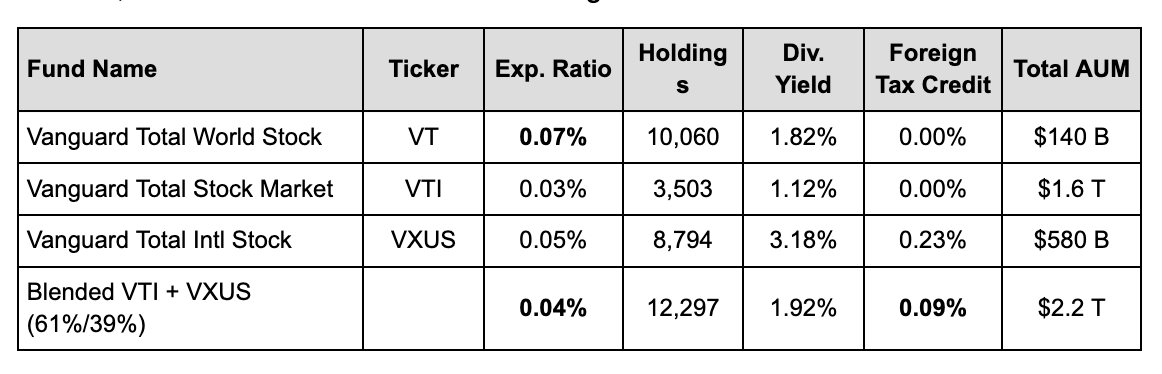
The 0.13% combined benefit from the lower expense ratio and the foreign tax credit is pretty substantial, equivalent to $1,300 per $1 million of investment every year.2
A Few Additional Bonuses
The two-ETF solution provides a bit more diversification, as it holds 20% more individual stocks. This is because VT and VXUS track FTSE indexes while VTI tracks a CRSP index, and we think the indexes are equally good.
The two-ETF approach also provides greater scope for tax-loss harvesting, since there’s a reasonable chance that one fund might decline while the other rises in any given period.












