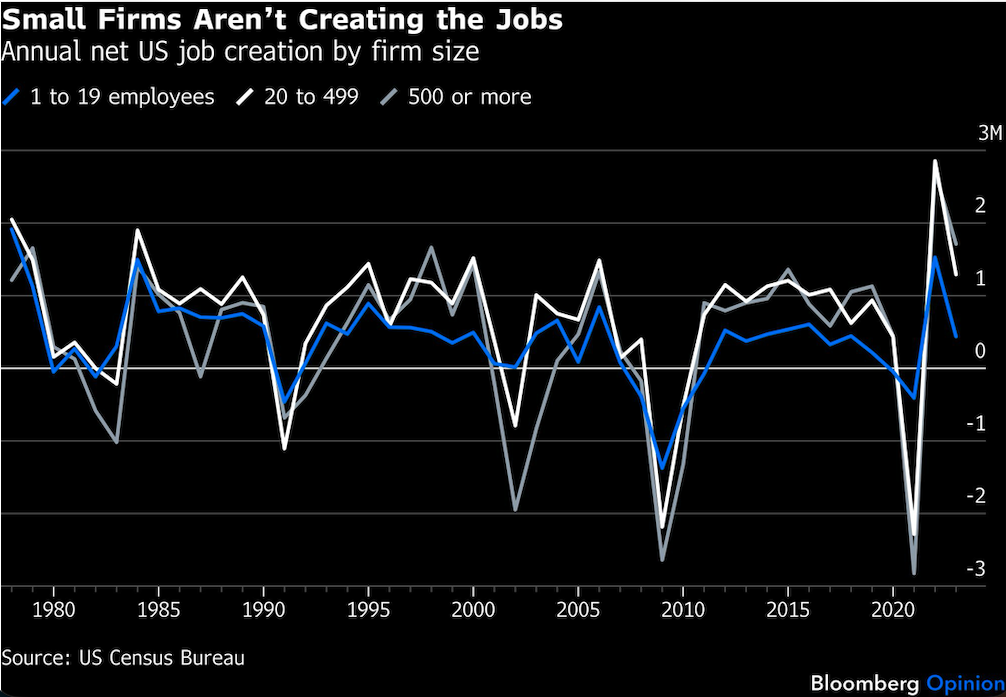
While US financial markets brace for what could be the three biggest initial public offerings ever, most entrepreneurship in the US is headed in the opposite direction: New businesses are shrinking.
Some of this has to do with the leverage provided by technology. Two of those three potential gigantic IPOs, large-language-model purveyors OpenAI and Anthropic, have employee numbers far smaller than any other company with valuations approaching $1 trillion. (The third, SpaceX, has a somewhat larger headcount.) And you’re probably familiar by now with reports of startups using LLMs to bring in big revenue numbers with hardly any employees.
But most of the businesses being founded in the US these days aren’t aiming for that kind of growth, and most appear never to provide full-time work even for their founders. The available statistics show a real boom in business formation since the start of the Covid-19 pandemic, but it’s increasingly looking like one aimed mainly at job-market insurance, self-actualization and help with paying the bills. All of those are perfectly reasonable motivations for starting a business, they’re just not necessarily indications of economic dynamism or progress.
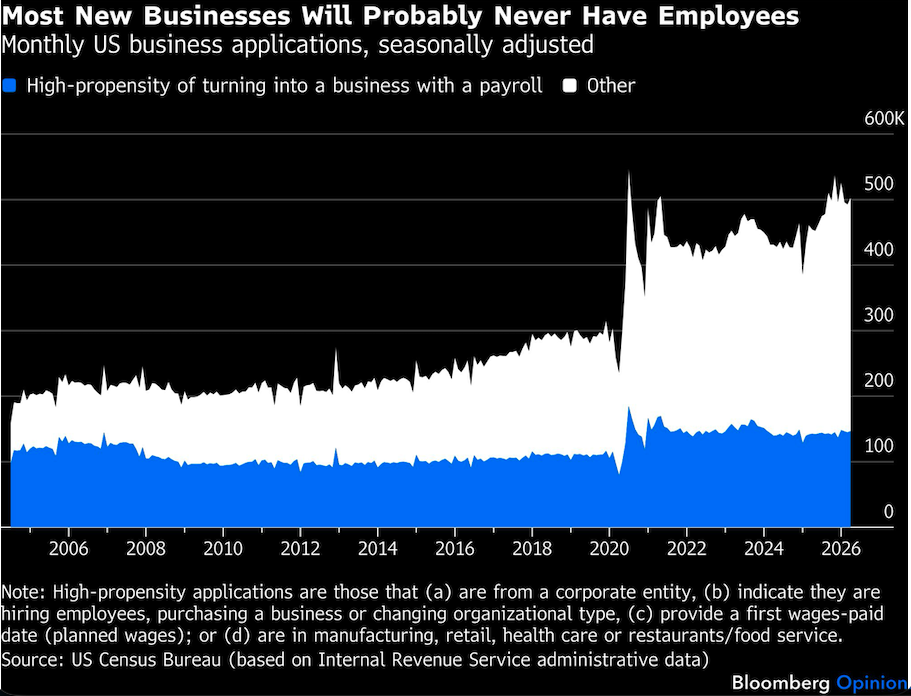
Let’s start with that boom in business formation, which the US Census Bureau measures by counting Employer Identification Number (EIN) applications submitted to the Internal Revenue Service that are deemed to be primarily for business purposes. These are then sorted into so-called high-propensity applications likely to lead to actual hiring of employees (see chart for the criteria used), and a growing majority that are not (EINs can be useful even if you don’t hire anybody).

In the mid-2000s, high-propensity applications constituted 60% of the total. Now it’s less than 30%. The number of high-propensity applications is up relative to the 2010s but is about the same as a share of the 16-to-64 US population as in the mid-2000s — and a 2024 Small Business Administration study found that only about a third of even the high-propensity applications actually do become businesses with employees.
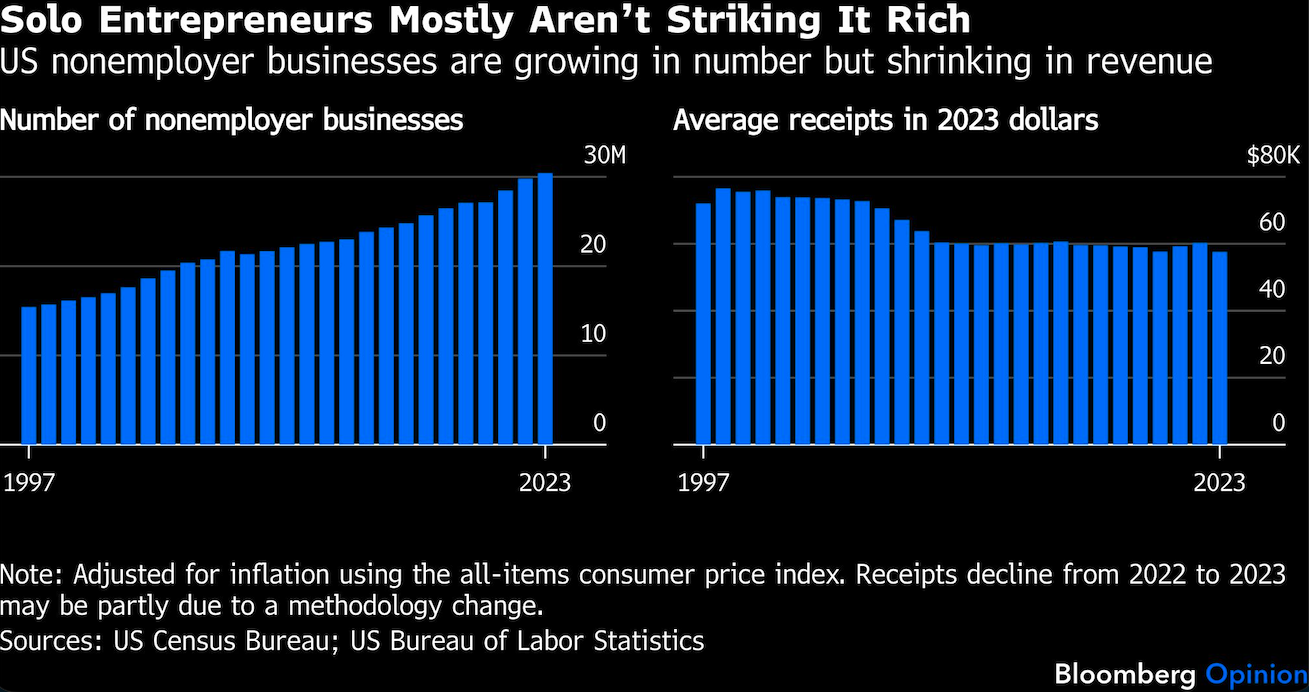
The Census Bureau’s nonemployer statistics, which include the great majority of sole proprietors who don’t apply for EINs but do have to file Schedule C’s with their tax returns — alongside sole proprietors with EINs and owners of zero-employee partnerships and corporations — also show big increases in numbers over the past quarter century but declines in average real receipts.
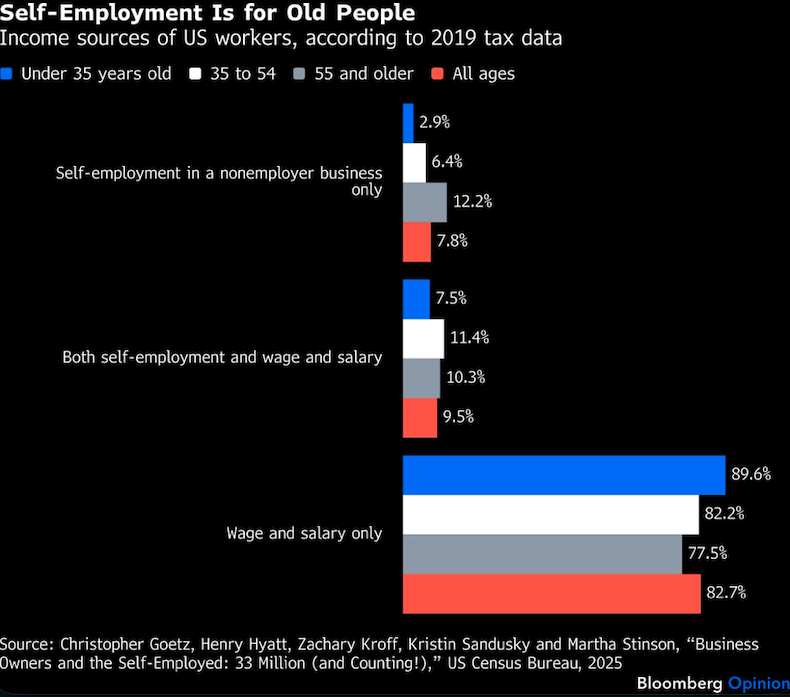
In a paper published last September, four researchers from the Census Bureau and one from the economic consulting firm Analysis Group delved much deeper into the nonemployer data (albeit only from before the pandemic) and found that most people with nonemployer businesses also received wage and salary income and about a third went from having business income in one year to having none the next (and vice versa). In other words, many of these are pretty marginal enterprises.
This research also found significant differences by age, with older workers much more likely to be self-employed than younger ones.
Another recent analysis of the nonemployer statistics by economists at the universities of Wisconsin and Missouri broke them down by geography and found the numbers to be growing fastest “in places with large non-White populations as well as low incomes and home values, suggesting that nonemployer business ownership may be a form of necessity entrepreneurship that is more common in low-wealth areas.” Having attended a small-business competition last week in the Bronx, where the median household income is just $46,040 and only 8.6% of the population is non-Hispanic White people, that certainly rang true to me. The winners were two guys with an already somewhat successful streetwear brand (Wisdom of Age) that are trying to take it to the next level — a classic case of a small business aiming to get much bigger — but most of the other finalists, and last year’s winner, seemed to have set their sights on goals more personal, local and community-oriented.
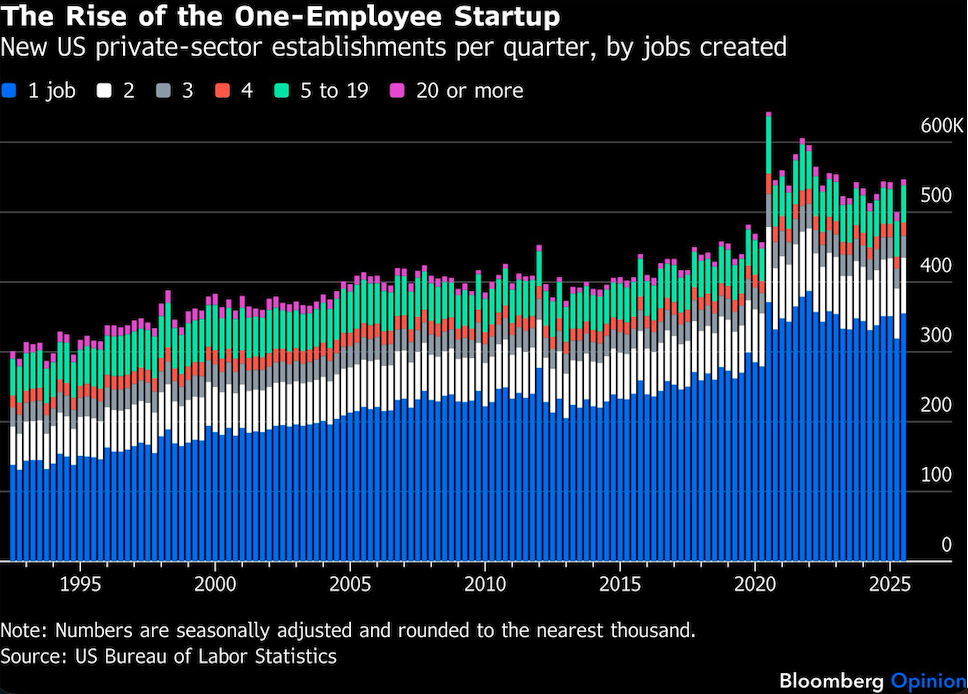
Even among new businesses that actually do hire employees, small size is now the order of the day. The business employment dynamics data published by the US Bureau of Labor Statistics, which are derived from reports filed with the states by employers of workers covered by unemployment insurance, show a sustained increase since the 1990s and a big leap during the pandemic in the number of new business establishments with only one or two employees. The number of new establishments larger than that is lower than in the early 1990s, even as the economy and population have grown. New establishments aren’t exactly the same as new businesses — if Walmart Inc. opens a store, that’s a new establishment — but one has to imagine that single-employee establishments usually are.
The BLS also has statistics on employment gains from firm openings, and not surprisingly they show firms with one to four employees accounting for a larger share of those gains now than they did in the early 1990s — around 60% compared with around 50%. But small firms are frequently closing too, and the Census Bureau’s business dynamics statistics, assembled from a mix of administrative and survey sources, indicate that small businesses’ role in net US job creation has actually been declining over time.
Other research has shown that US economic activity is becoming increasingly concentrated in the largest businesses. So what we have is an entrepreneurship boom aimed at a shrinking share of the economic pie that in some ways feels less like a boom than a cry for help.
A message from Advisor Perspectives and VettaFi: Discover something new! Click here to register for our upcoming webcasts.
Bloomberg News provided this article. For more articles like this please visit
bloomberg.com.
Read more articles by Justin Fox