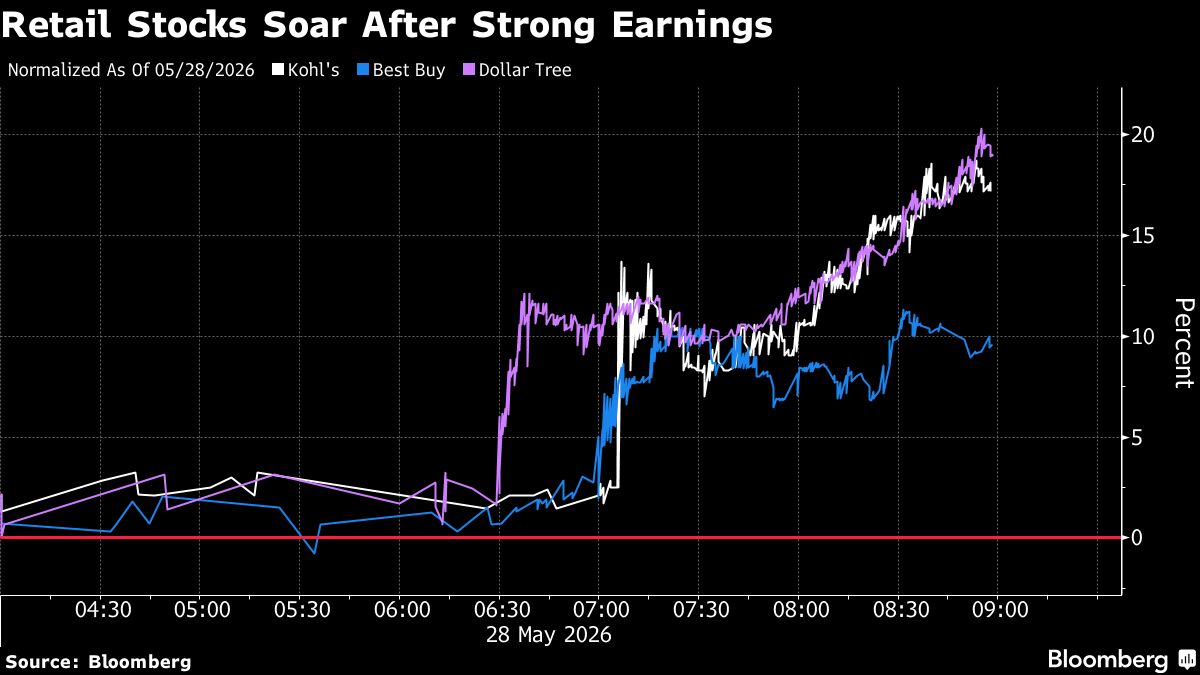
Shares of retailers spanning Kohl’s Corp. to Best Buy Co. and Dollar Tree Inc. rose on Thursday amid optimism that shoppers are still spending when they see what they want at the right price.
The three chains operate in very different parts of the retail sector, but all surprised investors to the upside in a sign of strength by US consumers who are facing multiple hurdles.
Gas prices have surged since the start of the war in Iran, workers are worried about the impact of artificial intelligence and there’s still elevated inflation. All that has weakened consumer confidence.
And yet, Americans are still opening their wallets. US data released Thursday showed that consumer spending edged up in April despite accelerated price increases.
At Kohl’s, stronger-than-expected sales boosted the department-store chain’s turnaround. Electronics seller Best Buy said revenue across major categories gained and this month was off to a strong start. Dollar Tree highlighted that customers spent more per transaction.
“Across all income levels, customers are value focused and definitely prioritizing affordability,” Dollar Tree Chief Executive Officer Mike Creedon said on the earnings call.
Shares of all three retailers jumped on Thursday. Kohl’s soared 25%, followed by Dollar Tree with a 16% advance and Best Buy at a roughly 8% gain.
Despite these results, retailers and consumer brands have been saying throughout this earnings season that there is plenty to worry about.
Last week, big-box retailers including Target Corp. and Walmart Inc. signaled that shoppers remain resilient despite years of elevated inflation. But higher prices on essentials like groceries and gas have squeezed shoppers’ discretionary budgets, pushing them to trade down to cheaper brands and cut back on less essential purchases.
Earlier this month, Kraft Heinz Co. Chief Executive Officer Steve Cahillane said lower-income Americans were “literally running out of money at the end of the month” because of higher costs, especially gasoline.
At Dollar Tree, its lower-income customers are visiting less because of their pressured finances, wrote Neil Saunders, managing director of GlobalData, in a note to clients. The retailer boosted comparable-store sales last quarter 3.5%, but that growth came from a gain in shoppers spending more on each transaction as the number of purchases fell 1%.
“The trips they’ve cut out are those of a more discretionary nature which, on some level, is pleasing because they’re still using Dollar Tree for essentials,” Saunders said.
Holding Off
Some chains have kept prices low amid their own rising costs to maintain market share. But it’s not clear how long they can maintaining that strategy. Walmart warned last week that if fuel prices stay at current levels, prices across the board could rise throughout the year.
Wealthier shoppers have been the driving force behind the US consumer economy for some time. But even they are feeling pressure and increasingly trading down to cheaper options.
Dollar Tree and other low-priced chains have been courting higher-income shoppers, often with great success. That’s a good outcome for these retailers, but raises doubts about the sustainability of these spending levels.
US consumer confidence edged down this month amid anxiety over the economy, according to the Conference Board. Two-thirds of shoppers reported cutting back on spending due rising prices, with many respondents saying they are delaying expensive purchases and buying cheaper versions of the same item.
Costco Wholesale Corp. reports later Thursday and should shed more light on the state of the consumer.
A message from Advisor Perspectives and VettaFi: Discover something new! Click here to register for our upcoming webcasts.
Bloomberg News provided this article. For more articles like this please visit
bloomberg.com.