Treasuries rallied back to be little-changed on the day, erasing earlier declines spurred by higher oil prices, after a key US inflation gauge rose less than expected.
Yields were mostly within one basis point of Wednesday’s closing levels after the inflation gauge — the price index for April personal consumption expenditures — rose 0.4% overall and 0.2% once food and energy was excluded. Economists had estimated increases of 0.5% and 0.3%, respectively. Still, the changes boosted the year-on-year rate, which Federal Reserve policymakers aim to keep around 2%, to 3.8%, the highest since May 2023.
“The Fed’s reaction function for hikes is not there yet,” Matthew Luzzetti, chief US economist at Deutsche Bank, told Bloomberg Surveillance Thursday after the data reports. “They’re giving time for inflation to come down.”

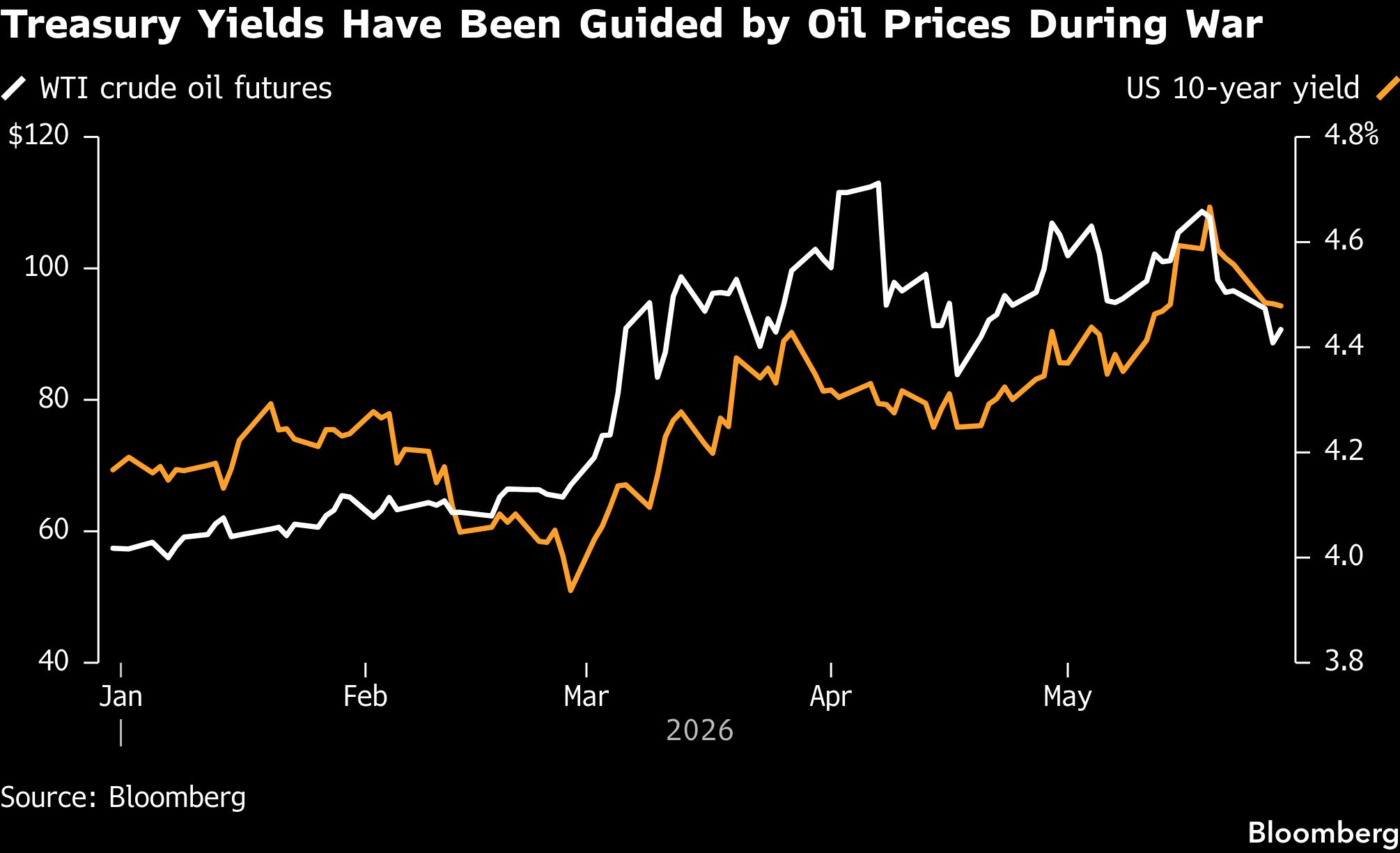
Actual and expected inflation have risen since the US attacked Iran in late February, unleashing a surge in oil and gasoline prices. The prospect that central banks will respond with interest-rate hikes helped drive Treasury yields to their highest levels of the year this month and yields have continued to take direction from oil prices.
While oil prices have retreated from their highest levels since the war began and slipped to the lowest levels in a month on Wednesday, they resumed rising after US forces carried out air strikes on an Iranian military site and struck other targets near the Strait of Hormuz.
Treasury yields reached session highs concurrently with oil prices before the US trading day began, rising as much as four to six basis points across maturities. The 10-year note’s yield, little changed at 4.48% after the US economic data, earlier reached 4.53%. The Bloomberg Dollar Spot Index also was little changed after rising as much as 0.3%.
Thursday’s recovery trimmed the expected yield for an auction of seven-year notes at 1 p.m. New York time to about 4.33%, still higher than seven-year auction results since January 2025. When the sale was announced last week, the expected yield was around 4.45%.
Demand was firm for auctions of two- and five-year notes earlier this week, a sign that higher yields are enticing investors.
Other US economic data released Thursday included weekly initial jobless claims that rose more than estimated while remaining near the low end of their range since 2022. April durable goods orders rose more than estimated, and the estimated first-quarter GDP growth rate was revised down to 1.6% from 2%.
“The hotter inflation report is not a surprise,” Scott Helfstein, head of investment strategy at Global X ETFs. “The market has already shifted expectations on interest rates 180 degrees this year from cuts to hikes,” and investors “can focus on fundamentals and the real economy rather than trying to game Fed moves.”
Swap contracts on what the Fed policy rate will be in the future trade at levels that imply around an 80% chance the Fed Chair Kevin Warsh will deliver a quarter-point interest-rate hike by year-end.
Fed Vice Chair Philip Jefferson late Wednesday warned that inflationary risks remain tilted to the upside, adding that higher energy costs risk curbing consumer spending. Separately, Minneapolis Fed President Neel Kashkari said inflation is still “much too high” in an interview with CNBC.
A message from Advisor Perspectives and VettaFi: Discover something new! Click here to register for our upcoming webcasts.
Bloomberg News provided this article. For more articles like this please visit
bloomberg.com.
Read more articles by Elizabeth Stanton