Large asset managers are rolling out a wave of actively managed emerging-market ETFs, pitching them as alternatives to benchmarks increasingly dominated by AI stocks.
Firms including Pictet Asset Management, T. Rowe Price Group and Baron Capital Group this year launched funds targeting companies such as commodity producers and technology suppliers, which they say are underrepresented in widely followed indexes. The offerings mark a shift from passive strategies tied to the MSCI Emerging Markets Index, which is increasingly driven by a small group of tech stocks, mirroring the concentration in the US.
“There’s a whole world of other opportunity there” beyond the indexes, said Mark Boulton, senior investment manager for emerging market equities at Pictet, which launched the RISE ETF in late April. In a passive fund, “probably up to 40% of what you’re buying is a handful of very big tech stocks.”
While the jury is still out on whether the newly launched funds can outperform their peers, the trend reflects a broader shift in how investors view emerging markets. Once treated largely as a macro trade tied to China, commodities and the dollar, the asset class has become more differentiated, with a growing pool of investors seeking targeted bets.

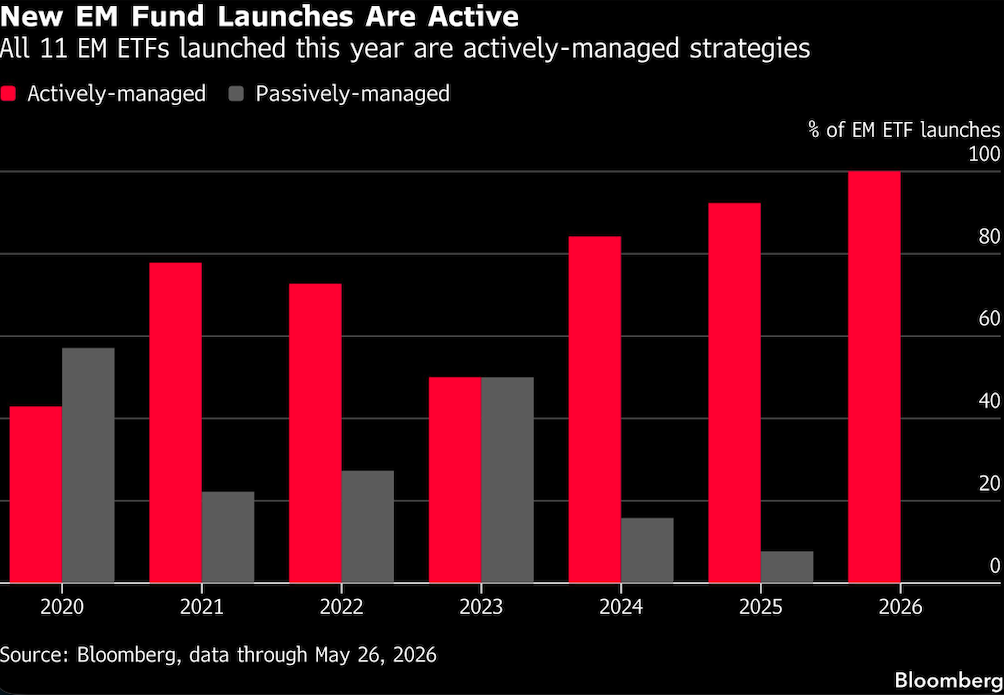
All 11 emerging-market ETFs launched this year are run by portfolio managers rather than tracking indexes, according to data compiled by Bloomberg Intelligence, underscoring how issuers are marketing themselves as offering diversification.
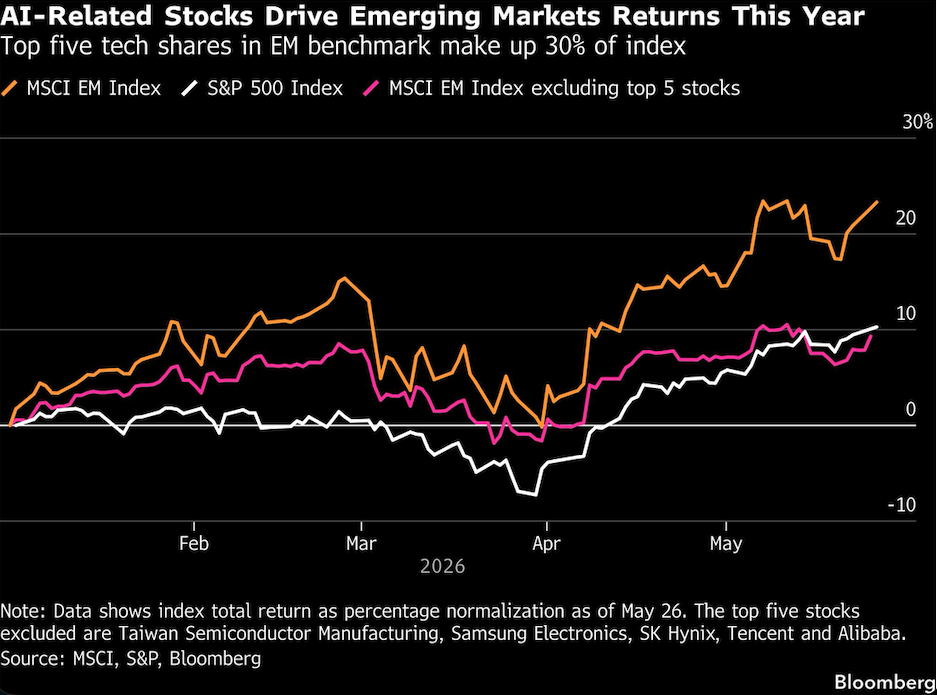
In doing so, though, the funds are largely avoiding the big tech stocks that have driven the bulk of the big emerging-market rally. The MSCI EM index has returned 24% this year, with five tech stocks — the biggest being Taiwan Semiconductor Manufacturing Co. — jumping, on average, more than 70%, according to Bloomberg calculations.
Actively-managed ETFs are costlier than their passive counterparts and, SPIVA data shows, they tend to post weaker returns over the long term.
That’s important for investors like Garrett Aird, vice president of investment management and research at Northwestern Mutual. He acknowledged that the increased index concentration means a passive strategy doesn’t give him broad exposure to the developing world. Still, he’s not yet sold on active strategies.
“While passive EM may not deliver what many investors assume it does, the solution to that problem is not automatically an active fund with higher fees,” Aird said.
Investor appetite for these strategies, however, is growing. Among all US-listed ETFs, about 90% of new money has flowed into actively managed funds this year through the first quarter, according to BlackRock Inc. data.
While emerging markets only captures a sliver of that flow, fund managers are betting investors will increasingly seek out both diversification and overlooked stocks.
“As much as you want the chips exposure, you also have to be careful of how much exposure do I have to that singular group of stocks,” said Todd Sohn, chief ETF strategist at Strategas Securities.
T. Rowe Price’s TEMR ETF is looking deeper into the semiconductor supply chain to find smaller cap stocks that still benefit from the AI frenzy— rather than sidestepping the AI trade entirely.
“The index is always somewhat backward looking and our research analysts are always forward looking,” said T. Rowe portfolio manager Leigh Innes. They’re looking “to identify the next winners and the next leading edge of the technology.”
Baron Capital’s BCEM ETF, meanwhile, is focusing on stocks exposed to AI infrastructure, deglobalization and a weaker dollar — rather than trying to chase broad country allocations.
While at Pictet, the RISE fund’s top holdings include banking and commodity companies such as Grupo Financiero Banorte and Petrobras, according to fund documents.
RISE’s managers are focusing on countries with expanding working populations and strong economic growth, while excluding China, South Korea and Taiwan.
A message from Advisor Perspectives and VettaFi: Discover something new! Click here to register for our upcoming webcasts.
Bloomberg News provided this article. For more articles like this please visit
bloomberg.com.
Read more articles by Carolina Wilson, Zijia Song