As the buzz of the holiday season takes hold, consumers wouldn't think twice about leaving home with just a debit or credit card in hand. The simple act of a purchase followed by swiping a plastic card occurs a staggering several hundred million times each day, with a step up in activity during the holiday season. Ready access to cash via ATMs and the ability to purchase with plastic at most retailers around the globe are a convenience demanded by consumers. MasterCard reports that its payment network supports more than 30 million merchant locations in more than 210 countries, not to mention the sizable networks of Visa and American Express.
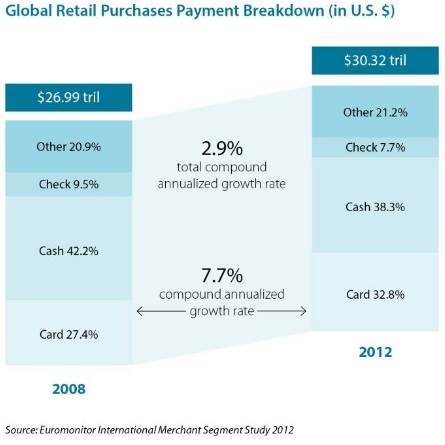
The substantial growth in credit and debit card usage is a multi-decade trend driven by increased global consumer activity and a shift in behavior to less transactions completed by cash or check (see graph below). The growth in online transactions has augmented these trends. Though a consumer's awareness of the payment system might only span the few seconds waiting for a card transaction to "go through", the payment ecosystem should serve as fertile ground for investment opportunities as the large transaction volume and expectation for continued growth continues with the paper-to-electronic shift.
The poster children for the attractiveness of payment system investing are MasterCard and Visa, which have outperformed the S&P 500 since their initial public offerings in 2006 and 2008, respectively. The two companies operate competing global payment rail systems over which a large share of card-based and electronic payments travel and are key beneficiaries of the ongoing global shift in the way consumers purchase. Importantly, the devices accepting a card at the point of sale, the process of verifying an account or connecting a retailer to a network, and the actual electronic exchange of a payment, all represent industries unto themselves. On average, 1–3% of each purchase completed with a card splits several ways among those enabling a transaction. While the build-out, maintenance, and security required to operate an effective payment system is substantial, the attractiveness of participating business models rests in their inherent scalability as they capture a small piece of the payment volume.
Mobile payments, like a smartphone purchase or swiping a card on an enabled iPad, and the emergence of alternative payment systems (like eBay's PayPal network, or Square) should continue to push secular growth in electronic payments. In fact, mobile payments are growing approximately three to four times as fast as overall retail sales. Alternative methods of payment will continue to emerge and in some cases a more direct payment link between a consumer and a store may threaten the traditional payment loop. Nonetheless, there should be ample opportunity for existing payment players to partner with mobile providers and share in the growth afforded by new purchase options, while relying on the efficiency and security of tested systems.
To be sure, there are investment risks to consider. Retail spending growth is directly linked to the health of the consumer in the context of the global economy. In addition, the potential for increased regulation of the payment system and of the fees attached to a transaction remains an industry concern. Tension has always existed between retailers and the various participants in the payment process. The profit motive for all involved – retailers, payment processors, networks, financial institutions providing the plastic card and more – have afforded consumers a tremendous ability to pay without cash at almost any location around the globe. We expect to continue hunting within the payment system for great long-term investment opportunities.
This is not a complete analysis of every material fact regarding any company, industry or security. The opinions expressed here reflect our judgment at this date and are subject to change. The information has been obtained from sources we consider to be reliable, but we cannot guarantee accuracy.
The S&P 500 Index is a representative sample of 500 leading companies in leading industries of the U.S. economy. The Russell 1000® Growth Index measures the performance of those Russell 1000® companies with higher price-to-book ratios and higher forecasted growth values and is a large-cap index. The Russell Midcap® Growth Index measures the performance of those Russell Midcap companies with higher price-to-book and higher forecasted growth values. The stocks are also members of the Russell 1000® Index. The Dow Jones Composite Average Index is computed from the stock prices of 30 of the largest and most widely held public companies in the United States.
Robert W. Baird & Co. makes a market in the securities of MasterCard and Visa. Robert W. Baird & Co. and/or its affiliates expect to receive or intend to seek investment banking related compensation from these companies within the next three months. For additional information on the securities mentioned contact us at 1-800-792-4011.
© 2013 Robert W. Baird & Co. Incorporated. Member SIPC. 777 East Wisconsin Avenue, Milwaukee, WI 53202. 800-792-4011. Baird Investment Management. Baird Investment Management
MC-36543v3.
www.bairdinvestmentmanagement.com











