Has China averted a financial crisis? Not according to behavioral evidence.
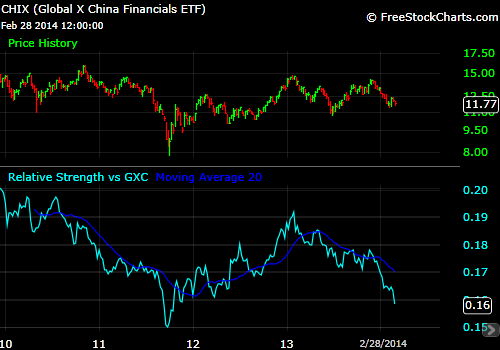
The attached chart examines the technical behavior of CHIX, a narrowly defined China-financial-sector ETF. The upper panel presents weekly prices going back to December 2009. The lower panel presents a simple relative-strength line comparing CHIX to GXC, a broadly defined China ETF containing only 30% financials. As you can see, the financial sector has deteriorated relative to the broad market since early 2013. This trend has accelerated in recent weeks at an alarming pace not seen since September 2011 during the height of the euro crisis.
Fundamental analysis is also raising serious questions. China’s financial sector is trading at roughly half the multiple of the broad market. (CHIX has P/E and P/B ratios of 6x and 0.8x, respectively, versus 10x and 1.5x for GXC.) On the surface, financials look cheap. But extreme relative valuations are reminiscent of the US market in 2007, suggesting the possibility of a “value trap” in which the market is discounting a credit crisis ahead.
So, how will we know when China’s long-term investment outlook has turned? A trend reversal in CHIX versus GXC is the behavioral key. A series of higher lows and higher highs in relative-strength would mean that banks are leading the broad market higher, a healthy condition indicating that the danger of a severe credit shock has passed. Such a signal would occur with prices well off the bottom. But since fundamental valuations are so low, there should be plenty of time to participate once a positive long-term trend is established.
Bottom line? Don’t rely entirely on valuations or anecdotal journalism to assess financial conditions in China. Chart evidence is also important. It’s wise to heed the old Wall Street saying: “Watch their feet, not their mouths.”











