Vladimir Putin’s and Russia’s military action in the Crimea, formally a part of the Ukraine, made it hard to focus on much else Monday. Aside from the obvious and important humanitarian concerns, the military threat carries immense global risk and potentially significant economic consequences.
“The geopolitical uncertainty is worse than at any point we’ve seen since 9/11,” said Ian Bremmer, president of Eurasia Group, over the weekend.
Former National Security Adviser Zbigniew Brzezinski on CNN compared the situation to the first moves by Nazi Germany against neighboring countries in the run-up to WWII, and said “Western nations must prevent, deter and discourage [Russia]. We must warn them explicitly of the negative consequences.”
And the Obama administration took up this theme through Secretary of State John Kerry, putting on hold preparations for the G-8 summit in Sochi, Russia and warning that US and Western powers are prepared “to go to the hilt” to isolate Russia by political, diplomatic and economic measures.
With the situation in such flux, it is hardly productive to focus too much on updating these political developments.
Of course, investors are looking at global equity markets sliding, led by a nearly 12% decline Monday in Russia’s equity indices, the biggest stumble there since 2008. Oil and gold, not surprisingly, were soaring, as were food-related commodities. The interdependence of global, particularly European, oil and natural gas markets with this region increases the stakes for all. Here, of course, we will feel some of the effects of rising prices but it is comforting to know that thanks to fracking, the US now out-produces Russia in petroleum products and is now less than 35% dependent on foreign oil.
However, with all of this global turmoil to think about, here at home we have the ever-optimistic Warren Buffett. The Oracle of Omaha released Berkshire Hathaway’s 2013 Annual Shareholder Letter over the weekend and he said, “On the operating front, just about everything turned out well for us last year – in certain cases very well.”
And Buffett’s section on investing advice contained some words of wisdom that are timely and timeless. He said, excerpted here in part:
–Keep things simple and don’t swing for the fences. When promised quick profits, respond with a quick “no.”
–Owners of stocks too often let the capricious and often irrational behavior of their fellow owners cause them to behave irrationally as well.
He amplified these remarks Monday morning in an interview with CNBC and commented on the Ukraine situation. Buffett reassured the interviewer and investors that he was not about to panic out of investments he believed in for the long term. In fact, he said he was buying on the dip.
While we might not always agree with everything Buffett says, we can certainly support his strong belief in strategic discipline.
As Jerry Wagner, President of Flexible Plan Investments, said in early February during the US market downturn arising from emerging market and Fed tapering concerns:
While one can never be sure when these declines will occur, the comforting fact for investors whose accounts are managed by an active manager is that the actively managed strategies are risk managed and already have built into them defensive moves…And should the market begin to recover and the clouds pass over, the strategies will automatically begin taking on more risk again. That’s the advantage of having a firm of over 80 employees dedicated to providing you with dynamic, risk managed investment solutions.
And while we, like Buffett, do not think one should follow market predictions out the window, it is comforting to know that seasonality factors for March and April are in the market’s favor.
Bespoke Investment Group analyzed the monthly performance of the Dow over the past 100, 50 and 20 years and concluded, “Investors have a reason to cheer up entering the month of March, because March and April have historically been the two best months of the year when combined.”
March has “been the most consistently positive month over the last 50 years (68%),” while for the past 20 years, April has had the highest average monthly returns at +2.7%.
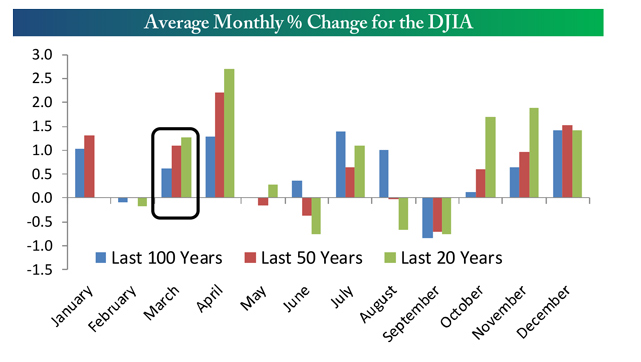
Source: Bespoke Investment Group
So, for now, at least, we will try and put the gloominess aside and let the markets and our models decide the best course of action.
Based upon expectations for improving post-winter economic data, some continued strong earnings stories, and the market’s apparent comfort level with Janet Yellen’s Fed leadership, the market deserves the benefit of the doubt until proven differently.
But let’s do keep an eye on the geopolitical situation and wish the citizens of the Ukraine safe passage through these times.
David Wismer











