Ever since spring had come it had been there. Like a sentry at its post it guarded its domain. Shrilly the apparition would call out, only to be answered by another plaintive cry.
The work commenced. In the cattails at the lakeside, they built. And then their vigil began. Always alert, forever watching, they shared the duties … until the intruder came. Since spring has finally arrived (just in time for summer), the beautiful days here in Michigan have been accompanied by nest building by a family of Red-winged Blackbirds in the wetlands behind our home. This is nothing new. It happens every year and like the return of the swans and geese, it can be depended on like clockwork (including, like their departure and return, the semi-annual spring forward and fall back).
Since Red-winged Blackbirds are one of the most widespread bird species, with over 190 million estimated in the US, it’s an event I imagine many of our readers have witnessed. But twice in the last two years, the return of the blackbirds to their summer residence has given me a chance to observe a rarer happening.
Twenty feet above the marshland, the dance begins. Like footage from a World War I movie, two small objects in the sky above dart in and out harassing the bulk of the much larger predator soaring above the nesting spot. A Red-tailed Hawk had invaded the normal refuge of the blackbird. With eggs in the nest and a new family on the way, the birds did what they could do to chase away the flying marauder.
Amazingly, they succeeded. After repeated attempts to discover what the small birds, like flies buzzing around a bit of meat, were so eager to protect, the hawk soared higher and left. And the blackbirds returned to their vigil, their treasures were safe … this time.
Here’s a view of the aerial “dogfightâ€Â with a great jazz accompaniment (since my jazz article of two weeks ago proved so popular):
We’ve been watching a similar drama play out in the stock market of late. Substitute market bulls for the “blackbirds†and the stock market bears for the “hawk†and the analogy is complete.
The market bulls have been maintaining their vigil. Stocks have soared over 100% since 2009, but now the bear looms above them.
The bulls are smaller and weaker than they were when the rally commenced. Rather than simply building their nest eggs, they must guard them against bearish scenarios that are now common and seem to be capable of overwhelming them. The market lately has been a good example of this.
For over a month we have heard the media pound away with its rhyming “Sell in May and go away†mantra. Yet, when the month had ended, the results were unexpectedly bullish. Stock markets around the world, the US included, moved higher during May, led by, can it be – what happened to the impact of our sanctions – Russia:
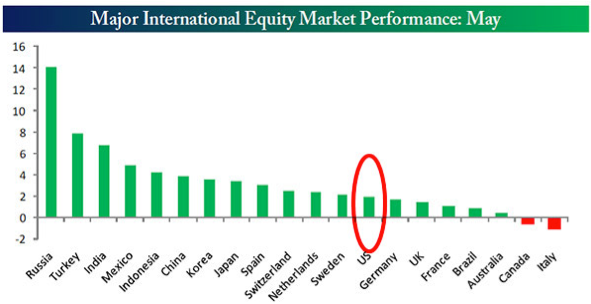
Source: Bespoke Investment Group
Of course, there were other threatening bearish stories that appeared suddenly like a summer thunderstorm to wreak havoc on the market, like the unexpected decline in the Gross National Product reported last week, the low volume seen on this advance and the paucity of new highs by individual securities. Yet, by week’s end, we had experienced not one new high in the S&P 500 Index, but instead a new high every day last week! The bullish blackbirds had kept the predator away again.
Last Monday we reported that the market sentiment (only one-third of investors are bullish) and volatility (VIX below 12) conditions in the market favored the bulls over the bears. And while the economic reports coming in from around the US have moved into a bit of a sideways pattern over the last two weeks with the number of reports beating expectations matched by those that failed to do so, the year-over-year comparisons and monthly beat ratio remain strongly in the bullish camp.
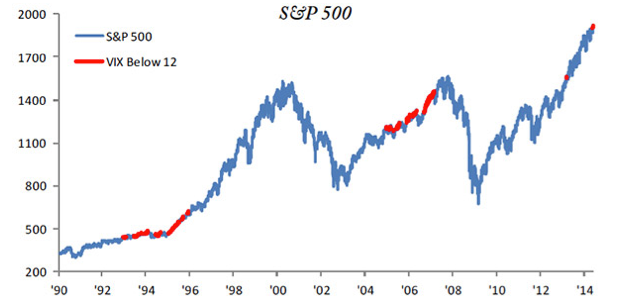
Source: Bespoke Investment Group
Similarly, while we wish the “beat rate†on earnings reports from the first quarter had been more robust, the growth rate of earnings reported has been very bullish.
And interest rates could not be more supportive, as they continue to trend lower.
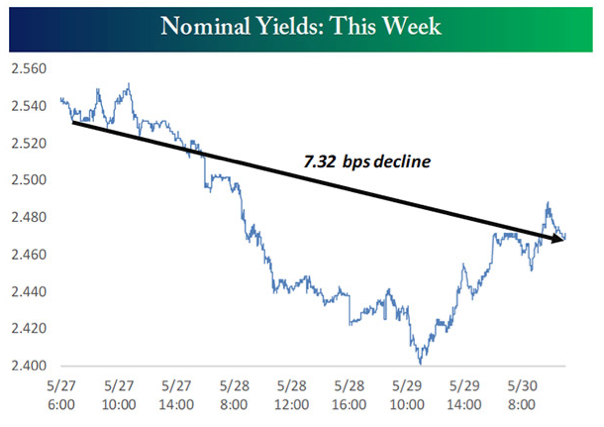
Source: Bespoke Investment Group
On the seasonality front, the outlook could be better. The first day of the month following an up month tends to be lower. And the month of June is more persistently down than May, being second on the bearish calendar only to September.
Pecking away at this seasonal bearish case are some pretty determined defenders, however:
1) In the short term, whenever the S&P ends the month at a new high, about 70% of the time the market has been higher one and two weeks later;
2) In the intermediate term, one of our favorite indicators, the ten-day relative strength of the NASDAQ Composite Index versus the S&P 500 Index, just turned bullish. Since 1971, when this condition exists, the S&P has scored nearly all of its gains and the NASDAQ over 100%;
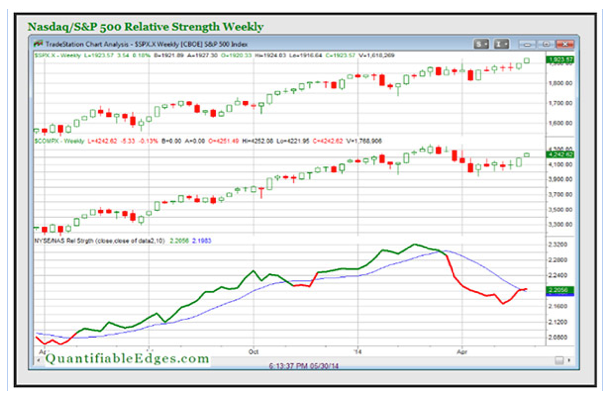
Quantifiable Edges Weekly Research, June 2, 2014 edition, www. quantifiableedges.com
3) Finally, one of the best indicators of long-term economic and stock market health, the weekly number of initial jobless claims, with an unexpected fall to just 300,000 (the second lowest level of the recovery), continues to point to higher stock prices. When you invert the series (falling claims causing the index to move higher), as the claims line rises, the stock market line does as well.
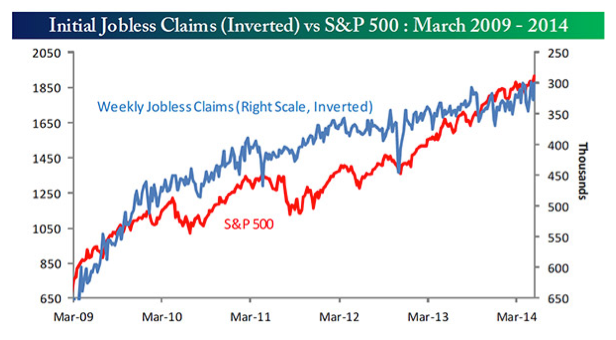
Source: Bespoke Investment Group
With four out of four record closes on the S&P 500, stocks are a bit overbought, and some short-term weakness can be expected as the market pauses to refresh, but so far there is little evidence that the long-term bull market trend is over.
I have not seen the Red-tailed Hawk now for over two weeks. Just like the Red-winged Blackbird standing guard atop a tall surviving cattail from a year ago, I watch for its return. I know it’s only a matter of time.
I know it is only a matter of time, too, until a market correction descends upon us, or, worse still, we are visited by a black swan.
In the meantime I’ll depend on our tactical strategies to keep us close to fully invested while the new highs are made and on our strategically diversified portfolios to provide us with comfort if the dreaded black swan returns.
All the best,
Jerry
Disclosures











