Forward looking analytics embedded in recent introductions of multi-factor Smart Beta ETF products demonstrate causality among its components and an ability to replicate past future pricing. Unclear is the extent to which Smart Beta indexes and related funds adequately discern the directional value of securities in aggregate at points of inflection to consistently outperform allocated Beta, Index-plus or Alpha portfolio strategies.
Certainly in capital market rally and recovery modes dynamic flat-weighted portfolio structures merit consideration for baseline benchmark index replacement. In this context however, as Small-Cap Growth and Mid-Cap Value asset classes are often alternating performance leaders, distinct valuation drivers typically reveal the limitations of Smart Beta’s construct. Performance dispersion among investment alternatives underscores the lag effects of set period-defined rebalancing, economic sector rotations and resultant fluidity within the traditional nine grid capitalization style box.
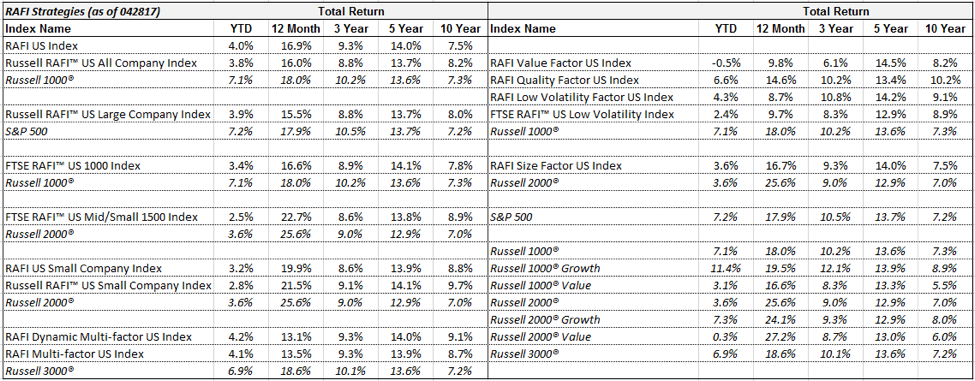
In initial review representative FTSE RAFI fundamental indexes, Smart Beta benchmarks plus corresponding Standard & Poor's and Russell indexes are detailed on a YTD, 12-month and 3/5/10 year basis:

Misleading perhaps in examination is Smart Beta's premise of interoperability in replacing benchmark indexes, sector/subsector proxies and conventional portfolio strategies as baseline comparables. The error in assignment is demonstrated by Smart Beta's inability to consistently outperform standard benchmarks in its own zero sum environment, that Alpha is Beta in market aggregation. Advocating alternatives to market capitalization-based industry standards (both style and size) without consistently discernable value-adds fails to significantly relieve portfolio manager and analyst responsibilities to monitor, evaluate and quantify changes in valuation over corresponding periods or alter the decision making process requisite in modifying portfolio weight allocations based on expected market conditions.
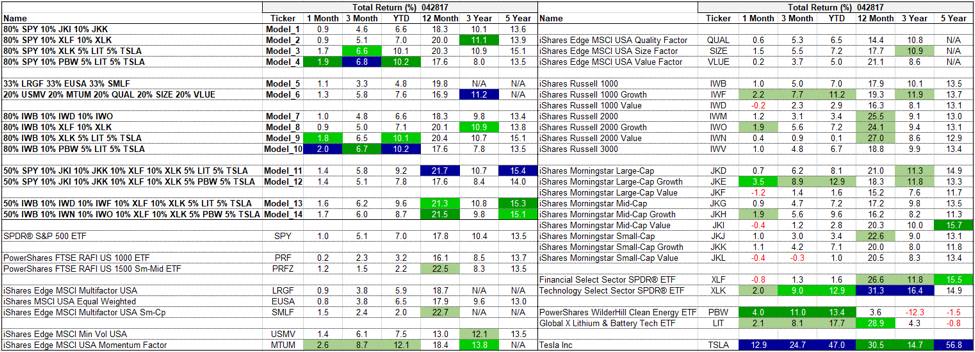
In the example below, 14 model portfolios are constructed to illustrate Smart Beta fundamental index (FTSE RAFI US 1000 and 1500), multi-factor (Small-, Mid- and Large-Cap) and single factor (Quality, Size, Value, Minimum Volatility, Momentum) performance against more traditionally constructed portfolio strategies from an investment universe of over 30 index, benchmark, sector and niche proxies (broad market, capitalization-based, finance, technology, binary-thematic, Alpha). ETF proxies are utilized for baseline benchmark total return figures and represent performance differentials. Portfolio Models_ 1-4, 7-14 reflect performance at date intervals and allocated weights in determined management strategies away from a market neutral posture:
Models_1-14 are ranked first (blue), second (dark green) and third (green) at period dates with representative indexes and proxy benchmarks ranked similarly and distinguished from peers by noted period performance equal to or greater than the third ranked Model portfolio (grey). New introductions of multi-factor Smart Beta funds SMLF/EUSA/LRGF limit performance comparables (3- and 5-year) at period-end 042817 though a longer view extrapolation of 12-month performance of PowerShares FTSE RAFI US 1500 Sm-Mid ETF (22.5%), iShares Edge MSCI Multifactor USA Sm-Cap (22.7%) and iShares Edge MSCI USA Value Factor (21.1%) begins to support Smart Beta design attributes. Single factor credence is bolstered from 3-year markers evidenced by iShares Edge MSCI USA Momentum Factor (13.8%), iShares Edge MSCI Minimum Volatility USA (12.1%) and iShares Edge MSCI USA Size Factor (10.9%) relative to peer alternatives.
Significantly, of the 13 model portfolios presented on a 3-year basis, Model_6 (composite portfolio derived equal weight single factor Smart Beta USMV/MTUM/QUAL/SIZE/VLUE) outperformed all other market capitalization weighted portfolios (11.2%; n=12). In survey of occurrences on a 2017 YTD and 12-month standalone basis Smart Beta proxy ETFs met or exceeded third position model placement or greater on only three occasions (from 20 opportunities, 15.0%) compared to 28.6% for iShares Russell Index ETFs (n=14) and 11.1% for the iShares Morningstar J_capitalization suite (n=18). Expanding data points to include 3- and 5-year performance results, Smart Beta bested its peers (18.8%; n=32 > 17.9%; n=28 > 13.9%; n=36, respectively) highlighted by iShares Edge MSCI USA Momentum Factor second seed placement (13.8%) over the 3-year total return period versus proxy ETF performances (XLK 16.4%).
Alpha-Beta strategies are incorporated in modeled results (JKI/JKK, XLF/XLK, XLK/LIT, PBW/LIT, IWD/IWF, IWN/IWO, TSLA) to represent common passive and combined active/passive portfolio management strategies. Positioning in emerging technologies (XLK), nascent policies (PBW) and niche markets (LIT) serves to demonstrate Small- and select Mid-Cap company effects on a price basis more observable than conventional drivers of valuation in broad index and asset class-based strategies. Paired themes of technological innovation and renewables exhibit policy adoption to capital investment in parallel scenarios (XLK>LIT>TSLA, PBW>LIT>TSLA) and include less granular sector exposures for economic growth (XLF), long-term trends (XLK) and subsequent catalysts for valuation changes based on fund flows (I_series, J_series, single factor Smart Beta).
From our modeled example, TLSA 12-fold rise in valuation over the past five years is captured tangentially within structured business segment operations (BSOs) industry segment verticals (Fuel Cells – Lithium, Automotive – Manufacturers) on a proportional portfolio weighted classification basis from then a Mid-Cap company (<$4BN) to its industry leading positions today (>$50BN). Linking relevant company BSOs within an investment universe across capitalization, asset classes, economic sectors and geography in a latticed approach provides a ready matrix to advance Alpha’s generation.
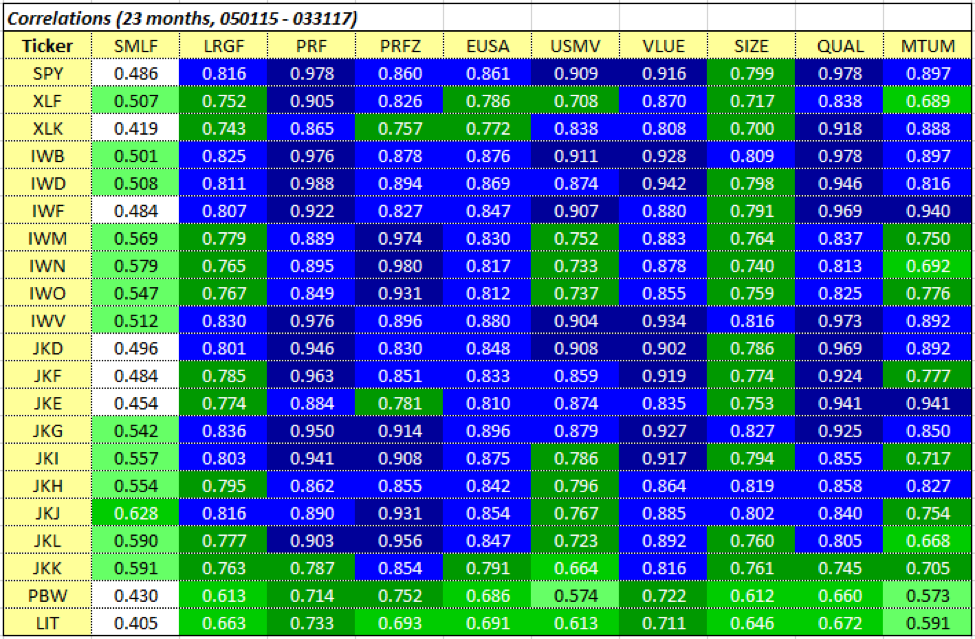
In the proceeding correlation table (thru 1Q17) measured performance period wins among the five strongest levels of correlations PRF/IWD (0.988), PRFZ/IWN (0.980), PRF/SPY (0.978), SPY/QUAL (0.978) and IWB/QUAL (0.978) predictably alternate though potential Alpha wedges (1.000 minus correlation level) are demonstrated by skewness of Small-Cap returns relative to broad market and competing asset classes. Notably when contrasting fundamental, equal and capitalization weighted structures embedded in Smart Beta products (SMLF/EUSA/LRGF, USMV/MTUM/QUAL/SIZE/VLUE) idiosyncratic risk drives variance of Small-Cap returns from mean levels. For companies uncorrelated to empirical Smart Beta metrics and yet to be fully captured by standard GAAP quotients, the singularity of one or several corporate profiles aligned with its functional peers (BSOs) provides for active management of Smart Beta's tenets (balance sheet attributes, technical indicators) and enables Alpha generation beyond algorithmic Alpha-Beta allocations via an exercise in peer group analytics and valuation:
Bounded by opportunity and risk, dispersions of multi-factor Small-Cap SMLF correlations range from 0.628/0.591/0.590 (market weighted Small-Cap Composite/Value/Growth) to 0.405/0.419/0.430 (thematic LIT/ tech sector proxy XLK/thematic PBW). At 12 performance intervals for the 12 months ending 042817 thematic and sector proxies outperformed 11 times (91.7%) intimating Alpha's prospective effect in Go markets given persistent market inefficiencies in valuation of smaller capitalized companies.
Clearly sequenced over period segments, disparate performance variance from mean measured peer alternatives seemingly overshadows the feasibility of Smart Beta's past forward predictive patterning and statistically engineered ecosystem for baseline benchmark replacement. For example, Brexit’s initial sell-off demonstrated event risk and subsequent broad-based capital market recovery underscored a soaring 40% increase in correlated effects of SMLF (price change 062316-110816: +2.9%) to PBW (-3.7%)/LIT (-5.2%)/XLK (+7.8%) pairs (0.672/0.645/0.712) and macro impact on I_series IWM (+1.8%)/IWN (+3.0%)/IWO (+0.6%) levels (to 0.822/0.827/0.810). Sequentially, the Value trade continues to build after the US election (price change 110916-123016: IWN +13.1%, JKL +10.3%) apart and in parallel to SMLF (+10.1%, 0.869/0.840/0.876) anticipating tax and regulatory reforms in far greater effect than PBW (+2.9%)/LIT (+2.4%)/XLK (+2.1%) growth-oriented strategies (0.448/0.116/0.317) from Paris climate accords and Silicon Valley incubators.
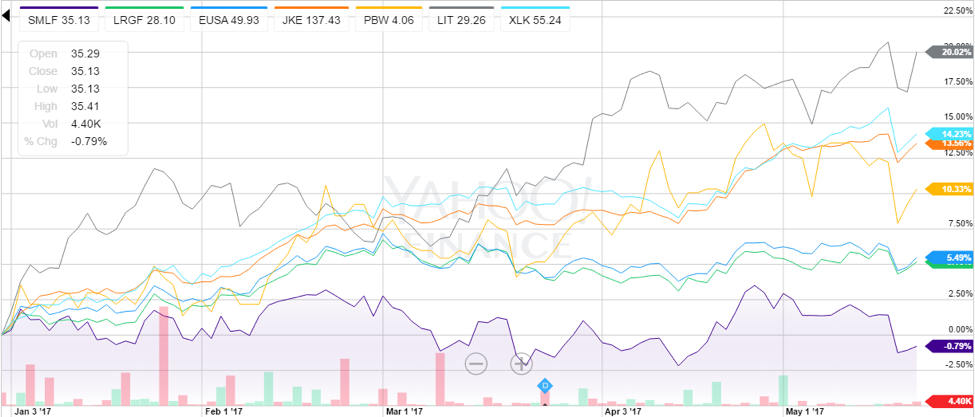
Change is once again evident in 2017 YTD performance along flight-to-quality scenarios (JKE), reinforcement of secular trends (XLK) and continued strata of thematic investing (LIT, PBW). Absolute ranged returns of component members from PBW (+103.6%, -46.7%), LIT (+45.5%,-22.5%) and XLK (+55.6%, -32.2%) advantages portfolio managers taking uncorrelated Alpha positions thru cycles, macro driven or tiered-specific corporate catalysts:
Borne from relative valuation, outperformance persists as the virtue of capital market endeavors and is the dominant measure in all implied institutional investment scenarios. Proprietary research suggests outperformance is unsustainable if one forgoes fundamental company-specific financial analysis and qualitative assessments in favor of a statistically-based holistic investment approach. To an extent pragmatic and another defeatist, Smart Beta pioneers suggest pursuit of Alpha is moot (all prospective gains lost in aggregation) though measured reallocation of resources based on Smart Beta factor rationale is supported by its stated importance of relative valuation—adjusting to current cycles and subcycles within greater cyclicalities.
Examination of Smart Beta’s premise in both single and multi-factor formats against model portfolios naturally provides a comparative dashboard to monitor capital market trends given shared variables inherent in competitive market information, strategy effectiveness and opportunity costs. However, as data populates its empirical trendline towards forward period adjustments, Smart Beta is challenged to think again in order to capture the catalysts of change among externalities and invention.
© Universal Orbit
Read more commentaries by Universal Orbit