The global economy is now more than seven years into a durable but modest expansion. But what will happen when the cyclical tailwind that began last summer fades? And how will key policies in the world’s major economies pivot in response to both rising populist pressures and diminishing returns from unconventional monetary policy and fiscal austerity? These were among the critical topics discussed and debated at PIMCO’s 36th annual Secular Forum held on May 8–10 in Newport Beach.
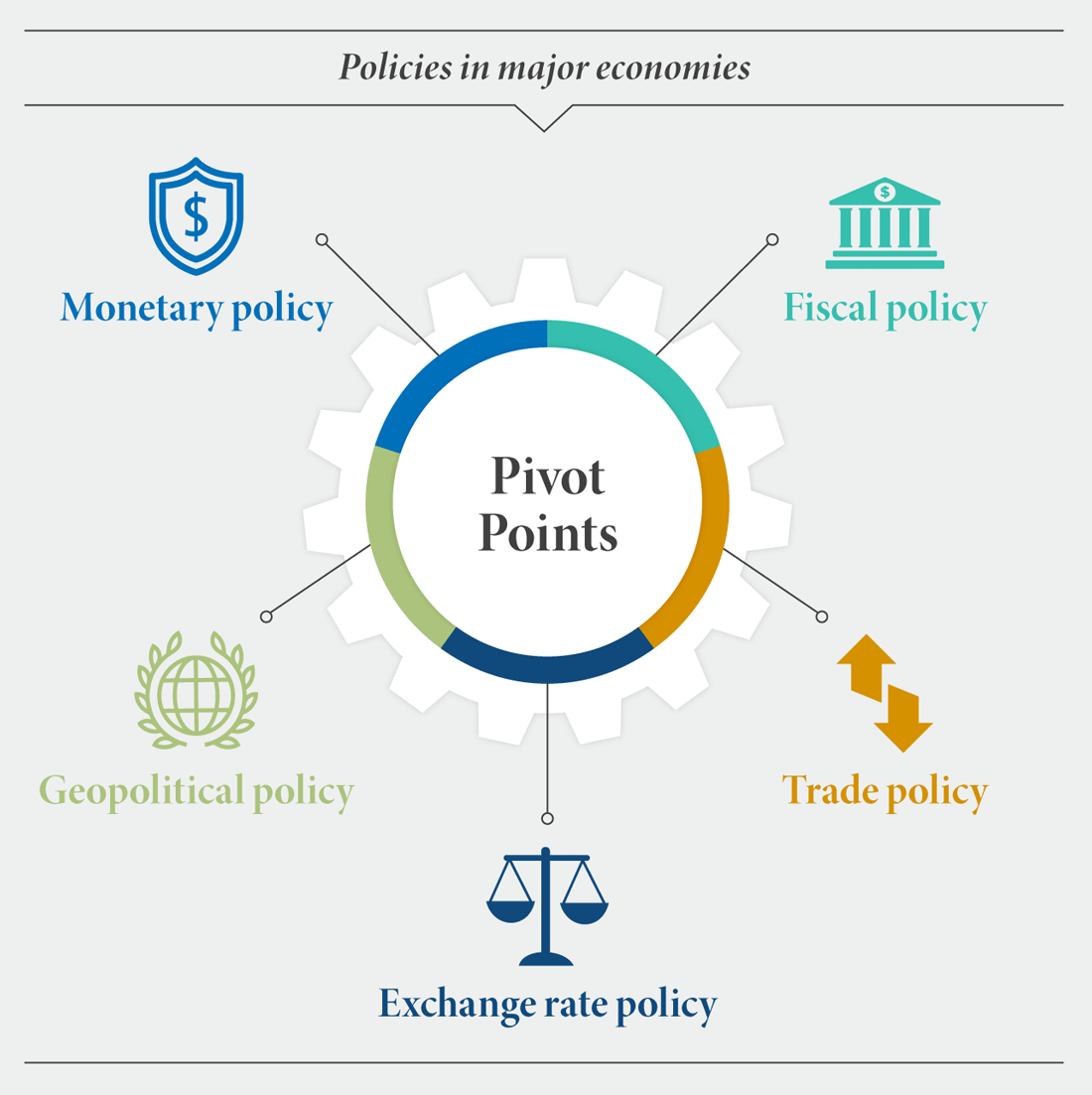
Over the next five years, the global economy may undergo five significant pivots in the direction and scope of monetary, fiscal, trade, geopolitical and exchange rate policies. But while the direction of some of these policy pivots may be known, the path that policies actually take, their impact on the global economy and markets, and their ultimate destination are today all highly uncertain. That said, over our five-year secular horizon we believe that the global economy will be “driving without a spare tire” as the Fed raises rates and shrinks its balance sheet, and that any pivot to fiscal policy that materializes will be unlikely by itself to boost global growth prospects in a sustainable way.
In addition, we see increasing downside risks to the outlook for Chinese growth and eurozone stability. Expansions may not die of old age, as the saying goes, but if history is any guide, we believe the probability of a recession sometime in the next five years is around 70%. In the next recession, whenever it occurs, central banks in The New Neutral world will likely have limited scope to cut rates. Also, with sovereign debt levels already high, fiscal space outside the U.S., China and Germany – which won’t be inclined to use it – will be constrained. Since our previous Secular Forum in May 2016, the global economy has surprised on the upside: Markets have shrugged off and indeed rallied after the Brexit vote and the U.S. presidential election, and risk appetite has been robust, resulting in lofty equity valuations, tight credit spreads and low realized volatility. But we believe that many market participants today are too relaxed, that medium-term risks are building and that investors should consider using cyclical rallies to build cash to deploy when markets eventually correct – and possibly overshoot – as risks are repriced.
As always, our focus at the three-day Secular Forum was to identify the key forces, whether political movements, demographics, technology or other fundamental trends, that will drive the global economy and financial markets over the next three to five years. To help develop and refine our views, we welcomed six invited speakers, heard fresh ideas from our newest class of MBAs, and engaged in active debate among our investment professionals who gathered from our offices around the world as well as with our Global Advisory Board. As in past years, our task at the Secular Forum was to develop a baseline view on where the global economy and economic policies are heading and to analyze the plausible left- and right-tail scenarios (i.e., downside and upside possibilities) that could diverge in material ways from that baseline.
The PIMCO Secular Forum is an integral part of our investment process, which combines a disciplined “top-down” macro view with rigorous “bottom-up” research on individual securities, companies, sectors and countries. No investor has a crystal ball, but at PIMCO we do have a process that we have refined over 40 years to enable us to seek above-benchmark returns at benchmark levels of volatility while aiming to provide yield and preserve the capital we invest on behalf of our clients. The Secular Forum provides the concept, the construct and the compass for that process. With the forum we allocate the time and space to examine new ideas – and we continually strive to enhance, iterate and innovate. This year, for example, we welcomed insights from an expert in cognitive neuroscience. While our forum process has always included a thorough examination of our priors, we gained fresh perspective on challenging our established views and mitigating the optimism biases that can cloud analysis of real data. Such biases (often unconscious ones) can lead investors to extrapolate recent positive trends into the future, even amid conflicting evidence. There may be cause for optimism, but the analysis to such a conclusion must be void of bias.
In the end, PIMCO’s Secular Forum is about both ideas and actions: a clear vision of the direction and destination of the global economy in the years to come that in turn informs real-time investment decisions.
A look back at the 2016 secular outlook: Stable But Not Secure
To set the stage for this year’s forum discussion, we briefly reviewed our conclusions from May 2016. In our baseline view, we saw a global economy continuing – but just barely – to “muddle through” with tepid growth and low inflation, but argued that this apparent stability was deceptive. The system had avoided collapse only via massive doses of unconventional monetary policy (quantitative easing, zero or negative interest rates) and a debt-financed boom (bubble?) in some prominent emerging market economies, and by 2016 we saw these props running into diminishing if not negative returns over the secular horizon.
While this was our baseline view, we also foresaw the distinct possibility that the downside risks were increasing, and that monetary policy exhaustion and an overhang of debt could pose material threats to the sustainability of the global recovery and financial stability. We also considered upside scenarios for the global outlook, such as a potential rebound in global productivity – which would support higher investment, consumption and “animal spirits” – and possibilities for a shift in the global policy mix toward fiscal policy or even coordinated monetary-fiscal “helicopter money” programs.
While we acknowledged that probability distributions have both left and right tails, our secular thesis was that risks to global economic stability were rising, meaning investors should be compensated up front for the heightened uncertainties they faced. We positioned our strategies for this “Stable But Not Secure” outlook.
Four big questions
A lot has happened since May 2016. Indeed, following our December 2016 Cyclical Forum, we observed,
“SINCE MAY, ALL THREE KEY RISKS THAT WE SAW ON THE SECULAR HORIZON – ELEVATED AND RISING DEBT LEVELS, MONETARY POLICY EXHAUSTION AND THE ASCENT OF POPULISM – HAVE EITHER ALREADY MATERIALIZED OR BECOME MORE REAL …. WHO WOULD HAVE THOUGHT BACK IN MAY THAT WITHIN THE FOLLOWING SIX MONTHS THE UK WOULD VOTE FOR BREXIT, DONALD TRUMP WOULD BE ELECTED PRESIDENT OF THE UNITED STATES, ITALY WOULD VOTE “NO” ON REFORM, AND THAT MARKETS WOULD LIKE IT?”
Our May 2017 forum was preceded by a pronounced cyclical tailwind for the global economy. The shift in sentiment – especially in the U.S. after the presidential election – along with the surprisingly strong global data and the prospect for a pivot away from unconventional monetary policy and fiscal austerity to monetary policy normalization and fiscal stimulus led many market observers to romance the idea that the U.S. and perhaps the global economy is about to pivot to a “new paradigm.”
The stage was set. To get our secular call right, we needed to come out of this year’s forum with answers to four big questions:
What is – or even is there – an endgame for unconventional monetary policy?
Will the potential for a U.S. fiscal policy pivot outweigh the potential for protectionism to succeed in limiting global trade?
How will political polarization and populism affect trade, defense and exchange rate policy over our secular horizon?
How will Chinese policymakers navigate the economic, trade, leadership and geopolitical pivots that may follow the meeting of the 19th National Party Congress later this year?
Pivots on the horizon
Throughout the forum, as we heard from our invited speakers and our Global Advisory Board and discussed these questions among ourselves, a single common theme emerged: Global markets over the next five years face the potential of significant pivots in the direction and scale of monetary, fiscal, trade, geopolitical and exchange rate policies.
The challenge for investors is that while the direction of these five types of policy pivots may in many cases be known (in the U.S., more fiscal stimulus and less monetary accommodation), the path that policies actually take, their impact on the global economy and markets, and their ultimate destination are today all highly uncertain. An intention to change the direction of policy does not guarantee its success, a plan to implement policy does not define its path, and the market reaction may change the policy’s ultimate destination. For this reason, investors need to identify and assess each of these policy pivots, invest in markets that will benefit from policies that succeed, and guard against policies that are likely to fail.
Potential pivot away from unconventional monetary policy
One of our big questions is will, and if so how will, central banks execute what could be an extended and potentially disruptive pivot away from unconventional monetary policy. As several colleagues noted during our discussion, it is surprising how little we know today, nearly three years after the conclusion of QE3, about how the Federal Reserve plans to execute its desire to wind down its $4.5 trillion balance sheet to a more normal size. As of this writing, the Fed has left unresolved – and appears to be undecided about – a number of crucial details: How will this process proceed – will it be passive or predictable (the unwind of its portfolio of MBS holdings can’t be both passive and predictable at the same time!)? Starting when? At what pace? Over what time frame? To what destination? Needless to say, if (as the Fed and PIMCO believe) QE 1, 2 and 3 lowered the term premium on long-maturity U.S. Treasuries and mortgages, then the unwinding of this portfolio likely will put upward pressure on term premia and thus long-term bond yields and mortgage rates. We do believe over our secular horizon that a positive term premium will re-emerge in the U.S. yield curve. The consensus that emerged from our discussions is that the ultimate size of the Fed’s balance sheet will be about $3.5 trillion, implying an expected reduction of only $1 trillion spread out over a number of years.
As for the European Central Bank (ECB), uncertainty about the balance sheet evolution is even more elevated. Our baseline is that the ECB continues to grow the balance sheet in 2018 but begins to taper the pace of its monthly purchases, taking into account growth and inflation prospects. In this scenario, even though core inflation and inflation projections are likely to remain below the inflation target, we expect that a majority of the Governing Council will be eager to move away from the negative rate policy and lift the deposit facility rate above zero at some point, perhaps toward the midpoint of our three- to five-year secular horizon (which coincides with the end of ECB President Mario Draghi’s term in October 2019). While this may be the modal (baseline) outcome, the tails of the distribution are fat, and the ECB appears to be proving a less reliable backstop to disinflation than we expected last year.
Finally, in light of these scenarios for the Fed and the ECB, we also discussed the implications for unconventional policy at the Bank of Japan (BOJ). Our baseline is that the BOJ only gradually raises the target yield on 10-year Japanese government bonds – at present “around zero” – but with balance sheet expansion continuing as required to maintain the yield target, and perhaps accelerating if, as is possible, expansionary money-financed fiscal policy is formally attempted.
Pivot in trade policy: Can potential pitfalls be averted?
We believe the odds of a protectionist pileup or a global trade war have diminished over our 12-month cyclical horizon, but over the next three to five years the risks remain material, though in our baseline case a global trade war is averted. Indeed, based upon what we heard from our invited speakers, perhaps the central risk scenario is not the outbreak of a global trade war with the U.S. unilaterally withdrawing from the World Trade Organization (WTO), but rather a high-stakes bilateral trade renegotiation between the U.S. and China outside of the WTO dispute settlement forum, a process U.S. Trade Representative Robert Lighthizer calls “derogation.” China of course runs a large bilateral trade surplus with the U.S., so it would have an incentive to bargain as it would face a threat of lost access to the U.S. market. But the U.S. would be vulnerable as well to a Chinese response against U.S. companies, as well as to the risk that China devalues the yuan and/or unloads its massive holdings of U.S. Treasuries. In sum, we see a left-tail risk that a China-U.S. trade renegotiation could turn inflammatory, with risk of miscalculation on both sides and the attendant negative externalities rippling through the global economy and financial markets. However, this is not our base case. And there is a right-tail scenario as well: These are still the early days of the Trump administration, and few details have been provided about its “America First” trade policy. But in combination with a serious reform of the corporate tax code, infrastructure investment and a sensible agenda on deregulation, a focus on trade deals that open markets, protect intellectual property and encourage firms to invest in the U.S. could be a plus for U.S. growth and incomes toward the end of our secular horizon.
Potential for a U.S. fiscal pivot
Our baseline U.S. outlook is for a continuation of 2% GDP growth and 2% inflation on average over the secular horizon. Our forum discussion focused on the balance of risks to this baseline.
On the bullish side, some colleagues argued that we should begin to see a pivot in the U.S., and perhaps global, policy mix away from the exclusive reliance on unconventional monetary policy and toward a more balanced reliance on deregulation of economic activity coupled with expansionary fiscal policy. According to this view, these policies would stimulate the U.S. economy out of low-growth New Normal lethargy, boosting growth well above the post-crisis average of 2%. Under this right-tail scenario, Republicans in the White House and both houses of Congress enact an ambitious agenda that includes reforming the corporate tax system and rationalizing the regulation of energy, finance, the environment, healthcare, labor markets and the welfare system. Fiscal, infrastructure, and deregulation policies raise productivity, making higher growth rates sustainable in the long term and thus reinforcing the initial boost to animal spirits and investor optimism. And even apart from policy, productivity growth in the U.S. could surprise on the upside. Perhaps the Fed successfully executes the handoff to higher policy rates and a smaller balance sheet. In this scenario, rates rise, but the process is orderly with yields converging to levels somewhat above what is priced in to the forward curves but well below the levels that prevailed in the pre-crisis old normal world.
We also heard from a number of colleagues who believe that risks to the U.S. outlook are tilted to the downside. This scenario scales back the expected size of the Trumponomics fiscal package that ultimately gets enacted by Congress and signed by the president. Tax reform – to be contrasted with tax cuts – is hard to do, period, and even harder to do well (the last such reform was the Tax Reform Act of 1986). Moreover, to the extent the ultimate package scales back the size of the corporate tax piece and/or the infrastructure piece to fit into a revenue-neutral budget goal without the cash flow from a border adjustment tax (which is consistent with what we heard from some of our invited speakers), the supply-side benefits of potentially faster productivity growth generated by more capital investment and infrastructure development (which become much more relevant over our three- to five-year secular window) would be diminished as well. Confidence, as one of our forum speakers reminded us, may be the cheapest form of stimulus, but at some point to be sustained it needs to be confirmed by hard data. Another important consideration is that, with the U.S. apparently close to full employment, any boost to aggregate demand from fiscal stimulus may increase inflation more than real growth unless it is accompanied by a boost in productivity.
Taking all this into account, we reaffirmed our New Normal, New Neutral baseline view that the U.S. economy is likely to grow at about 2% per year with inflation running close to the Fed’s target of 2%. We forecast the fed funds rate at the end of our secular horizon anchored in a New Neutral range of 2%–3%, but with the risks skewed to the downside on rates. Of real concern for the U.S. outlook as well as the global outlook is the driving-without-a-spare-tire risk at this late stage of the business cycle. (Indeed, we’ve cautioned about the risks of a global economy “driving without a spare” as far back as 2010, when it was the title of our global secular outlook essay.) In the next recession, whenever it occurs, the Fed and other central banks will have less room to cut rates than in past cycles. Some countries – the U.S., China, Germany – will likely have some “fiscal space” to deploy in the next downturn, but with sovereign debt levels already very elevated, fiscal policy is unlikely to fully offset the constraints on monetary policy in the next global downturn. Consequently, we would likely see central banks reviving QE and other unconventional monetary policies – including price-level targeting in the U.S. – if a future downturn is severe.
China’s potential pivots in fiscal, trade and exchange rate policies
For China, we discussed a wide range of possible scenarios given the considerable uncertainty that surrounds President Xi Jinping’s intentions and ability to deliver as an economic reformer as well as the considerable challenges that China faces in liberalizing its financial markets, dealing with excessive leverage and its shadow banking system, and managing the costs of shifting resources and capital out of its state-owned enterprises (SOEs). Under our baseline scenario, Chinese growth slows gradually to about 5.5%, and following the 19th Party Congress, President Xi moves China away from the “growth at any cost” model. Our baseline sees an orderly crawling depreciation of the CNY exchange rate, and remaining capital controls are sufficient to limit reserve losses to less than $1 trillion.
In an optimistic scenario, some colleagues believe that President Xi pulls off a clean sweep at the 19th Party Congress and uses his enhanced stature to end policy paralysis and embark on a major reform agenda that improves the economy’s efficiency: better balanced, less reliant on leverage, and an attractive destination for capital inflows. In this upside scenario, China’s growth remains above the current pace of 6.5%, disruptive devaluation is avoided, and the glide path to a floating exchange rate is a smooth one. President Trump and President Xi strike a grand bargain on trade, currency and geopolitical spheres of influence, perhaps including an acceptable freeze or wind-down of North Korea’s missile program.
However, there is also a bearish scenario for China. In this left-tail view, President Xi overreaches, and the 19th Party Congress is deemed a failure, setting off a vicious cycle of policy misfires – making August 2015 look like a picnic – and an intensified power struggle ensues as the old guard, resistant to SOE reform, reasserts its muscle. In this downside scenario, the economy stalls, defaults mount, the shadow banking system implodes and GDP growth collapses. The U.S. levies across-the-board tariffs against Chinese imports, triggering a bilateral trade war. China follows with a globally disruptive CNY devaluation, which accelerates capital flight and leads to a huge drain on foreign currency reserves. The People’s Bank of China is forced to tighten in a vain effort to maintain some control over the exchange rate. However, with property and equity markets in free-fall, the central bank gives up on the peg, the CNY floats, and capital outflow intensifies, causing a risk-off jolt to global markets and confidence.
While the most likely scenario is that of the baseline discussed above, we do believe the risks to China are skewed somewhat to the downside.
Europe: A geopolitical policy pivot to – or away from – populism could affect exchange rate policy as well
Regardless of whether or not any worst-case scenarios come to pass, investors over the next three to five years will have to respect and factor into their asset allocations the broad-based wave of anti-globalization sentiment and political polarization that is evident in the Brexit vote, the U.S. election and the rise of populist political parties in France, the Netherlands and Italy. We do note that Emmanuel Macron’s victory in the French presidential election is significant, a positive for the euro, and a potential positive for trend growth and employment in France. However, the road to genuine reform may be difficult to navigate if, as may happen, Macron must govern with less than an absolute majority in the National Assembly.
Under our baseline secular scenario, the eurozone delivers trend growth of 1.25% on average over the next five years with inflation hovering between 1% to 2%. Although there are bullish and bearish tails to the distribution of macro outcomes, we came out of this forum seeing risk to the outlook as roughly balanced for the eurozone in the near term, but with risk increasing and tilting to the downside toward the end of our secular horizon. In particular, the most acute risk for the eurozone over the next five years is a crisis brought about by fears of an Italian exit from the single currency. We think an actual exit of Italy from the eurozone is highly unlikely. That said, the odds of a crisis brought about by markets pricing in that possibility of redenomination risk – perhaps triggered by a victory of the Five Star candidate in next year’s Italian presidential election – are not minuscule. For the ECB, higher risk premia associated with even latent redenomination risk would tighten financial conditions and blunt the transmission mechanism.
Japan: possible monetary and fiscal pivots, but structural headwinds still persist
Japan still faces several challenging circumstances. First, we do not believe that 2% inflation is a credible target. The neutral rate and inflation expectations remain depressed in Japan. Lowering long-term interest rates in an effort to get the economy closer to the inflation target would not necessarily be effective given negative implications for banks, insurers and pensions. Second, demographics and the elderly poor are already a very real crisis. By 2025, 30% of the population will be age 65 or older. Demand for precautionary savings in Japan is massive; savings rates are rising among younger generations. Third, while the mistake of premature tightening is unlikely in both monetary and fiscal policy, massive fiscal and monetary policy coordination is also unlikely to occur. This leads to our base case secular outlook for Japan of 0%–1% inflation and the Bank of Japan only gradually able to raise the 10-year yield target. Right-tail risks to our base case are labor market reforms that lead to productivity growth and hence an upside wage surprise. Left-tail risks stem from a potential weak-U.S. dollar policy and a Bank of Japan with zero room to respond.
Emerging markets respond to developed market and geopolitical policy pivots
Emerging market (EM) countries outside of China remain “conditions takers” susceptible to left and right global tail risks. However, barring significant global shocks or dislocations, emerging markets are well-positioned to demonstrate healthy growth and returns. Given the uncertainties around unconventional monetary policies, deglobalization and protectionist risks, the differentiation between EM countries is going to be as important as ever. At last year’s Secular Forum we were “reasonably constructive” on EM, and since then conditions on the ground have continued to improve. EM assets also benefit from the technical tailwind of fair-to-cheap valuations in a world of artificially distorted prices. In our baseline view, EM countries do well over our secular horizon, but we remain cautious due to significant downside risks. Downside risks include the U.S. political dynamic, an exit from never-before-tried monetary policies, a China hard landing and a downside commodity surprise. Assets today are also not priced even close for the risk of a North Korea left-tail outcome.
Investment implications
As we discussed at beginning of this paper, the Secular Forum is integral to our highly structured investment process established more than 30 years ago to encourage contrarian views and ensure we take a sufficiently long-term horizon when making investment decisions. Inviting distinguished guest speakers with alternative views to our forums is critical to challenging our assumptions before we crystallize our investment conclusions, and this year we appreciated the presentation by Tali Sharot, a neuroscientist and director of the Affective Brain Lab in London who surveyed us before the forum and then provided feedback on our potential for optimism bias. Her talk sparked a robust debate with portfolio managers, analysts and other investment professionals speaking up from across our two-story circular conference room, in which each seat has a microphone. We commit time in our discussions to address process improvements, such as acknowledging the potential for optimism bias, and we believe this leads to even more effective decision-making. Speakers from past years who pushed our thinking have included “The Black Swan” author Nassim Nicholas Taleb, and professors Carmen Reinhart and Kenneth Rogoff.
Regarding our investment conclusions from the forum, we should reiterate that they stem from the view that investors face a number of potential pivots in monetary, fiscal, trade, geopolitical and exchange rate policy over the next five years, pivots that individually and in combination could have a significant impact on the economy, markets and investors.
While the baseline macro outlook has become somewhat more stable given generally more balanced risks, the outlook for financial markets we see as somewhat more insecure, reflecting risk asset valuations that have tightened significantly over the past 12 months. While we reaffirm our secular New Normal/New Neutral framework, which we expect to continue to anchor financial market valuations, we need to be cautious about beta return expectations over the secular horizon, given elevated initial valuations.
We will maintain a focus on capital preservation and grinding out alpha rather than rely on hoped-for capital gains. To identify and assess the policy pivot points and invest accordingly, we will combine top-down macroeconomic and policy assessment with bottom-up sector and security selection. And we will complement both with PIMCO’s traditional emphasis on structural alpha trades, which seek to benefit from exploiting market inefficiencies and to provide a diversified source of return from our other active positions.
Duration
Global government bond markets have priced in The New Neutral, and we see levels as broadly fair given expectations for low policy rates sustained over the next three to five years. Taking the U.S. as an example, forward rates look broadly fair given the expectation that the Fed will raise the policy rate (in our baseline view) to 2% to 3% and reduce the size of its balance sheet gradually over the secular horizon. Across different countries, and across different curves, we expect to find a lot of opportunities for relative valuation positioning, but at current valuations we expect to remain fairly neutral overall on duration risk. Reduced downside risks to inflation mean that we continue to see U.S. Treasury Inflation-Protected Securities (TIPS) as offering reasonable valuation and an attractive hedge against upside inflation surprises.
The Federal Reserve has shown that it is possible for a central bank to raise rates from the zero bound, and it is set to embark on a gradual process to shrink the size of its balance sheet. We expect the ECB to continue to taper its quantitative easing program, while the BOJ will remain engaged in yield curve targeting as a means to limit the overall growth of its balance sheet.
Less central bank support is a source of upside risk to government bond yields. However, as noted above, we expect reductions in the stock of assets held on central bank balance sheets to be very gradual. Against that, with the economic expansion growing older across developed countries, and given a range of economic and political downside risks, we remain concerned about the risk that the global economy may be driving without a spare tire. Policy measures may not be sufficient to counter the next downturn, whenever it materializes.
We will seek to avoid investments that rely to a great extent on central bank support. In the event of a recession, central banks, given the starting conditions, risk running into policy exhaustion at an early stage. While we anticipate some handoff from monetary to fiscal policy in countries that have capacity for it, especially in the event of a recession, there are no guarantees a fiscal stimulus will be used in a timely or effective manner.
Risk assets
Our baseline secular outlook is consistent with a modestly positive view overall on risk assets. That said, there is little cushion in terms of valuations in the event of a recession. This warrants a focus on security selection and bottom-up research, and while we will look to position to benefit from relatively attractive yields, we will invest based upon an assessment of strong fundamentals, hard asset coverage and seniority in the capital structure.
In the eurozone, in our baseline scenario we expect ongoing growth and somewhat more balanced macroeconomic risks. However, we also see key secular risks in terms of reliance on central bank support, less certain central bank support, and the risk of populist movements gaining more ground (the French election outcome notwithstanding). We expect to be cautious on eurozone peripheral risk at current valuations.
We see emerging market fundamentals as improving, generally, and our baseline global outlook is favorable for emerging markets. Valuations have again tightened, and we expect to continue to find good opportunities across countries and sectors in this very differentiated asset class. China remains a key source of risk, both for emerging markets and for global growth.
Alpha focus
In an environment of lower returns across most asset classes, alpha generation has the potential to be a greater share of total return. And we underline the fact that, in line with our recently published research, active management may confer advantages in fixed income markets where the growth of non-economic and passive investors tends to enhance opportunities for alpha generation. (For a synopsis and more information, please read our colleague Jamil Baz’s blog post, “Bonds Are Different: The Active Advantage.”).
A secular journey with multiple pivot points in global markets should offer fruitful opportunities for active managers. We plan to maintain a flexible and tactical approach to take advantage of the opportunities.
Key takeaways
PIMCO’s secular forum process, refined over decades, enables us to look long-term to manage risks and pinpoint opportunities in a global economy poised to undergo multiple policy pivots.
Secular pivot points with baseline outlook
-
Monetary policy: We expect Fed balance sheet normalization, but less than many think, with a New Neutral destination for the fed funds rate.
-
Fiscal policy: We expect any U.S. fiscal package that passes will be tilted to tax cuts, but light on reform; we see limited fiscal space in Europe.
-
Trade policy: We expect the U.S. to focus on bilateral deals (e.g., China, NAFTA) and aggressive use of existing authority within the WTO.
-
Exchange rate and geopolitical policies: Amid populist movements in Europe and beyond, we expect the euro to survive and Italy to remain in the eurozone. The Chinese yuan is likely to grind weaker.
Macroeconomic risks …
- In our view, downside and upside risks are roughly balanced for the U.S.; downside risk to growth in both Europe and China is rising over the secular horizon.
- We see a significantly lower tail risk of global deflation.
- We see a risk the fed funds rate lands to the downside of New Neutral levels.
- We are monitoring the global economy’s “driving-without-a-spare-tire” risk in the next recession, whenever it happens.
… and portfolio responses
- Focus on valuation – lots of “good news” is priced in to markets.
- Maintain focus on capital preservation.
- Seek relative value in rates and credit.
- Look to a global opportunity set, including emerging markets.
For more insights into our long-term economic outlook and to learn how the Secular Forum guides our investment process, please visit our Secular Outlook page.
© PIMCO
Read more commentaries by PIMCO