SUMMARY
- Including ESG factors in sovereign risk assessments can help identify credits that have lower long-term credit or default risk.
- ESG criteria have been an integral part of PIMCO's sovereign ratings analysis since 2011, when we explicitly included ESG factors in PIMCO's sovereign ratings model.
- We believe our approach provides a solid foundation for credit assessments that integrate ESG but recognize that challenges and areas for development remain.
Social radicalism, political polarization and the growing impact of climate change are prompting many investors to focus more on Environmental, Social and Governance (ESG) factors when they consider investing in sovereign bonds. Traditional sovereign credit analysis focuses on financial and macroeconomic variables that materially affect a country’s probability of default and the expected loss if default occurs. Today, it is increasingly apparent that a government’s ability and willingness to meet its financial obligations are also influenced by politics, governance, social considerations, natural disasters and the longer-term impact of environmental factors.
Importance of ESG for sovereign risk
Integrating ESG into sovereign risk analysis adds a holistic and long-term perspective that is very much aligned with investing in sovereign fixed income. In addition to their long maturity, sovereign bonds have fewer available enforcement mechanisms compared with other types of bonds, and sovereign governments have broader objectives than profit maximization or narrow economic goals. As a result, frameworks with longer horizons that consider a multitude of risks are more suitable.
A broader framework for assessing country risk can ultimately improve portfolio construction. The potential benefits include reducing long-term credit/default risk; identifying countries with positive and/or negative momentum; and better recognizing latent risks, which can help investors manage left tail risks more effectively. (“Tails” refer to the end portions of distribution curves, the bell-shaped diagrams that show statistical probabilities for a variety of outcomes. A left tail risk is the low probability of a significant downside result.)
Correlation between ESG factors and sovereign risk
A key goal in sovereign credit analysis is finding sovereign credits that have lower long-term credit or default risk than what is reflected in market prices. Including ESG factors in sovereign risk assessments improves this identification significantly. However, not all ESG components are equally important in determining sovereign credit risk; some factors have a direct material impact while others have indirect and more diffuse effects.
- Variables related to governance (“G”) have been found to be effective indicators of sovereign credit risk, particularly in countries at the lower end of the ratings scale where governance and the quality of institutions can be a binding constraint. This should come as no surprise: Moody’s Investors Service reports that “about 30% of past sovereign defaults have been directly related to institutional and political weakness, ranging from political instability to weak budget management and governance problems or to political unwillingness to pay.”
- Measures of social (“S”) factors are less significant but tend to be highly correlated with GDP per capita and initial wealth conditions, which themselves are key drivers of sovereign risk. Intuitively, a country’s social capital ‒ proxied by education, health, the poverty rate and inequality, among other factors ‒ is likely to be highly relevant in determining social cohesion, and productivity, which contribute to competitiveness and growth potential.
- Finally, environmental (“E”) variables are least correlated with sovereign risk, aside from specific cases where the impact of climate change is more acute (due to hurricanes, earthquakes, etc.) or more immediate (e.g., sinking islands).
PIMCO’S approach
ESG criteria have been an integral part of PIMCO’s sovereign ratings analysis since 2011 when we explicitly included variables that measure ESG factors into the PIMCO sovereign ratings model. More recently, we have developed a standalone ESG scoring framework that provides valuable input into our sovereign risk scenario assessments.
Overall, we aim to identify and invest in sovereigns with robust underlying credit fundamentals, solid and improving medium-term prospects, lower downside risks and attractive pricing. We place paramount importance on avoiding countries where we believe creditworthiness is overpriced or deteriorating, or default appears likely. We believe these objectives are consistent with, and enhanced by, ESG considerations.
Our sovereign analysis starts with in-depth, bottom-up country risk analysis. This includes taking stock of financial, macroeconomic and ESG variables, considering both near-term and long-term risks, and accounting for direct/indirect effects of credit drivers (i.e., factors or developments that could materially affect sovereign credit quality). The analysis is complemented by our in-country assessments where we broaden our perspective by engaging with government officials, politicians, local banks and business leaders, political consultants, trade unions, journalists, NGOs and members of civil society.
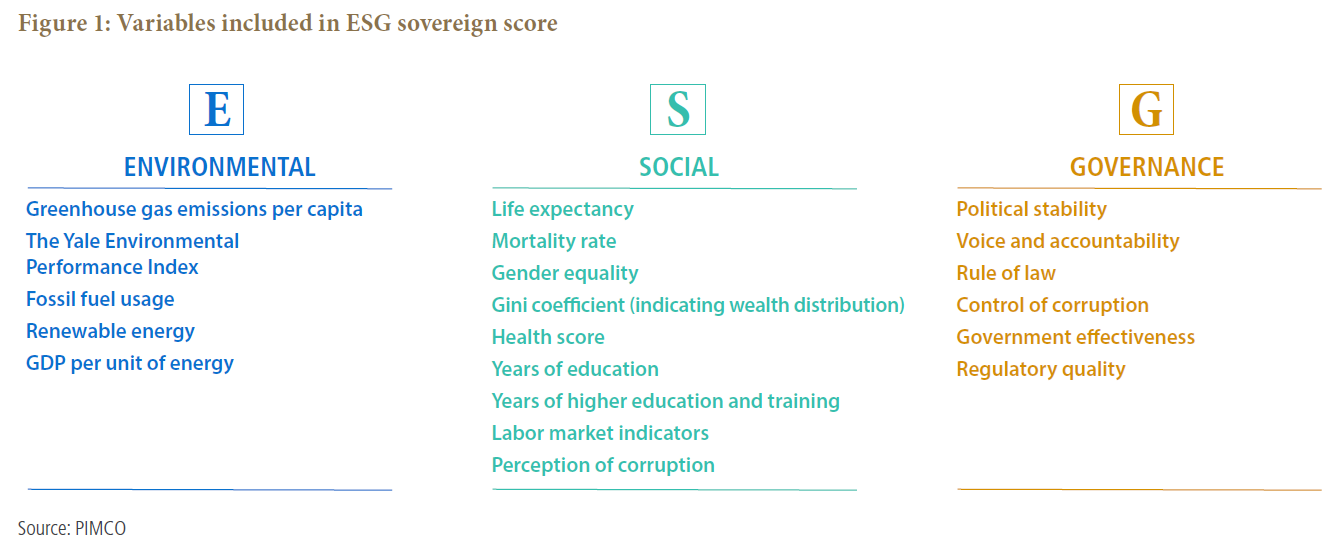
In addition to the traditional financial metrics used in sovereign credit analysis, we explicitly score the sovereign on each ESG component as shown in Figure 1.

Next, PIMCO’s proprietary sovereign ratings model assigns a credit rating to the sovereign. This uses five-year forecasts, current data and specific quantitative ESG variables from our country analysis as inputs. We benchmark every sovereign, first on quantitative factors and then by overlaying qualitative and subjective factors. These are then weighted to score each sovereign on a relative and absolute basis. The result is a sovereign credit rating for each entity reflecting our assessment of credit risk relative to the universe of developed and emerging market sovereigns, and over time (as far back as 2011).
The third component of our sovereign credit risk assessment is country-specific scenario analysis to assess both negative and positive tail risks. We analyze long-term debt sustainability, resource depletion scenarios, natural disaster scenarios, and contingency risk. In each study we incorporate medium- and long-term risks to the sovereign from both macro and ESG factors and consider any tail risk scenarios.
Challenges and areas for further growth
We believe our approach to sovereign bond analysis provides a solid foundation for credit assessment that carefully integrates ESG considerations. Still, we see challenges and areas for development.
Broad challenges include the lack of visibility of ESG risks, the long time horizon over which ESG risks should be assessed, the appropriate methodology for incorporating the qualitative aspects of ESG, and the lack of reliable and consistent data. Other key challenges include assessing ESG risks that can be latent for a long time but pose significant downside risks if triggered as well as accounting for the more indirect/diffuse impact of ESG on sovereign risk.
Importantly, the rating agencies are making their approach to ESG criteria more transparent. The three main agencies now take ESG factors into account insofar as they materially affect credit default probabilities. More broadly, the market is becoming more aware of ESG considerations: Many institutional investors are now allocating assets on the basis of ESG criteria, and new ESG data sources and products are rapidly evolving.
At PIMCO, alongside our broader initiative on ESG investing, we are actively discussing ESG and sovereign credit analysis under the guidance of the UN PRI (Principles for Responsible Investment). We are also discussing with rating agencies how to improve the analysis of ESG factors in our sovereign ratings, and continually assessing and incorporating new data on ESG to help our sovereign credit assessment effort.
© PIMCO
© PIMCO
Read more commentaries by PIMCO