The eurozone has finally joined the global growth party. With growth likely to print at 2.3% in 2017, the region has been expanding at a rate well above trend, experiencing the best sustained economic performance in the post-Lehman era. With fiscal policy modestly supportive, monetary stimulus fostering an upturn in the credit cycle, global trade faring well, and pent-up demand being released after many years of meager growth, the upturn has further to run.
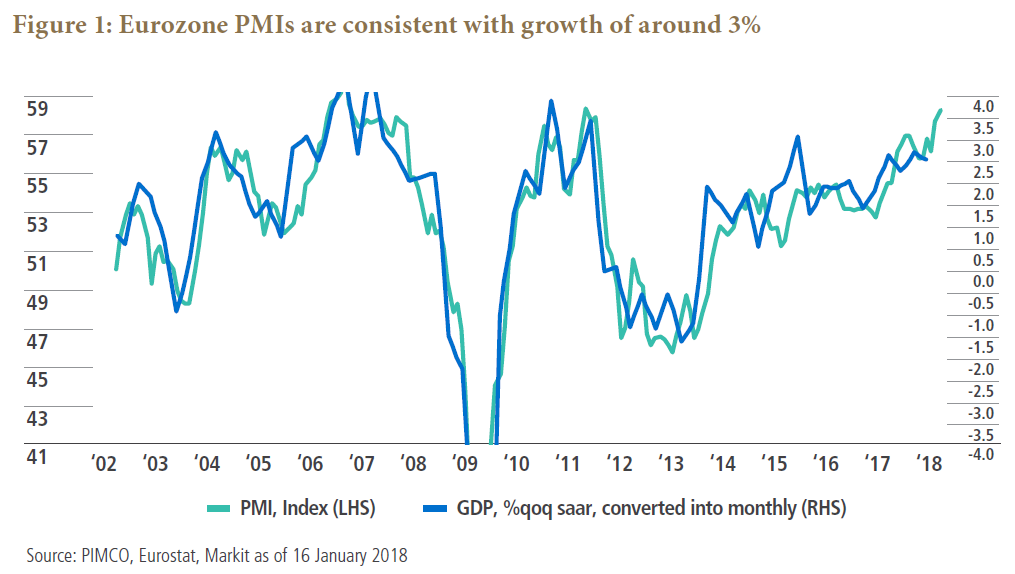
At our cyclical forum in December, we forecast real GDP growth of 2%-2.5% for the eurozone in 2018. If anything, recent data point to upside risk to this outlook. At 58.1 in December, the PMI (arguably the best contemporaneous monthly indicator of economic activity) was consistent with growth north of 3% annualized (see Figure 1). In Germany specifically, the headline IFO Institute business climate index in November and December was the highest it has been in the series’ history.

Growth is not just strong but also synchronized across countries. In addition to Germany, French, Italian and Spanish PMIs have been climbing steadily and signaling well-above-potential growth. The rising tide is lifting all boats, including smaller ones, with the Irish, Portuguese and Cypriot economies recovering briskly, and the Greek economy showing some signs of healing.
Despite the strong upturn, inflation in the region remains depressed as core inflation hovers close to 1% year over year. With its “close to but below 2%” target remaining elusive, the European Central Bank (ECB) is likely to exit its accommodative stance very slowly. ECB asset purchases will be tapered from January, and will probably stop altogether by the end of this year, but policy rates are likely to remain unchanged until around the middle of 2019. This strong stimulative stance should continue to support cyclical growth momentum in the region.
Political risk on the decline in the near term
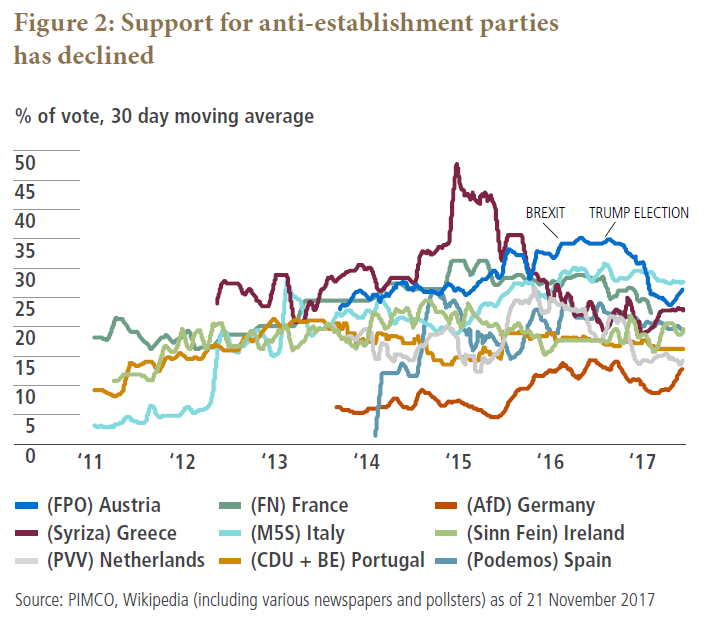
The improving economy has come alongside a reduction in political risk. The French and Dutch elections in 2017 delivered moderate governments. In Germany, coalition building talks are proving long and difficult but, even if a new election ends up being needed, this is unlikely to significantly change the political status quo. Importantly, electoral polls across the region show a general trend of stabilization or gradual decline in support for anti-establishment parties (see Figure 2), especially after Brexit and the election of President Trump in the U.S. Finally, several anti-establishment parties have been moderating their anti-European rhetoric, having witnessed Marine Le Pen’s failure to secure enough votes with this policy during the French election.
Looking ahead, the electoral calendar in Europe looks lighter. The key political event is the Italian election in March. With no single party or coalition likely to command an outright majority, the most probable outcome is a weak coalition of moderate parties. While this is far from ideal for the prospect of future reform, it avoids the risk of an anti-establishment government being elected.
As mentioned before, there may also be a repeat German election; however, this will likely deliver another CDU-led government. Finally, Greece looks set to exit its third bailout program in the summer. Whether or not it will manage a “clean exit,” meaning without extra funds from the EU/IMF, is unclear. However incentives to avoid disruptive events both in Europe and Greece currently look aligned.
Overall, political risks in the eurozone appear contained over the cyclical horizon.
So, all good for Europe’s economy? Not really
While things look good over the cyclical horizon, investors shouldn’t be complacent about the long-term outlook, as the region is still far from resolving its existential challenges. Specifically, the following features underlie continued medium-term fragility of the eurozone structure:
-
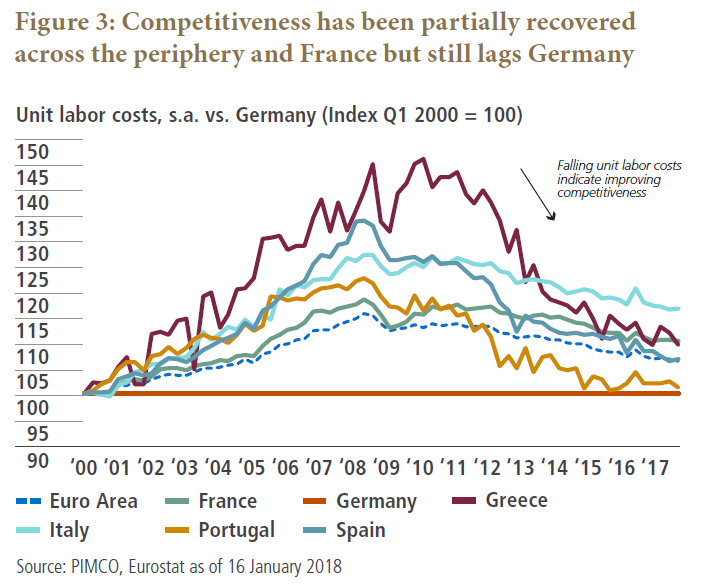
Structurally low inflation in Germany, alongside the need for several countries to disinflate and recover competitiveness vis-à-vis the region’s largest country, pose significant challenges to the public and private sector deleveraging that is necessary across the region. The ECB’s flaky commitment to its “close to but below 2%” inflation target only exacerbates this problem.
- There is no commitment to macro convergence policies in the region, especially across core countries. Macro convergence policies require reforms and expenditure containment in the periphery, alongside demand and wage-/price-boosting policies in the core. While progress has been uneven and arguably still insufficient in the periphery, there have been some steps forward through the recent crises. Efforts in the core to raise demand and prices, on the other hand, have been negligible. Germany and the Netherlands currently run current account surpluses in the order of 8% to 9% of GDP, and government budget surpluses of 0.5% to 1% of GDP, with no clear policies in place aimed at boosting internal demand vis-à-vis the rest of the region. Importantly, there continues to be a strong aversion across the population and institutions in Germany to allow inflation to trend higher.
- The absence of macro convergence could be filled by increased solidarity aimed at smoothing divergent macro dynamics and asymmetric shocks. However, while the region has set up emergency liquidity mechanisms like the European Stability Mechanism (ESM), which extends loans to stretched sovereigns, it is far from creating a meaningful budget with counter-cyclical federal spending power. What’s more, eurozone capital markets remain fragmented due to the absence of a true banking union, and in particular a common deposit insurance system.
- The lack of appropriate macro convergence policies or fiscal stabilization mechanisms has so far been filled by the ECB. By keeping rates low, and purchasing bonds of struggling eurozone countries, the ECB has acted as a de facto lender of last resort (LOLR) for sovereigns. Its policies have helped to contain interest costs for sovereigns, and allowed countries to run easier fiscal policies than they otherwise would have been able to sustain, thus helping to smooth the ongoing macro adjustment. It is clear, however, that the ECB is at best an imperfect LOLR. The central bank’s self-imposed issue and issuer limits on purchases (whereby the central bank can own up to 33% of each bond and each issuer’s outstanding stock of bonds), alongside political pressure across core countries for the ECB to reverse or at least discontinue the aggressive policies of the recent years, are clear evidence of that.
While these features of the eurozone system are not an issue right now, they will likely come to the fore when the region is next hit by an economic shock. At that point, unless progress has been made on some or all of these fronts, the integrity of the region will likely be tested again.
Don’t count on a Franco-German grand bargain
There is some hope that newly elected French President Emmanuel Macron and likely future Chancellor Angela Merkel will, over the next year or two, engineer a deal which will deliver significantly expanded integration. The contours of the deal are unclear, but hopes are that the eurozone will have increased federal fiscal capacity; that the existing liquidity provision mechanism, the ESM, will be turned into a more powerful counter-cyclical stabilization tool (with its name changed to the European Monetary Fund or EMF); and that the area will have a finance minister administering this expanded fiscal capacity.
We are skeptical that such a grand bargain is in the cards in the near term. While Macron is clearly pro-European and would like to move toward the above objectives, he seems aware of the political challenges in implementing them. His speech at the Sorbonne University in September last year was less ambitious than his pre-election rhetoric suggested, pointing to only a small common budget for eurozone spending funded through corporate receipts. President Macron’s speech also skirted altogether the issue of common eurozone bond issuance.
In Germany, meanwhile, the vision for Europe looks to be more of the same, with a German Finance Ministry paper issued in October last year viewing the to-be-formed EMF as a tool to increase sovereign supervision and monitoring, and to enforce sovereign debt restructurings as a way to enforce discipline. The willingness to accommodate Macron’s European agenda will in part depend on the composition of the new German government. But, even if the more pro-European SPD party were included in the new government, German views are likely to remain far apart from the more ambitious plans put forth by France.
In short, don’t expect big changes to the eurozone infrastructure any time soon.
Investment implications
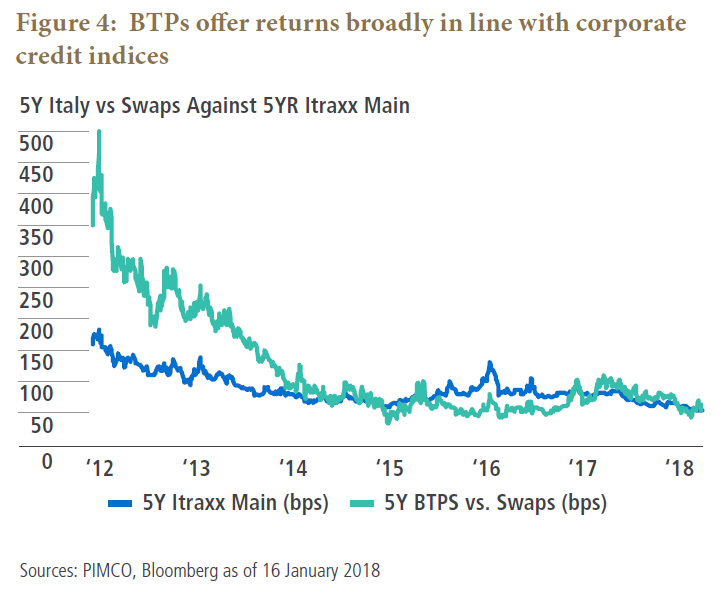
The theme of cyclical bullishness versus medium-term fragility leaves us fairly neutral on eurozone peripheral debt at this juncture. Yields on Italian BTPs (sovereign bonds) are much less attractive than they were in recent years, but still offer a decent source of carry in today’s tight valuation world. At spreads of around 85 basis points (bps) over German Bunds in 5-year maturities and 155 bps over Bunds in 10-year maturities (as of 16th January 2018), BTPs offer returns broadly in line with corporate credit indices like the iTraxx Main, which are comparable in terms of liquidity and credit quality (see Figure 4). At around 50 bps and 100 bps over Bunds in 5-year and 10-year maturities, respectively (as of 16th January 2018), Spanish Bonos offer lower returns, although this reflects in part the fact that the sovereign enjoys generally better fundamentals.
Our cyclical bullishness on the eurozone outlook suggests that we could see further compression in Italian and Spanish spreads ahead. Our long-term caution, on the other hand, dissuades us from having a clear overweight stance in these assets. What’s more, medium-term uncertainty means we place a lot of value on liquidity, leaving our preferred peripheral sovereign exposures focused on larger issuers such as Italy and Spain.
Read PIMCO’s Cyclical Outlook for 2018, “Peak Growth,” for more insights into global macroeconomics, policies, markets and the implications for investors.
DISCLOSURES
Past performance is not a guarantee or a reliable indicator of future results.
All investments contain risk and may lose value. Investing in the bond market is subject to risks, including market, interest rate, issuer, credit, inflation risk, and liquidity risk. The value of most bonds and bond strategies are impacted by changes in interest rates. Bonds and bond strategies with longer durations tend to be more sensitive and volatile than those with shorter durations; bond prices generally fall as interest rates rise, and the current low interest rate environment increases this risk. Current reductions in bond counterparty capacity may contribute to decreased market liquidity and increased price volatility. Bond investments may be worth more or less than the original cost when redeemed. Investing in foreign-denominated and/or -domiciled securities may involve heightened risk due to currency fluctuations, and economic and political risks.
There is no guarantee that these investment strategies will work under all market conditions or are suitable for all investors and each investor should evaluate their ability to invest long-term, especially during periods of downturn in the market. Investors should consult their investment professional prior to making an investment decision.
This material contains the opinions of the manager and such opinions are subject to change without notice. This material has been distributed for informational purposes only. Forecasts, estimates and certain information contained herein are based upon proprietary research and should not be considered as investment advice or a recommendation of any particular security, strategy or investment product. It is not possible to invest directly in an unmanaged index. Information contained herein has been obtained from sources believed to be reliable, but not guaranteed.
© PIMCO
© PIMCO
Read more commentaries by PIMCO