An interesting dynamic has emerged in high yield (HY) markets following the overall rally in bond yields year-to-date. On the one hand, the presumed “margin of safety” that yield provides against future defaults has declined, thereby shifting the potential distribution of future returns more to the downside. On the other hand, the rise of low- or negative-yielding fixed income assets more broadly, coupled with investors’ need for income, has created a powerful technical factor driving demand for high yield credit.
While these two opposing forces create both pitfalls and opportunities for high yield investors, they also highlight the importance of active portfolio management, rigorous credit analysis, and taking a cautious and selective approach.
O yield, where art thou?
Bond yields seem to be evaporating: Around $13 trillion of global fixed income assets (as defined by the Bloomberg Barclays Global Aggregate Index) are now trading at a negative yield, compared with $8 trillion at the beginning of 2019.
This rally in yields has helped push approximately 50% of HY bonds above their next call price, a near record high, as per September data from Goldman Sachs. HY issuers have accordingly been taking the opportunity to refinance callable debt at lower yields, with the proceeds from nearly 70% of new issue supply year-to-date earmarked for refinancing, also according to Goldman Sachs. As a result, upside potential from capital appreciation in the HY market is becoming increasingly constrained, in our view, and – absent a meaningful sell-off – future returns are likely to be a function of income/coupons. Conversely, we believe price risks are skewed to the downside – bond prices would initially suffer should there be a move higher in yields or spreads.
The importance of credit selection
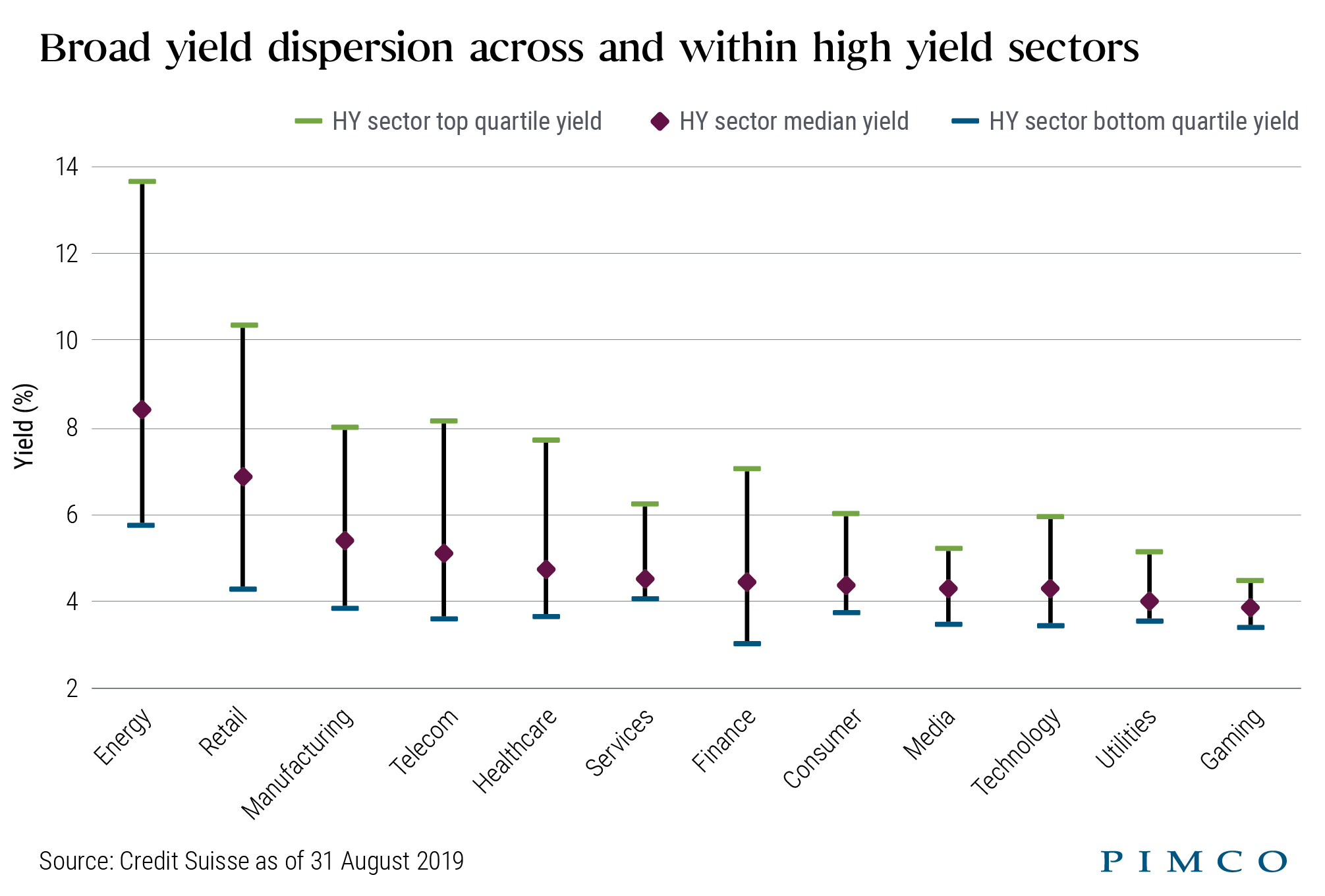
Dispersion, or differences in the credit spreads of bonds within the U.S. HY market, is currently at three-year highs, according to Deutsche Bank. As dispersion has increased, matching the yield of the index has become more challenging with higher-rated HY generally trading at yields significantly inside the index average, and at the other extreme nearly 10% of the market trading at distressed levels (as per data from ICE BAML) and with their yield unlikely to be realized.
Dispersion is also high within individual HY sectors and particularly those whose issuers span the ratings spectrum, such as energy or health care (see chart). Conversely, for sectors that largely consist of higher-quality issuers with stronger fundamentals, such as gaming, dispersion and yields are both relatively low.

In light of these dispersion trends and generally tight yields with limited margin for error, we are advocating for a cautious and selective approach in HY.
A case in point is the energy sector, the largest and worst performing sector within U.S. HY this year through 31 August, and which has accounted for over 40% of U.S. HY defaults this year (according to Credit Suisse). Despite this, the dispersion of returns across different energy subsectors has been significant, with refining and midstream/distribution actually outperforming the broader U.S. HY market, and conversely exploration/production and equipment/services delivering negative total returns (as per ICE BAML indices data).
This highlights the importance of careful positioning in high yield. We believe passive HY investors in particular should exercise caution and be aware that they are fully exposed to all issuers in the index and the downside risks.
Yet while we see clear areas of stress, fundamentals remain robust for many HY issuers. At the other end of the HY spectrum (and despite the attention on fallen angels – i.e., bonds that have been downgraded from investment grade to high yield), overall ratings migration in 2019 has been in the opposite direction, with approximately 4% of the ICE BAML U.S. HY index either moving up to investment grade or being redeemed following acquisition by investment grade issuers. Meanwhile, just under 1% has been downgraded from investment grade to HY (as per BAML data). These ratings transitions are typically accompanied by meaningful changes in price, thus identifying potential rising stars (i.e., high yield bonds that are upgraded to investment grade) in advance can be an important source of return potential for HY investors, alongside avoiding defaults.
Investment takeaways
With yield increasingly scarce in global bond markets, HY may offer investors a potentially attractive level of income. However, the return asymmetry associated with HY bonds trading above their call price, along with high dispersion and idiosyncratic risks, highlights the increasing importance of credit and sector selection.
At PIMCO we believe that while there remain attractive opportunities within HY in defensive, noncyclical sectors with stable cash flows, we seek to avoid exposure to generic HY credit beta and specifically issuers in cyclical industries with secular headwinds.
Sonali Pier is a portfolio manager focusing on high yield and multi-sector credit. Matthew Livas is a credit strategist.
DISCLOSURES
Past performance is not a guarantee or a reliable indicator of future results.
All investments contain risk and may lose value. High yield, lower-rated securities involve greater risk than higher-rated securities; portfolios that invest in them may be subject to greater levels of credit and liquidity risk than portfolios that do not. Investing in the bond market is subject to risks, including market, interest rate, issuer, credit, inflation risk, and liquidity risk. The value of most bonds and bond strategies are impacted by changes in interest rates. Bonds and bond strategies with longer durations tend to be more sensitive and volatile than those with shorter durations; bond prices generally fall as interest rates rise, and low interest rate environments increase this risk. Reductions in bond counterparty capacity may contribute to decreased market liquidity and increased price volatility. Bond investments may be worth more or less than the original cost when redeemed. Equities may decline in value due to both real and perceived general market, economic and industry conditions. Management risk is the risk that the investment techniques and risk analyses applied will not produce the desired results, and that certain policies or developments may affect the investment techniques available in connection with managing the strategy.
Statements concerning financial market trends or portfolio strategies are based on current market conditions, which will fluctuate. There is no guarantee that these investment strategies will work under all market conditions or are suitable for all investors and each investor should evaluate their ability to invest for the long term, especially during periods of downturn in the market. Outlook and strategies are subject to change without notice. No representation is being made that any account, product, or strategy will or is likely to achieve profits, losses, or results similar to those shown. Index data is shown for informational purposes only. It is not possible to invest directly in an unmanaged index. Investors should consult their investment professional prior to making an investment decision.
© PIMCO
© PIMCO
Read more commentaries by PIMCO