November 2019
 Image Pop Up
Month in review
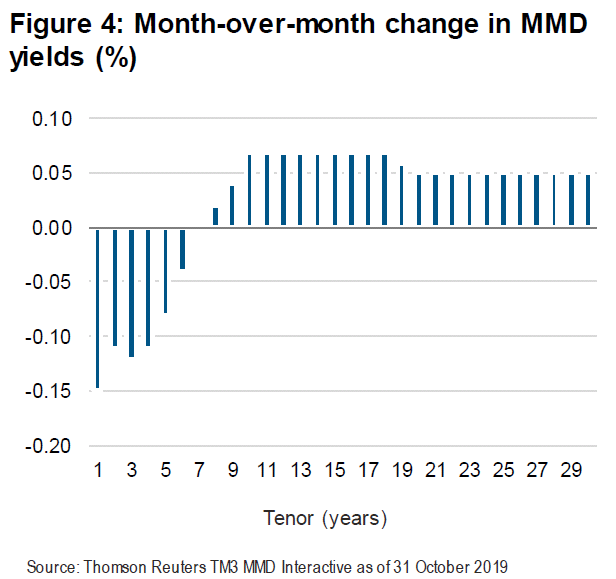
Monthly municipal bond issuance in October exceeded $52 billion, marking the largest such figure since December 2017. The AAA municipal yield curve experienced an observable steepener over the month, with yields inside of seven years falling by as much as 15 basis points (bps) and yields beyond seven years rising by up to 7 bps.1
- On October 30, the Federal Reserve cut interest rates by a quarter point for the third time this year as part of its efforts to sustain the economic expansion despite U.S.-China trade tensions. Chair Jerome Powell signaled a change in the Fed’s rate-setting policy in his address following the latest Fed meeting, implying a likely refrain from further cuts unless its economic outlook deteriorates sharply.2
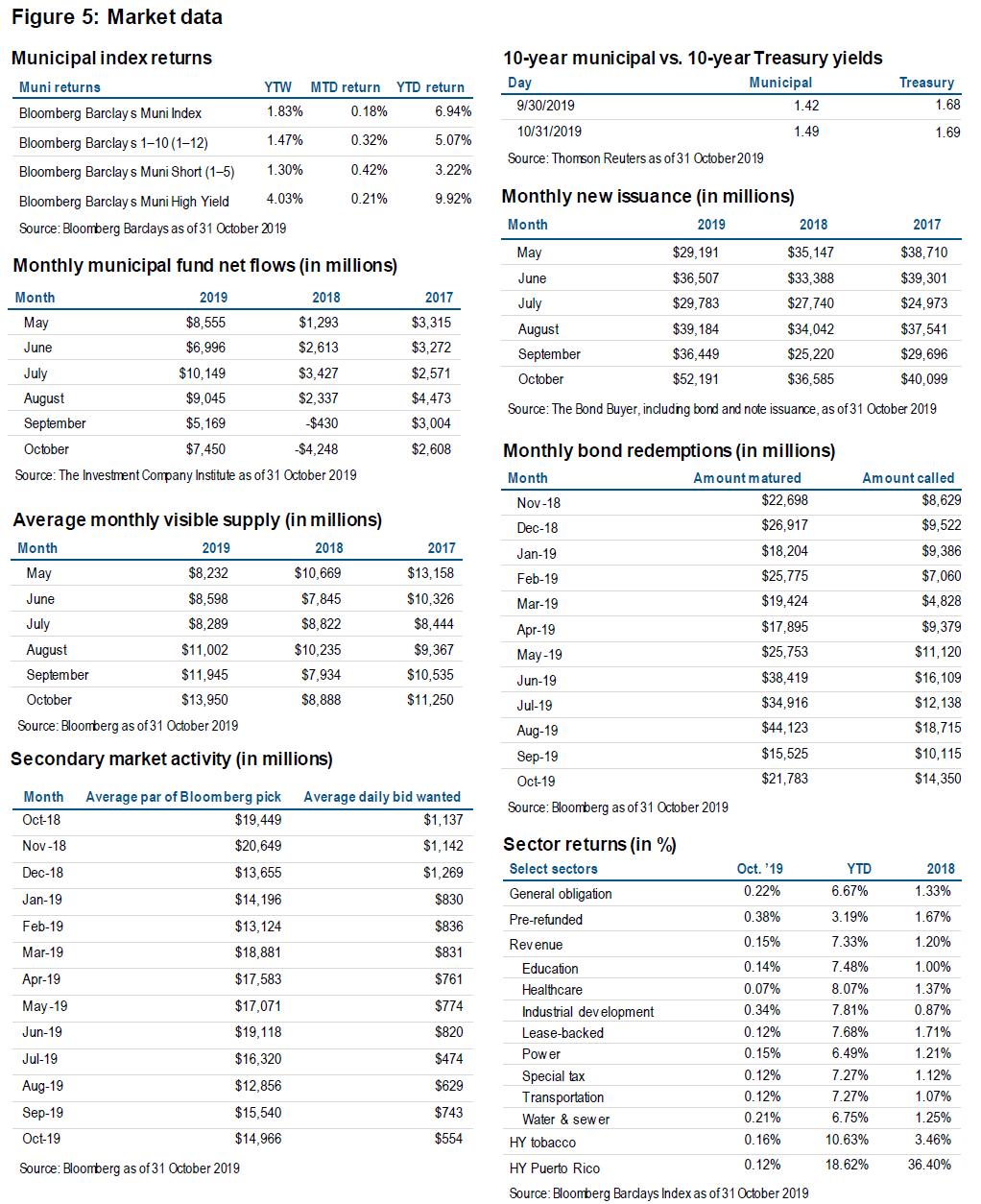
- The Bloomberg Barclays Municipal Bond and Bloomberg Barclays Municipal Bond High Yield indices returned 0.18% and 0.21% in October, respectively, flipping returns positive again after the calendar year’s first month of negative returns in September.3
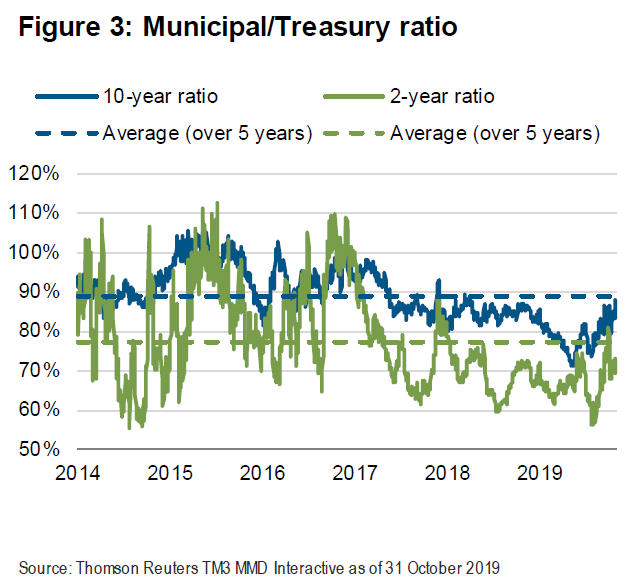
- Muni/Treasury ratios remained relatively stable across the curve in October. The two-year ratio moved from 75% to 73%, while the 10-year ratio moved from 85% to 88%.4
- October’s primary market issuance of $52.2 billion, including $13.7 billion in taxable municipal issuance, represented a 43.2% increase from September 2019 and a 42.7% increase compared to October 2018.5, 6
- Secondary market trade volume increased slightly in October, with par traded totaling $243 billion and the quantity of trades totaling 693,000. These figures are up 7.7% and 10.0% from September and down 11.7% and 0.6% year-over-year over the same time frame last year, respectively.7
Muni credits in focus: California wildfire risks
Image Pop Up
The Bloomberg Barclays Municipal Bond Index delivered a modest gain of 0.18% in October, as slightly higher rates on the intermediate to long portion of the curve acted as a headwind for performance.8 October marked the 11th straight month of net inflows into municipal mutual funds, as average inflows reached $1.86 billion per week.9 The rally in municipal bond supply, which took hold in August, gained momentum in October, with more than $52 billion in total new issuance.10 Continuing the trend we noted last month, taxable municipal issuance surged to $13.7 billion, nearly six times the volume issued in October 2018.11
Though the state of California enjoyed an upgrade from Moody’s Investors Service to Aa2 at mid-month, headlines were dominated by wildfires, mandatory evacuations, and power outages.12 Ultimately, approximately 700,000 California homes and businesses were left without power as a result of precautionary blackouts, costing the state $400 million–$600 million in lost economic output, as estimated by Moody’s Investors Service.13 With figures such as these in investors’ minds, we felt it was an opportune moment to address wildfire risk in the muni market more broadly.
Historically, exceedingly few cases of municipal obligors defaulting on debt have been solely attributable to natural disasters. Furthermore, cases that do exist were typically isolated to extremely small, unrated municipalities that were already distressed at the time of the disaster. In spite of this historical record, and recognizing that the future does not always mirror the past, wildfire risk is incorporated as a key component of our risk analysis, given the rapid increase in frequency and severity of wildfires in recent years.
As such, we look to gauge not only municipal exposure to wildfire risk, but perhaps even more importantly, whether local tax bases and economies are sufficiently deep and resilient to be able to withstand and recover from natural disasters. For example, a geographically desirable city, such as Malibu, California – which has strong credit factors and occupies prime oceanfront property – will likely show relative resilience after severe wildfires, with residents more willing and able to return to rebuild.14
Image Pop Up
1 Thomson Reuters TM3 MMD Interactive Data. Bond Buyer: Primary Market Statistics – A Decade of Bond Finance, 31 October 2019
2 Nick Timiraos, “Fed Cuts Rate for Third Time This Year, Signals Pause,” Wall Street Journal, 30 October 2019
3 Bloomberg Barclays, 31 October 2019
4 Thomson Reuters TM3 MMD Interactive Data, 31 October 2019
5 Bond Buyer: Primary Market Statistics – A Decade of Bond Finance, 31 October 2019
6 Bond Buyer: Long-Term Bond Sales, 31 October 2019
7 Bond Buyer: Secondary Market Statistics, 31 October 2019
8 Bloomberg Barclays, 31 October 2019
9 Investment Company Institute, 31 October 2019
10 Aaron Weitzman, “Muni volume hit $52B in October — the most in 22 months — thanks to taxables,” The Bond Buyer, 31 October 2019
11 Ibid.
12 Romy Varghese, “Bloomberg Brief: Muni, California Gets Moody’s Lift to Aa2,” Bloomberg, 15 October 2019
13 Bloomberg Brief: Muni, Bloomberg, 30 October 2019
14 Noah Buhayar and Anousha Sakoui, “Californians Expected to Rebuild Burnt Homes Despite Continued Fire Risk,” Bloomberg, 14 November 2018
DISCLOSURES
A word about risk: Investing in the bond market is subject to risks, including market, interest rate, issuer, credit, inflation risk, and liquidity risk. The value of most bonds and bond strategies are impacted by changes in interest rates. Bonds and bond strategies with longer durations tend to be more sensitive and volatile than those with shorter durations; bond prices generally fall as interest rates rise, and low interest rate environments increase this risk. Reductions in bond counterparty capacity may contribute to decreased market liquidity and increased price volatility. Bond investments may be worth more or less than the original cost when redeemed. Income from municipal bonds is exempt from federal income tax and may be subject to state and local taxes and at times the alternative minimum tax; a strategy concentrating in a single or limited number of states is subject to greater risk of adverse economic conditions and regulatory changes.
Statements concerning financial market trends or portfolio strategies are based on current market conditions, which will fluctuate. There is no guarantee that these investment strategies will work under all market conditions or are suitable for all investors and each investor should evaluate their ability to invest for the long term, especially during periods of downturn in the market. Outlook and strategies are subject to change without notice.
Forecasts, estimates and certain information contained herein are based upon proprietary research and should not be interpreted as investment advice, as an offer or solicitation, nor as the purchase or sale of any financial instrument. Forecasts and estimates have certain inherent limitations, and unlike an actual performance record, do not reflect actual trading, liquidity constraints, fees, and/or other costs. In addition, references to future results should not be construed as an estimate or promise of results that a client portfolio may achieve.
PIMCO does not provide legal or tax advice. Please consult your tax and/or legal counsel for specific tax or legal questions and concerns. The discussion herein is general in nature and is provided for informational purposes only. There is no guarantee as to its accuracy or completeness. Any tax statements contained herein are not intended or written to be used, and cannot be relied upon or used for the purpose of avoiding penalties imposed by the Internal Revenue Service or state and local tax authorities. Individuals should consult their own legal and tax counsel as to matters discussed herein and before entering into any estate planning, trust, investment, retirement, or insurance arrangement.
This material contains the opinions of the manager and such opinions are subject to change without notice. This material has been distributed for informational purposes only and should not be considered as investment advice or a recommendation of any particular security, strategy or investment product. It is not possible to invest directly in an unmanaged index. Information contained herein has been obtained from sources believed to be reliable, but not guaranteed. No part of this material may be reproduced in any form, or referred to in any other publication, without express written permission. PIMCO is a trademark of Allianz Asset Management of America L.P. in the United States and throughout the world.
©2019, PIMCO
© PIMCO
Read more commentaries by PIMCO
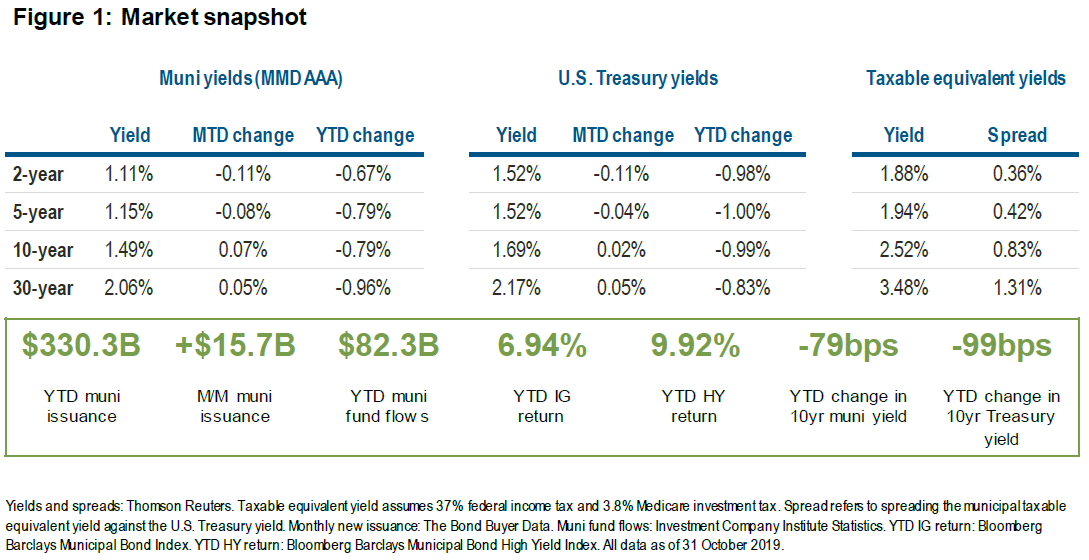 Image Pop Up
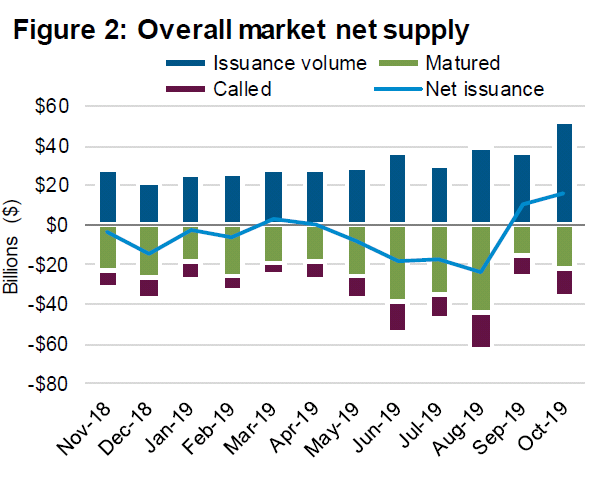 Image Pop Up