SUMMARY
- Facing serious demands on their time, many financial advisors are turning to model portfolios for help with portfolio construction.
- Although this approach represents a change to many advisors’ business models, we think it can offer three substantial benefits: time savings, more predictable outcomes, and protection against cognitive biases.
- In the past, model portfolios were an all-or-nothing proposition, but today advisors have more flexibility to reap the potential benefits of models and still retain the level of discretion that’s most appropriate for their individual practice.
- PIMCO offers a range of actively managed model suites, including fixed income models designed to address a variety of investor objectives and multi-asset models across the risk spectrum.
Financial advisors are facing serious demands on their time. They need to provide a broader set of services to a diverse clientele, build new client relationships to grow their business, and handle complex operational and practice-management issues on a moment’s notice. On top of these challenges, advisors must grapple with portfolio construction amid volatile late-cycle markets, full valuations across many major asset classes, and historically low interest rates.
Many advisors have turned to model portfolios for help. In fact, Cerulli estimates that nearly half of all advisors now utilize professionally managed models in some capacity, and up to 90% may incorporate models in the coming years.
Going forward, learning when it makes sense to outsource portfolio construction will be critical for financial advisors to deliver the best potential solutions for investors and free up resources so that they can provide even more value to their clients.
The benefits of model portfolios
Professionally managed models have been around for decades, but adoption has grown significantly in recent years. According to Cerulli, models now play a role in the management of $6.5 trillion in wealth management assets and have the potential to ultimately influence up to $11 trillion as advisors weigh the costs of managing portfolio construction themselves against the potential benefits of utilizing home office and third-party models. At PIMCO, we understand that this approach represents a change to many advisors’ business models, but ultimately we think it can offer three substantial benefits:
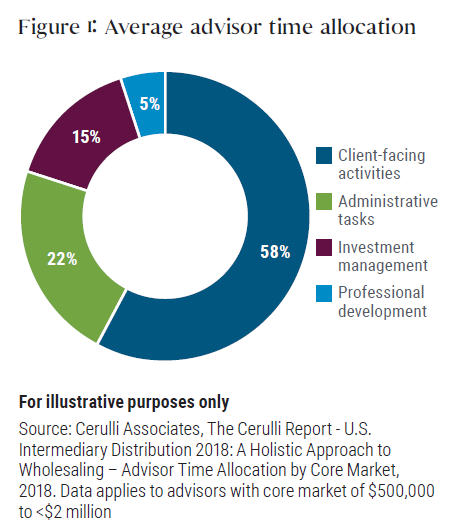
Time savings. Many financial advisors spend considerable time on portfolio construction: On average, investment management responsibilities comprise 15% of the average advisor’s time (see Figure 1), which translates to 300−400 hours over the course of a full calendar year. With time becoming an increasingly scarce commodity for advisors, models offer a compelling solution that frees up valuable capacity to deepen existing client relationships, source new clients, and build additional value-added capabilities to offer clients.

-
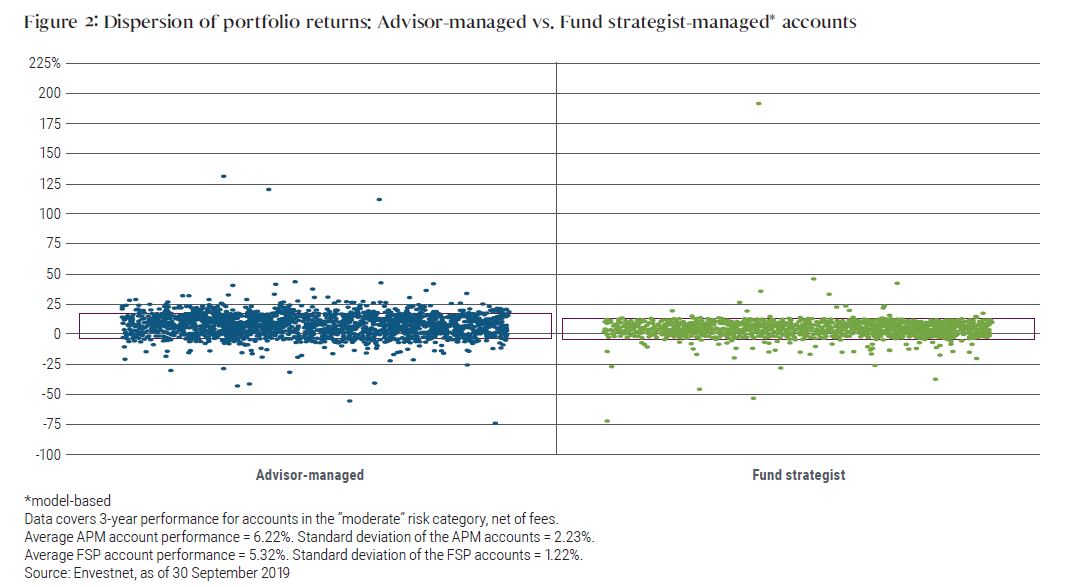
More predictable outcomes. One of the greatest risks to a financial advisor’s practice is unexpected portfolio outcomes. Utilizing model portfolios can potentially increase the predictability of outcomes. Figure 2 compares portfolio returns of advisor-managed accounts to those of model-based accounts: With considerably more data points closer to the central line, the model-based accounts demonstrated roughly half the return dispersion of the advisor-managed accounts.
Image Pop Up
Importantly, the data does not imply superior performance from model-based accounts, but rather suggests that using models can help increase the likelihood of predictable outcomes, mitigate the risk of unpleasant surprises, and potentially lead to a smoother ride for the advisor and the client.
-
Protection against cognitive biases – Virtually all investors bring a myriad of cognitive and emotional biases to their investment decisions. These embedded biases can be difficult to self-diagnose, and even more challenging to account for before an irreversible suboptimal investing decision is made.
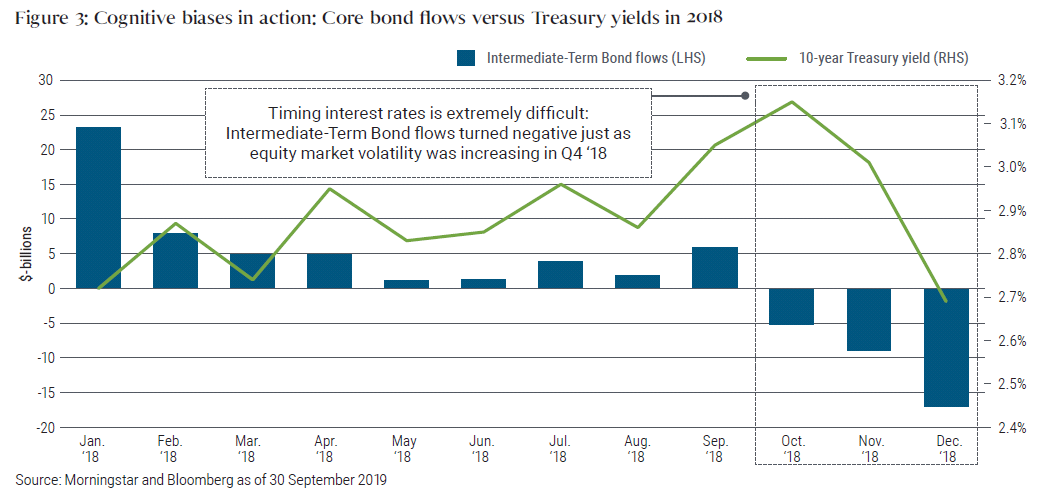
Figure 3, which examines monthly asset flows into intermediate-term bond funds relative to the 10-year U.S. Treasury yield in 2018, provides a useful recent example of these biases in action and their potential impact. Through the first nine months of 2018, flows into the high quality (core) bond category were positive as Treasury yields largely remained range-bound. However, investor sentiment changed rapidly when Treasury yields increased in October and many market participants suddenly worried that the Fed was falling behind the curve on inflation. Whether the sentiment stemmed from confirmation bias (as investors thought that recent upticks in yields were a signal of the rising rate environment they’d long been waiting for) or the bandwagon effect (as investors saw their peers running for the hills), the result was clear: Investors fled from high quality bonds in the fourth quarter last year − as stock market volatility increased and bond prices rose. That left many without sufficient diversification away from the equity market.
Image Pop Up
Models offer a way to potentially reduce the impact of biases. By entrusting portfolio construction or guidance to a professional asset manager, advisors can help clients keep emotions in check, separate signals from noise, and maintain a disciplined, long-term approach to managing for specific outcomes and maximizing future return potential.
Where do models fit in?
For many years, model portfolios were essentially an all-or-nothing proposition: Advisors either outsourced investment selection altogether or built their own portfolios using individual securities, mutual funds, and exchange-traded funds (ETFs). Now, advisors have more flexibility to reap the potential benefits of models while still retaining the level of discretion that’s most appropriate for their individual practice.
-
Option 1: Full outsourcing – For advisors who want to focus on providing holistic financial planning services to existing clients and prospecting for new relationships, fully outsourcing to model providers is a valuable option that can potentially generate time savings upwards of 300 hours per year. That said, many advisors have long-standing client relationships that were built primarily on investment selection and asset allocation advice, so a full-scale immediate shift in operating model can be a big leap for both the advisor and the client.
-
Option 2: “Unbundle” the traditional model portfolio – For advisors looking to free up capacity but still retain some portfolio construction engagement, unified managed account (UMA) platforms and expanded product offerings now allow for a hybrid, building-block approach. Rather than choosing one portfolio model provider, advisors can now select a few asset management partners to oversee different sleeves of their client portfolios. At PIMCO, we see this hybrid, unbundling option as a great middle ground for advisors. It offers substantial time savings and allows for more flexible implementation of client preferences (level of active management, fees, etc.); but it is a less drastic change than Option 1 and keeps advisors more entrenched in clients’ holistic financial plans.
-
Option 3: In-source decision-making, leverage guidance – Rather than simply listing all the potential ingredients, model portfolios now detail the asset manager’s suggested recipe. So even for advisors that retain full control over portfolio construction, asset manager models can offer value as an additional input in the decision-making process, providing guidance on the number of line items and position-sizing in certain strategies across client objectives.
At PIMCO, we recognize the challenges that advisors face, and we are excited to offer a range of actively managed model suites, including:
- Fixed income models that are designed to address a variety of investor objectives, including capital preservation, equity diversification, and income generation
- Multi-asset models across the risk spectrum, including income-focused strategies designed for clients nearing or in retirement
© PIMCO
© PIMCO
Read more commentaries by PIMCO