Estate planning can be overwhelming when you sit down to write your will or setup a revocable trust. This is why for many and it’s a perpetual “get to it later” topic. However, it doesn’t need to be something to worry about later, and more importantly, putting it off for too long can cause unnecessary headaches for your beneficiaries. The good news? Getting your estate plan in order, even if just the basics, isn’t difficult. With just a bit of guidance, you can put together a clear plan that ensures your wishes are respected, your family is protected, and your legacy endures.
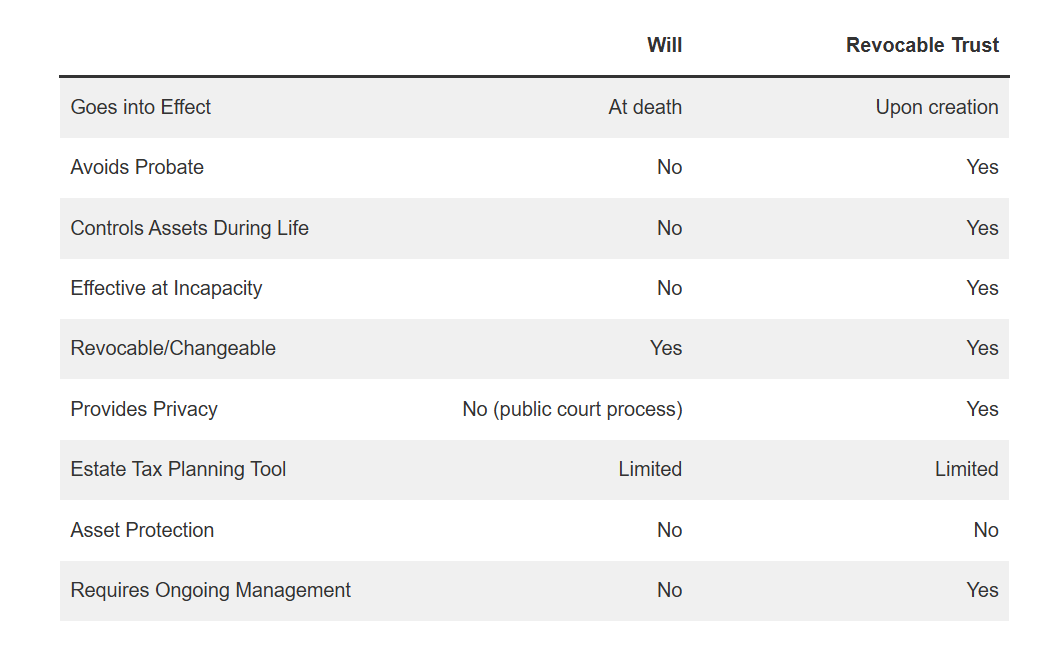
Two of the most common estate planning tools to utilize are a Will and a Revocable Trust. Both essentially perform the same purpose, ensuring your wishes are fulfilled, but they do so in different ways. Understanding their differences can save your family from unnecessary probate, costs, and stress.
Let’s break it down.
What Is a Will?
A Will is a legal document that specifies how your assets should be distributed upon your death. In your Will, you name an executor who carries out your instructions. You can also appoint guardians for minor children. However, it’s important to remember that after you pass a Will becomes a public record and may require probate – a court-supervised process that validates your Will and oversees asset distribution.
Key benefit: A Will is one of the simplest estate planning measures to implement that will cover all your assets.
Key fact: A Will only goes into effect after your death and typically requires probate.
What Is a Revocable Trust?
A Revocable Trust, often called a “living trust,” is a legal entity created while you’re alive. You transfer assets into the trust, maintain control over them, and appoint a successor trustee to manage these assets upon your incapacity or death.
Key benefit: A Revocable Trust bypasses probate, maintaining your family’s privacy and reducing administrative hassles. It can also protect your assets during incapacity.
Key fact: A Revocable Trust is effective while you are alive, which means assets you move into the Trust are placed in name of the Trust.
Understanding Irrevocable Trusts
Unlike a Revocable Trust, an Irrevocable Trust generally can’t be changed or revoked after creation. Why choose this option?
The answer lies in asset protection, significant estate tax reduction, and the ability to enhance multigenerational wealth preservation. These trusts are particularly beneficial for high-net-worth individuals, business owners, and those with substantial estates.
Why Not Just Use a Will?
For many individuals, particularly those with straightforward estates and beneficiaries, a Will might suffice. But for families with more complex situations, like blended families, properties in multiple states, or those valuing privacy, a Revocable Trust offers distinct advantages, particularly avoiding probate. In addition, the benefit of avoiding probate is twofold – it typically expediates the passing of assets to beneficiaries and can save you the cost of opening a probate estate (which requires attorney fees and court filing fees).
However, neither tool alone covers every scenario effectively.
That’s why at Defiant Capital Group, we typically recommend a holistic approach that combines a Will, one or more Trusts, precise asset titling, and updated beneficiary designations.
Exhibit: Comparing Wills, Revocable Trusts, and Irrevocable Trusts
Summary: An Estate Plan Grows with You
Estate planning can be overwhelming, but the good news is that you don’t need all the answers today. Overtime your estate plan will change and adapt to your life situations. But it’s important you take the first steps and start before it’s too late. A simple Will is a meaningful first step, while a Revocable Trust is often a valuable next step that smooths asset transitions and provides your family with privacy. Ultimately, the best estate plans blend multiple tools tailored specifically to your life’s evolving circumstances and goals.
At Defiant Capital Group, we assist founders, entrepreneurs, and business owners in crafting personalized estate strategies that grow with their wealth and family.
Because wealth is only meaningful if it lasts.
Four Frequently Asked Questions
1. Is a Will or Trust better for avoiding probate?
A Revocable Trust is significantly better for avoiding probate, as assets within the trust bypass court processes. A Will always requires probate.
2. Do I need both a Will and a Trust?
Often, yes. A Will manages assets outside of a trust and can appoint guardians for minors, whereas a Trust primarily handles asset management and probate avoidance.
3. What happens if I become incapacitated and only have a Will?
A Will doesn’t provide for incapacity. Without a Trust or a Power of Attorney, your family may face court proceedings to manage your financial matters.
4. Can I update or cancel my Revocable Trust?
Yes, you can amend or revoke a Revocable Trust anytime during your lifetime, provided you are mentally capable.
A message from Advisor Perspectives and VettaFi: To learn more about this and other topics, check out some of our webcasts.