The early days of the Trump administration have brought sweeping tariff announcements. While the situation is fluid, the direction is clear: trade restrictions are likely to increase, with China as a primary target. Although there is still significant uncertainty, we think there’s enough information to soften the global outlook significantly.
Trade Barriers Dampen Growth
Free trade boosts growth; restricting trade slows it. We need only look back to the 2018 trade war for evidence: the global economy downshifted in 2018 and 2019 in the wake of increased trade restrictions.
The near-term impact on growth comes via multiple channels:
- Tariffs raise the price of imported goods, reducing consumer purchasing power. Even before tariffs took effect, US consumer expectations of short-term inflation rose, and consumer expectations of the economy deteriorated.
- Trade policy uncertainty affects business decisions. In the absence of clear policy, firms are reluctant to invest in future production. How can a business decide on investments without knowing how trade restrictions might impact a given project?
- Financial markets have to wrestle with a less efficient growth environment—one in which growth may slow even as prices rise. Normally, when growth slows, markets expect central banks to intervene to support growth. But if price pressures prove persistent or inflation expectations rise, central banks may be less able to lend a helping hand in a deglobalizing world.
Trade Tensions Heighten Geopolitical Risks
Over the longer term, increased trade tensions raise even greater risks.
Ongoing trade tensions reflect the deglobalization trend we’ve discussed over the past several years. Deglobalization raises not only economic risks but also geopolitical ones. Trading partners have strong incentives to maintain stable diplomatic relationships to protect their mutual economic interests. Without shared interests in strong relations, global competition could become more pernicious.
Even if severe outcomes are avoided, countries may find themselves having to choose sides between the US and China, potentially accelerating deglobalization further.
To be clear, we believe we are far from the most severe outcomes. Our base case is that trade tensions remain more tension than conflict, and that restrictions slow but don’t stop the global economy. However, as tensions rise, there will likely be consequences, particularly for China.
China’s Trade Dynamics Are Shifting
The US and countries siding with it will likely raise trade barriers to Chinese goods to protect domestic jobs, to address trade deficits or for national security reasons. But unlike in 2018, China today is less reliant on the US and less vulnerable to economic disruptions from trade wars.
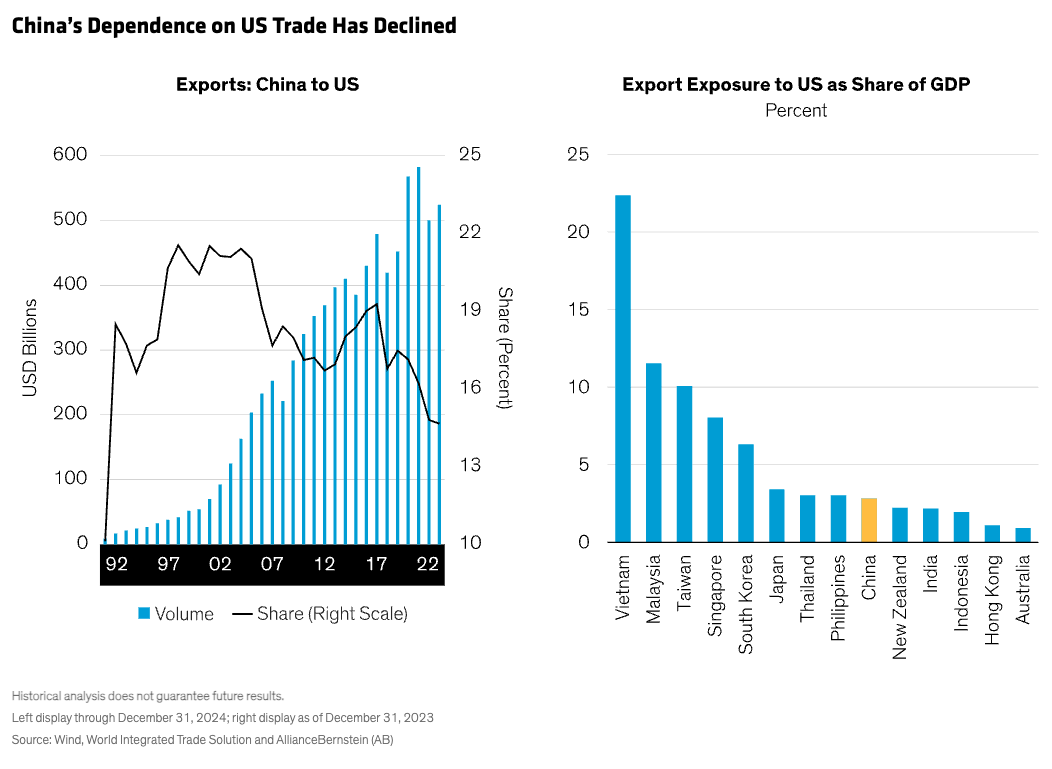
China holds an even higher share of global manufacturing than it did in 2018, accounting for 32% of the world’s total.* Since 2018, China’s exports to the US as a percentage of its total exports has fallen from nearly 20% to less than 15% (Display, left), and exports to the US now contribute only 3% to China’s GDP (Display, right).

And, while some Chinese goods are being rerouted and still end up in the US, the nature of China’s exports is changing. Products like mobile phones, electric vehicles and 5G equipment, which are not sold in the US, now make up a substantial share of China’s exports.
These shifts in China’s trade dynamics indicate a strategic adjustment to global trade tensions.
Picking Sides: A Double-Edged Sword
The critical question is what happens when trading partners are compelled to take sides, risking their bilateral trade agreements with the US. Recently, we have seen Mexico and South Korea indicate their intention to curb China’s backdoor entry for exports before entering trade negotiations with the US.
This complicates the identification of goods meant for re-export versus those intended for local demand. Countries might simply decide to deny all Chinese goods, which in our view would significantly impede Chinese growth. In this case, we would need to assess the impact of each country’s decision to reduce trade with China.
However, choosing sides in this way is a double-edged sword. Countries that have benefited from acting as intermediaries in the rerouting of Chinese goods would also suffer unless they can achieve full localization, including the transfer of intellectual property and increased local content. Asian countries that will need to make decisions include Vietnam, Malaysia, Singapore and South Korea.
Given its manufacturing capabilities, China’s economy is heavily reliant on exports. Yet China currently accounts for only 12% of global consumption. Unless China can significantly increase its share of global consumption to absorb its manufacturing output, it will need to persuade trading partners to maintain their trade relationship.
This is particularly relevant for countries in the southern hemisphere, where China’s trade surplus has grown the most in recent years. Nearly 50% of China’s US$1 trillion trade surplus is with countries in the global south, with US$200 billion of that increase occurring in the past three years alone.
Not all this increased trade with the global south is due to rerouting. Chinese companies have been proactively exploring new markets and seeking new demand for their products to mitigate the impact of trade barriers and diversify their export destinations.
Shaking Up the World Economy
Under deglobalization, trading relationships and even economic cycles are becoming increasingly disconnected and isolated. A less harmonized global regime, in which economic cycles vary more significantly across regions than they have in decades, suggests to us a less efficient world economy. Further, the trade-off between growth and inflation may become less favorable as trade wars progress. More inflation relative to growth would be unwelcome to central bankers and investors alike.
In our view, companies will need to carefully consider which markets to focus on, as well as decide on the technology, supply chains and materials they will use. Fractious trading relationships, brittle global supply chains, volatile inflation and growth dynamics, and potentially divergent monetary policy paths will likely complicate corporate investment decisions. In this environment, we expect companies to find targeting a global audience challenging.
Seeking a New Equilibrium
While the direction seems clear, the speed and magnitude of the journey are uncertain. Encouraging signs of technological innovation may offset some damage caused by trade wars. Policymakers currently pursuing trade wars may eventually conclude that the damage is too severe to continue, leading to greater stability over time. And we should not underestimate the resilience of the private sector and its ability to find solutions to new problems.
Though the near-term outlook appears challenging, we urge investors to maintain perspective. Deglobalization and trade tensions are not good for the global economy, but they need not be catastrophic. After more than 20 years of deepening ties, it may be inevitable that the world moves in the other direction for a time.
While periods of friction may be tough for the world economy and uncomfortable for investors, we believe that a new equilibrium will eventually be found.
*According to the World Trade Organization and the Center for Strategic & International Studies.
The views expressed herein do not constitute research, investment advice or trade recommendations, and do not necessarily represent the views of all AB portfolio-management teams and are subject to change over time.
A message from Advisor Perspectives and VettaFi: To learn more about this and other topics, check out some of our webcasts.
© AllianceBernstein
Read more commentaries by AllianceBernstein