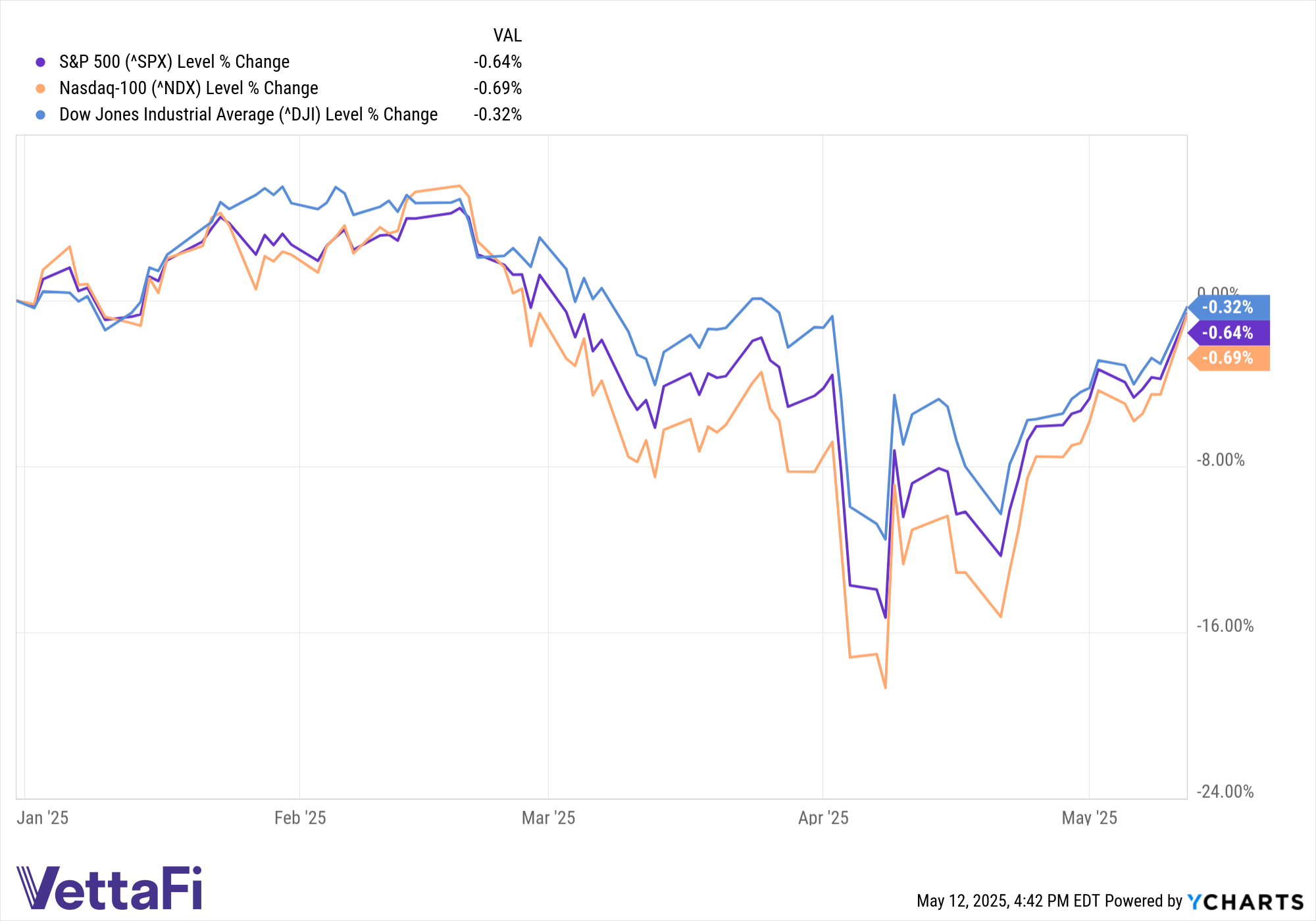
Major U.S. equity benchmarks made significant gains on Monday on tariff and de-escalation hopes in the trade war with China. While equities are on their way to recovering January 1 levels, enhanced volatility lends itself to actively managed strategies this year.
The announcement of a temporary pull-back of extreme tariffs between the U.S. and China sent U.S. stocks soaring on Monday. As of mid-afternoon trading, the Nasdaq Composite climbed 4.53%, hitting bull market territory from April lows. Meanwhile, the S&P 500 notched a gain of 3.26% and the Dow Jones Industrial climbed 1,100 points, according to WSJ data. The major indexes currently trend near their January 1 levels.

The deal rolled back the 145% tariff on Chinese goods to 30%, with a 90-day pause to negotiate. The 30% tariff includes 10% blanket tariffs and an additional 20% tariff related to fentanyl. In return, China cut its reciprocal tariffs on U.S. goods from 125% to 10%.
The pause gives times for further negotiations, with positive posturing from both sides on Monday. Should the U.S. and China reach a concrete, favorable agreement, it could alleviate pressure on many U.S. companies. China is a central hub for manufacturing and a supplier of goods to the U.S. across most industries. Ratcheting trade war costs resulted in sharp declines in shipping from China in April. The pause could see a resumption of trade, to a degree. 30% tariffs will still prove a significant hurdle for many companies, who will then pass on those costs to U.S. consumers.
However, the transient nature of U.S. tariff levels, rising and falling in rapid succession on the changing whims of the current administration, creates heightened risk. Equity outlooks remain muddled, with much still uncertain. It’s the type of environment that favors actively managed strategies.
Active Strategies Well-Positioned for Tumultuous Markets
Active strategies offer a number of potential benefits, particularly this year. For advisors and investors, it means passing off the time and attention that remaining responsive in 2025 markets requires. By choosing an active strategy, investors can rely on the fund manager to do the necessary research and keep up with the latest market updates. This frees up time for advisors to instead spend on client-facing tasks, and for investors it may help alleviate the stress of navigating market turbulence.
Additionally, actively managed strategies generally provide greater responsiveness to changing market regimes than passive peers. As outlooks evolve, or new economic data/policy is announced, these strategies can fine tune their portfolios. The portfolios of passive strategies maintain their exposures until the next rebalance, regardless of macro changes.
Finally, and arguably most importantly, active strategies rely on fundamental research when constructing portfolios. This means that active managers select those securities they believe will perform well and that align with the strategy. Of even greater importance, they’re able to exclude the laggards and poor performers. This means that, in a volatile and evolving market environment, these strategies can minimize the drag that passive strategies capture. It creates a foundation for potential outperformance in challenging and changing environments.
T. Rowe Price, an active manager with almost 1,000 investment professionals globally, offers a suite of actively managed ETFs for investors. These include the T. Rowe Capital Appreciation Equity ETF (TCAF), the T. Rowe Price U.S. Equity Research ETF (TSPA), and the T. Rowe Price Small-Mid Cap ETF (TMSL).
For more news, information, and analysis, visit our Active ETF Channel.
A message from Advisor Perspectives and VettaFi: To learn more about this and other topics, check out some of our videos.
Read more commentaries by VettaFi