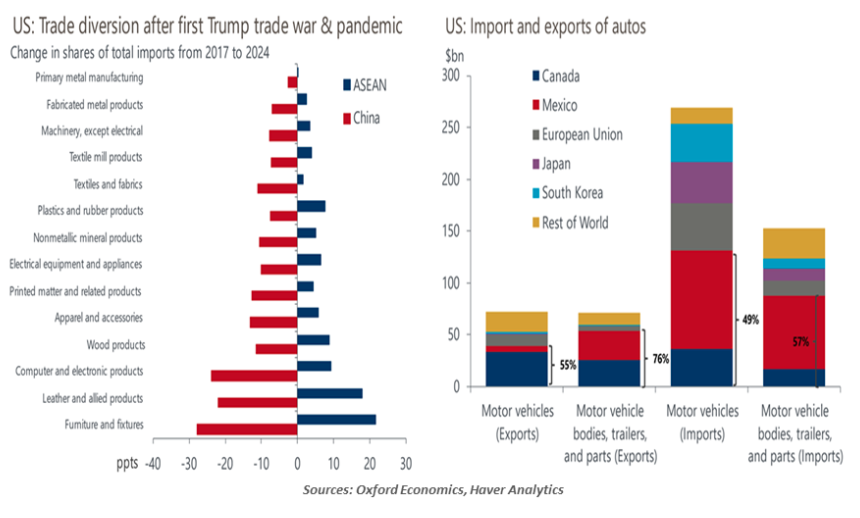
In the aftermath of the 2018 trade skirmishes with China and the pandemic, nearshoring and friendshoring quickly became buzzwords. But like many other catch phrases, these two may soon fade from usage and memory. The U.S. trade war and the administration’s preference for reshoring have changed the conversation.
Evolving geopolitical realities have forced many companies to diversify or move their production lines away from China, most often to other Southeast Asian countries or Mexico. But the calculus around nearshoring and friendshoring faces significant risks, as even America’s closest partners have not been spared from the tariff onslaught. Tariffs have undermined the U.S.-Mexico-Canada Agreement (USMCA), and diminished the attraction of forming supply chains within North America.

As of this week, many countries are now facing much higher import duties than even China, the U.S.’ main strategic rival. The threat of possible new tariffs and the risk that old ones won't be revoked will defer long-term investment decisions about building new capacity or sustaining production.
A continued retreat by the Trump administration toward lower levies will allow businesses to avoid a substantial recalibration, as those plans can be exhaustive and expensive. But corporations are coming to terms with a tariff regime that will not resemble the old normal. All of this uncertainty is driving some nations to intensify their search for new partners. As a prime example, China and the European Union are looking to reset their trade and economic ties.
Several countries and companies are committing to boost their investments and presence in the United States. But reshoring manufacturing to the U.S. will not be easy. Relocating supply chains is a challenging task that requires massive amounts of capital and time. American labor costs are far higher than in other competing economies. Sectors like autos rely on a global network for parts with inventory movement affected by longer-term trends than a typical monthly cycle. Sophisticated products like semiconductors are even more complex. Building a modern chipmaking factory can easily take three years and cost upwards of $10 billion.
The next few quarters will see companies making their best efforts to balance the threats and opportunities of friendshoring, nearshoring and reshoring. Global supply chains are unlikely to hum like a well-oiled machine anytime soon.
A message from Advisor Perspectives and VettaFi: To learn more about this and other topics, check out some of our webcasts.
Information is not intended to be and should not be construed as an offer, solicitation or recommendation with respect to any transaction and should not be treated as legal advice, investment advice or tax advice. Under no circumstances should you rely upon this information as a substitute for obtaining specific legal or tax advice from your own professional legal or tax advisors. Information is subject to change based on market or other conditions and is not intended to influence your investment decisions.
© 2025 Northern Trust Corporation. Head Office: 50 South La Salle Street, Chicago, Illinois 60603 U.S.A. Incorporated with limited liability in the U.S. Products and services provided by subsidiaries of Northern Trust Corporation may vary in different markets and are offered in accordance with local regulation. For legal and regulatory information about individual market offices, visit northerntrust.com/terms-and-conditions.
© Northern Trust
Read more commentaries by Northern Trust