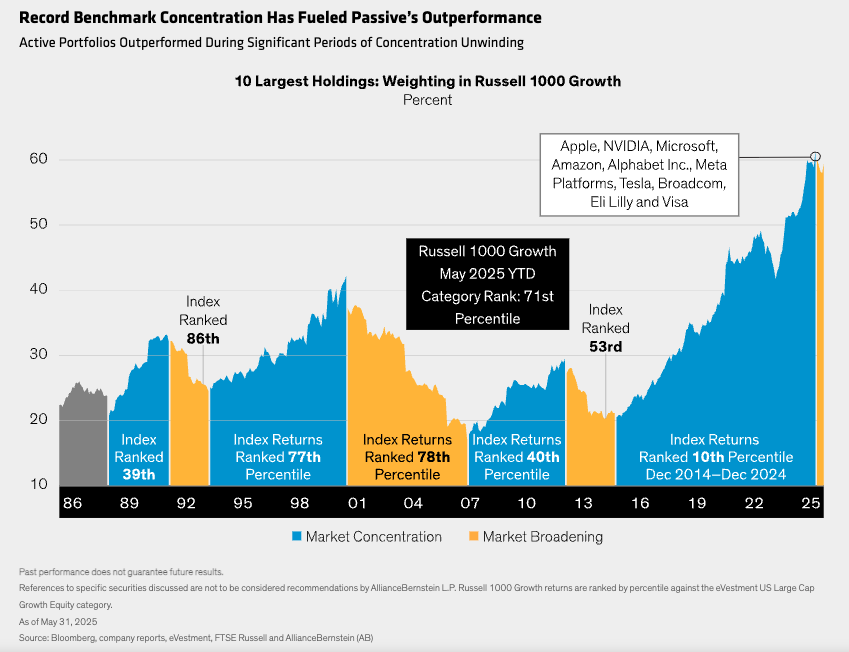
Over the last decade, the 10 largest stocks in the Russell 1000 Growth Index rose to dizzying heights to dominate the market (Display). When the top stocks consistently outperform, it’s hard for active equity portfolios to beat the benchmark, particularly those that adhere to time-tested principles of diversification. But we believe a potential reversal of this concentration could turn the picture around for skilled, active equity managers.
It’s well known that today’s market concentration is extreme. At the end of 2024, the 10 largest stocks comprised roughly 60% of the Russell 1000 Growth. That’s much higher than the last major concentration peak, when the top 10 accounted for 42% of the benchmark in May 2001.
Passive Portfolios Enjoyed the Ride
Market concentration rewarded passive investors who held market weights in the surging mega-caps. Since late 2014, passive index returns ranked in the 10th percentile of all portfolios in eVestment’s US Large Cap Growth Equity universe. In other words, only 10% of active managers outperformed.
The reason is simple: underweight positions in the mega-caps raised performance hurdles for active managers by creating big deviations from a soaring benchmark.
Active Did Well When Concentration Reversed
Passive performance during past concentrated markets was mixed. However, when concentration reversed, most active portfolios outperformed. From 1992 to 1994 and from 2001 to 2007, index returns dropped to the 86th and 78th percentiles, respectively, shown in the yellow segments of the display above.
Although past performance never guarantees future results, we think an unwinding of today’s concentration would energize active managers. We saw a glimpse of that in the first quarter of 2025: markets were more discriminating, returns of the largest stocks diverged, concentration dipped, and 68% of active US Large Cap Growth equity portfolios outperformed.
Of course, most of the US giants are great businesses. But in our view, they should be owned selectively and at appropriate weights according to an equity portfolio’s investment philosophy.
Will Markets Broaden?
Predicting the future is challenging, especially when it relates to trends that developed over years. But we think the domination of a small group of companies is unlikely to persist indefinitely as lofty valuations, geopolitics and antitrust pressure increase the importance of selectivity among the mega-caps going forward.
Perhaps most notable is the advent of AI as a computing platform shift. Every prior platform shift challenged incumbent leaders, whether it was the transition from mainframes to the PC era, or the development of the internet and mobile computing. We do not think that AI will be any different and already see signs that disruption is poised to enable new leaders while undermining others. Although disruptive trends are hard to forecast, research is the best antidote to extrapolating past success.
Today’s elevated concentration peak suggests that even a partial reversal could have a profound effect on return patterns. Yet the process won’t be linear over short periods; in the second quarter through mid-June, the mega-cap cohort did well again and market concentration resumed.
That said, this year shows that markets can broaden in both rising and falling markets. So when volatility strikes, we would resist the urge to reduce equity holdings. Instead, consider reallocating toward actively managed portfolios, which offer risk-management benefits for today’s uncertainty and the potential to capitalize on a long-term broadening of market returns toward stocks that deserve greater appreciation for their high-quality businesses.
The views expressed herein do not constitute research, investment advice or trade recommendations, and do not necessarily represent the views of all AB portfolio-management teams, and are subject to change over time.
References to specific securities discussed are for illustrative purposes only and should not to be considered recommendations by AllianceBernstein L.P. It should not be assumed that investments in the securities mentioned have necessarily been or will necessarily be profitable.
Gain clarity on H1 & strategize for the remainder of the year. Register now for the Midyear Market Outlook Symposium on June 26 at 11 am ET.
© AllianceBernstein
Read more commentaries by AllianceBernstein