Like all appetites, the consumer typically reaches some point of appeasement. That could be the case for central bank gold purchases, which have started to show signs of receding. But market experts do not see it faltering anytime soon.
The pace at which central banks are purchasing the yellow metal may start to dwindle. But there are other factors remaining in its favor. In a recent Sprott Precious Metals Report, Sprott market strategist Paul Wong identified eroding faith in the U.S. dollar as a driver for higher gold prices.
Eroding Faith in Dollar
The dollar has been the primary reserve currency for many years. But that status is coming into question. In times of yesteryear, as Wong identified, the dollar’s reserve currency status was founded on “the dollar as a medium of exchange, an official reserve asset and an ultimate safe haven.” That’s not so much the case anymore.
Among other factors, higher-for-longer inflation has certainly been an off-putting factor in turning investors away from the greenback. As such, central banks have been looking to alternative reserve assets such as this precious metal.
“This foundation is now shifting,” Wong said. “Sanctions have spurred adversaries to develop alternative payment systems and local currency invoicing, and now even allies are quietly diversifying away from U.S. dollar assets.”
“Gold has been the prime beneficiary, yet even gold’s recent rally still looks like the opening innings of a protracted saga,” he added.
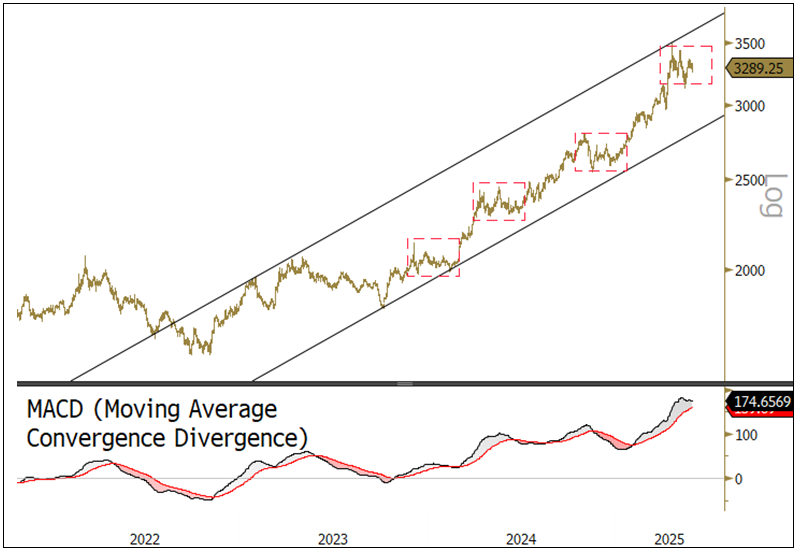
Despite the recent deceleration in momentum, gold is still up over 25% for the year. From a technical standpoint, its recent dip shouldn’t be cause for alarm. As mentioned in the Sprott report, gold is still trading within a bullish trendline. If that trend continues to prevail, it’s an ideal setup for gold buyers to buy the dip to ease any fear of missing out.
Figure 1. Gold Is Consolidating Inside a Bullish Trend (2022-2025)
Source: Bloomberg. Gold bullion spot price, US dollar/oz. Data as of 5/31/2025. Moving average convergence/divergence is a trend-following momentum indicator that shows the relationship between two exponential moving averages (EMAs). Past performance is no guarantee of future results.
Gold Surpasses Euro
It’s not just the dollar that’s in jeopardy. Our allies in the European Union (EU) saw gold overtake their own currency. As reported by CNBC, gold surpassed the euro as the second largest global reserve asset in 2024.
Whether it can maintain second place is another question. Data from the World Gold Council showed that purchases of gold by central banks fell 33% quarter-on-quarter in the first few months of this year. A notable buyer of gold — China — played a large part in that decline.
Still, market experts don’t foresee central bank buying to stop in the near or long term.
“Indeed, the perception of gold as hedge against global fiscal, inflationary, and geopolitical risks supports the case for central bank reserve managers to allocate a greater share of their portfolio to gold,” said Hamad Hussain, climate and commodities economist at Capital Economics. “Recent doubts over the dollar’s safe-haven status could also boost the attractiveness of both gold and the euro as reserve assets over the coming years.”
Uncertainty to Fuel More Purchases
If gold can extend its rally, it will need an additional catalyst. Trade talk negotiations and the direction of interest rates could bring forth a summer of uncertainty. In turn, this could keep central banks and investors firmly in buy mode.
“Despite the slowdown, central banks are likely to continue to add gold to their reserves given the still-uncertain economic environment and the drive to diversify away from the U.S. dollar. In the past six months, volumes have climbed by about 30 tonnes,” ING strategist Ewa Manthey said.
Since it’s not an infinite resource, there’s only so much gold to go around. With central banks stockpiling gold reserves, increased demand can only mean the direction for the metal’s prices is upward.
“If history is any guide, further increases in the official demand for gold reserves may also support further growth in global gold supply,” Manthey added.
Pure-Play Exposure
For easy gold exposure, consider a fund like the Sprott Physical Gold Trust (PHYS). The fund offers pure-play gold exposure, but also adds a degree of flexibility. Investors have the ability to convert their fund shares into physical bullion, offering a more tangible investment.
An investor should consider the investment objectives, risks, charges, and expenses carefully before investing. To obtain a Prospectus, which contains this and other information, contact your financial professional or call 888.622.1813. Read the Prospectus carefully before investing, which can also be found by clicking one of the links below.
Past performance is no guarantee of future results. One cannot invest directly in an index.
Funds that emphasize investments in small/mid-cap companies will generally experience greater price volatility. Diversification does not eliminate the risk of investment losses. ETFs are considered to have continuous liquidity because they allow an individual to trade throughout the day. A higher portfolio turnover rate may indicate higher transaction costs and may result in higher taxes when Fund shares are held in a taxable account. These costs, which are not reflected in annual fund operating expenses, affect the Fund’s performance.
Sprott Asset Management USA, Inc. is the Investment Adviser to the ETFs. ALPS Distributors, Inc. is the Distributor for the ETFs and is a registered broker-dealer and FINRA Member. ALPS Distributors, Inc. is not affiliated with Sprott Asset Management USA, Inc. or VettaFi.
Gold and precious metals are referred to with terms of art like store of value, safe haven and safe asset. These terms should not be construed to guarantee any form of investment safety. While “safe” assets like gold, Treasuries, money market funds and cash generally do not carry a high risk of loss relative to other asset classes, any asset may lose value, which may involve the complete loss of invested principal.
A message from Advisor Perspectives and VettaFi: To learn more about this and other topics, check out some of our webcasts.