A new era of regulation is bound to bring high hopes for the crypto bulls. House Republicans are now gearing up for “Crypto Week” – during which the committee has agreed to prioritize digital asset legislation and review several crypto-related bills. Moreover, the SEC is in the process of issuing new guidelines on disclosure requirements for crypto ETF filings.
While the legitimacy of cryptocurrencies as an asset class may spark debate, there is far less contention regarding the potential and practicality of future applications of blockchain technology.
Building Blocks for the Future
The global blockchain industry was valued at more than $27 billion in 2024. It’s projected to grow to nearly $2 trillion over the next decade. But there’s much more to the backbone of bitcoin than meets the eye. Blockchain is a digital ledger that allows for global decentralized, instant transactions that are highly secure and immutable, since records can never be altered — with zero costs. Some would go a step further, even calling blockchain the new internet. Web3, for instance, is an evolving concept centered around creating a more decentralized internet aimed at shifting power toward individual users.
Aside from the many publicly traded crypto-related and blockchain infrastructure companies out there, many significant pure-play investing opportunities exist only through the private equity universe, where the likes of Paradigm and a16z crypto PE funds operate. But ETFs are increasingly opening more public market avenues for the average retail investor.
Blockchain ETF Bright Spots
Several blockchain ETFs focus primarily on companies deeply involved in blockchain technology, crypto mining, and digital asset infrastructure. However, most still include some tangential tech or financial firms. The problem is, many pure blockchain firms are small- or midcap companies. They lack sufficient liquidity to make up a true pure-play ETF.

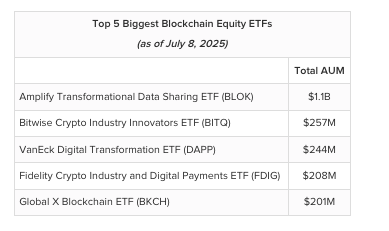
By far the largest in this category is Amplify. It launched the Amplify Transformational Data Sharing ETF (BLOK) in 2018. The $1.1 billion fund has seen a five-year average annual return of 25% and has rallied 33% year-to-date. This actively managed ETF owns blockchain stocks, crypto stocks, and underlying bitcoin indirectly through several spot bitcoin ETFs. The fund is highly diversified — with over 90% active share — spanning miners, platforms, apps, and venture capital.
Christian Magoon, CEO of Amplify, told me recently at VettaFi’s Midyear Market Outlook Symposium that BLOK’s flexibility allows for nimble navigation through crypto’s wild swings.
‘You Have to Have Risk Control’
“We think being in this space, you have to have risk control … and the ability to shift more towards blockchain during drawdowns in crypto and then more towards crypto during kind of bull runs in the crypto side has really helped from a risk-adjusted return perspective,” he said. “The fund has still a very high correlation to the cryptocurrency area, but, again, is actively managed, allowing you to kind of navigate some of the cyclical events that we’ve seen going back to 2018 in crypto.” He recommends owning BLOK as a risk-managed supplement to spot bitcoin ETFs.
Over the past month, two of the top-performing ETFs have been the Global X Blockchain ETF (BKCH) and the iShares Blockchain and Tech ETF (IBLC). Each has risen more than 20%. BKCH invests across multiple sectors and industries that broaden out beyond crypto. The fund is split nearly 50/50 between the software and services and financial services sectors. Top holdings include Coinbase, Cleanspark, Cipher Mining, and Terawulf.
Growing Sophistication of Investment Strategies
Similarly, IBLC offers global access to companies involved in the development, innovation, and use of blockchain via a dynamic, rules-based indexing approach. The fund has a roughly 70% weighting in tech, with nearly a quarter weighted in financials. Top holdings very closely mirror those of BKCH but also include AMD and Nvidia — which provide GPUs for blockchain and crypto mining — as well as Galaxy Digital.
For those seeking exposure to the transformative power of blockchain while balancing risk and returns, funds like BLOK demonstrate the growing sophistication of investment strategies within this space. As blockchain carves an increasingly prominent space in global finance, the rise of blockchain ETFs, coupled with the SEC’s evolving stance on crypto products, signals a maturing market poised for broader adoption and makes this an exciting frontier for investors to watch.
For more news, information, and analysis, visit VettaFi | ETF Trends.
A message from Advisor Perspectives and VettaFi: To learn more about this and other topics, check out some of our webcasts.
Read more commentaries by VettaFi