When the United States announced sweeping new tariffs in April, the market reaction wasn’t pretty. Equities, yields on Treasury bonds and the exchange value of the US dollar all fell sharply. But the stock and bond markets have since reversed those declines entirely.
Not so the dollar, which has continued to weaken. We expect it to fall further in the coming quarters, even though we don’t expect a US recession.
Why? Two reasons: valuation and the global implications of the US policy framework.
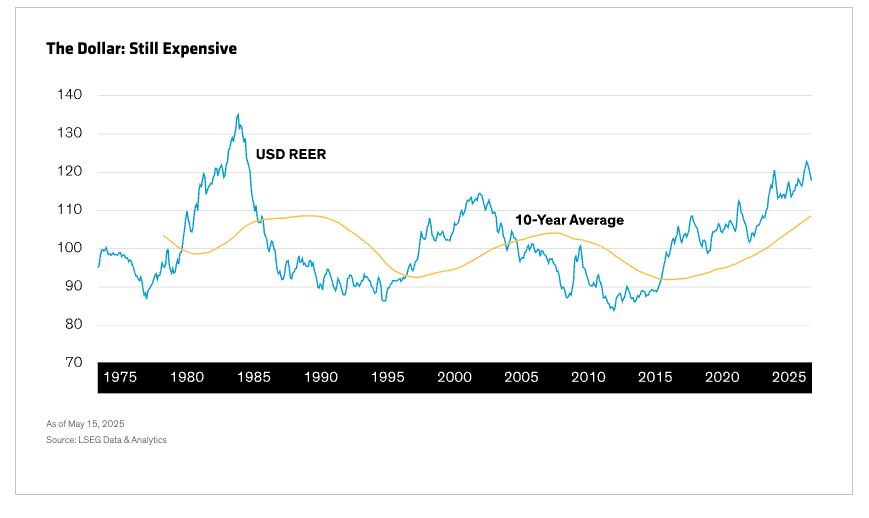
By most measures, the dollar is still expensive against its peers—even after its recent depreciation. Recall that the dollar appreciated sharply in the post-pandemic period as US economic exceptionalism dominated the market environment. On an effective-exchange-rate basis against a basket of other currencies, the dollar gained almost 20 percent between 2021 and 2025, and it ended 2024 close to its highest-ever value.

Policy Pulls the Trigger
Valuations in general do not do a good job of predicting the near-term direction of foreign exchange (FX) rates; after all, the dollar has been expensive for several years now. It typically requires a trigger to change momentum, and for currencies to return to more normal valuations after a period of divergence.
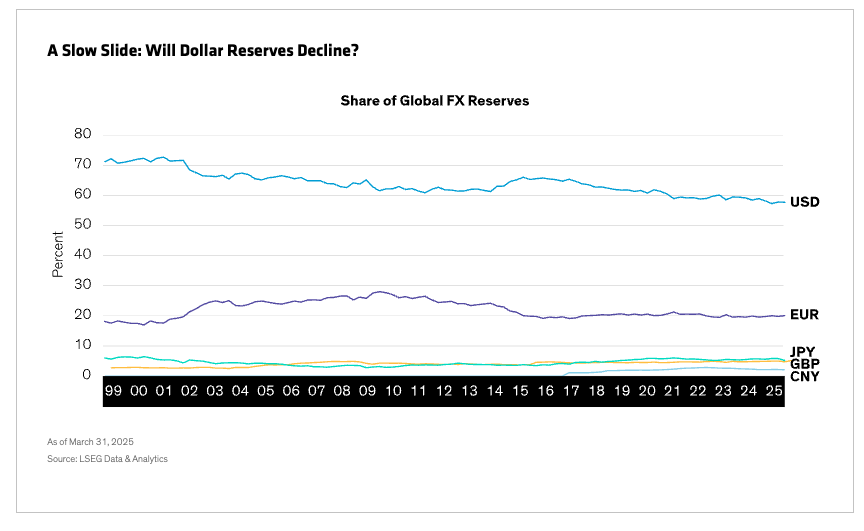
We believe that the policy environment in the US today is that trigger. A large part of the dollar’s strength over the years comes from its unquestioned role as the reserve currency of the world. Countries that hold FX reserves have held a disproportionate share of those reserves in dollars for a variety of reasons, some of which still hold today.
For example, the US economy is still the world’s largest and most important. The dollar remains the dominant currency in trade invoicing, debt issuance and international transactions. And US financial markets are the world’s deepest and most liquid.
But other reasons for the dollar’s preeminence are in doubt. Consider global central bank reserve managers—they hold assets for the long term and make their allocations based on policy predictability, reliability and adherence to a rules-based framework.
As the April tariff announcement made clear, however, the US policy framework isn’t quite so predictable or reliable anymore. To many observers, it no longer adheres to the existing rules and norms embraced by the global community. Reserve managers, who oversee very large reserve funds, tend to make changes slowly. But we think it’s clear that shifts in the US policy environment are difficult for these investors to manage, increasing their incentive to make those changes.
Beyond Tariffs and Trade
The potential for US policy changes now extends beyond tariffs and trade.
The fiscal bill Congress passed this month suggests the budget deficit and debt burden are likely to keep growing.
The possibility of reduced Federal Reserve independence is raising concern about potentially higher inflation and greater market and economic volatility.
And, given the speed of policy changes and the lack of a transparent process for discussing or analyzing those changes ahead of time, the international community may be bracing for other major changes to follow.
A weaker dollar likely means more competitively priced exports, which should provide a tailwind for US multinationals. It's also a potential tailwind for US-based investors in non-US equities. But prolonged dollar weakness could dent the profit margins of companies for whom imports represent a significant production input.
In bond markets, a dollar decline may open up opportunities for investors to embrace a globally diversified approach.
The Dollar Still Has Advantages
To be clear, we do not expect rapid capital flight. The dollar still has significant advantages over other currencies. But even incremental changes in reserve management are likely to weigh on the US currency, and we do think that uncertainty will lead global reserve managers to try to better diversify their FX holdings.
Reserve managers were already starting to diversify before the changes of the last few months, and we believe that trend is likely to accelerate as international investors lose trust in the US policy framework.
Reserve managers aren’t the only players in the global FX market, of course, but their allocations are large and tend to be persistent, giving other investors incentive to try to predict their movements.
That combination is likely to weigh on the dollar in the coming quarters, and while we don’t expect a collapse, a return to a more normal level of long-term valuation seems likely to us.
And that means a weaker dollar.
The views expressed herein do not constitute research, investment advice or trade recommendations and do not necessarily represent the views of all AB portfolio-management teams. Views are subject to revision over time.
A message from Advisor Perspectives and VettaFi: To learn more about this and other topics, check out some of our webcasts.
© AllianceBernstein
More Emerging Markets Topics >