(This article appeared in Kiplinger on July 27, 2025).
History shows that consistent, disciplined investing far outweighs any attempt at market timing, so focus on long-term growth and tune out the sky-is-falling news headlines.
If there’s one lesson to share with 401(k) investors, it’s this: Long-term investing prevails over short-term reactions.
Ignoring the nonstop news notifications is crucial in today’s 24/7/365 news cycle. The daily noise—news alerts, market flashes, economic predictions—should rarely, if ever, dictate your retirement strategy.
As an asset manager, our responsibility is to steward clients’ assets with diligence.
Over the years, we have witnessed countless market cycles, seen investors experience periods of highs and lows and observed how investor sentiment often swings wildly, influenced by the relentless drumbeat of daily financial headlines.
The principles of long-term investing in 401(k) and IRA assets apply equally to those still working and contributing to their retirement plans and to those who are retired.
The allure and danger of daily headlines
Every morning, investors wake up to a torrent of headlines—Stocks Plunge on Fed Fears, Markets Rally as Inflation Cools, Global Recession Looms—the verbiage is urgent and, often, anxiety-inducing.
Some news outlets, in their efforts to keep you engaged, are incentivized to dramatize market movements. Social media amplifies this further, with opinions and hot takes outpacing even the fastest breaking news.
For 401(k) investors, this environment creates a powerful temptation to react—to sell when the market sours, to buy when euphoria peaks and to constantly tweak investment allocations based on what’s happening right now.
However, history and discipline tell us that such short-term behavior is one of the most consistent destroyers of long-term wealth.
A powerful principle of investing is illustrated here: Investments are like a bar of soap in that the more you touch them, the less you may have.
Understanding the purpose of a 401(k)
A 401(k) account is, by design, a vehicle for long-term, tax-advantaged retirement saving. Its power lies in tax-deferred (or tax-free with a Roth 401(k)) compounding—over decades. The very structure of the 401(k) encourages patience; early withdrawals are penalized.
Many investors get distracted by market noise and lose sight of their long-term goals. Seeing your account balance drop can be distressing. But succumbing to this anxiety by reacting to daily headlines often results in poor decisions.
An easy mistake for a 401(k) investor to make is to equate their investment time horizon with their retirement date. The investor is better served to think of their 401(k) account through retirement. Viewing this account as meant to last for the rest of their lives will provide the benefit of a longer time horizon.
Volatility: A feature, not a bug
One of the hardest truths for investors to accept is that market volatility is normal and necessary. The equity markets have always been a bumpy ride, with regular corrections and occasional bear markets punctuating decades of overall advances.
Consider the history of the S&P 500 Index: Over the last century, it has weathered world wars, recessions, inflation crises, terrorist attacks, technological revolutions and pandemics. There have been crashes, booms and everything in between.
Yet, for patient investors, the long-term trend has been upward. Those who stayed the course made gains, while those who sold in fear or tried to time the market often missed the strongest rebounds.
The cost of market timing
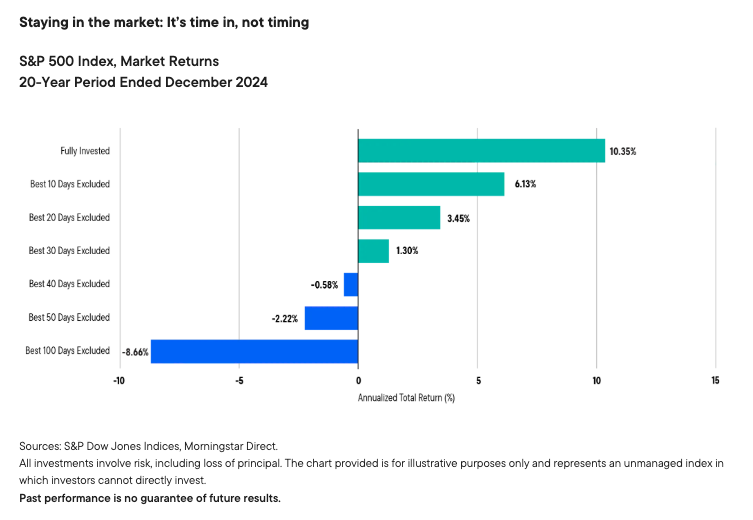
Perhaps the most compelling argument against reacting to daily headlines is the overwhelming evidence that market timing doesn’t work. For the average 401(k) participant, making frequent portfolio changes based on news headlines is almost guaranteed to reduce long-term returns.
Missing a handful of the market’s best days can dramatically impact your wealth. For example, research from J.P. Morgan Asset Management found that from 2004 to 2024, if an investor missed the 10 best days in the S&P 500, their overall return was cut in half compared with someone who stayed fully invested.1
Notably, these best days often occur amid periods of intense volatility, when headlines are most frightening. Selling during downturns means you’re likely to miss the subsequent recovery.

Behavioral biases and the media
Human beings are hardwired to seek safety and respond to perceived threats. This tendency, while useful in many areas, often leads to poor outcomes in investing.
Some in the media exploit these biases by highlighting risk and uncertainty, making it feel rational to act in times of turmoil.
Behavioral finance has identified several cognitive errors that plague investors— loss aversion, recency bias, herd mentality and overconfidence, to name a few. The constant barrage of alarming headlines feeds these biases, making us more likely to make impulsive decisions that derail our long-term plans.
The power of staying the course
What’s the alternative? The answer is deceptively simple: Develop a well-thought-out investment plan, aligned with your risk tolerance and time horizon, and stick to it.
The most successful 401(k) investors are those who automate their contributions, diversify their portfolios and resist the urge to tinker in response to the news cycle.
It’s wise to periodically review your portfolio, rebalance your allocations and reassess your goals as your life circumstances change. But these adjustments should be made according to a disciplined strategy—not in knee-jerk response to headlines.
Building wealth through consistency and patience
Let’s return to the basics: Wealth in a 401(k) comes from regular contributions, prudent asset allocation and the steady accumulation of returns over time. The market will always have its ups and downs; what matters is your ability to remain committed to your plan.
Dollar-cost averaging—investing a fixed amount at regular intervals—allows you to buy more shares when prices are low and fewer when prices are high, smoothing the impact of volatility.
Compounding does the rest, gradually transforming regular contributions into significant wealth.
Guidelines for navigating market noise
-
Define your goals. Know why you’re investing — retirement, a home, education — and keep your eyes on the prize.
-
Understand your risk tolerance. Choose an asset allocation that fits your comfort level so you’re less tempted to react during downturns.
-
Automate contributions. Take emotion out of the process by setting up automatic deposits into your 401(k).
-
Review, don’t react. Schedule regular portfolio reviews rather than checking your balance daily.
-
Seek professional guidance. If you’re unsure, consult a financial adviser who can help you maintain perspective and discipline.
Conclusion: Focusing on what matters
The news cycle shouldn’t dictate your financial future. The headlines will always change—sometimes optimistic, sometimes dire—but your 401(k) is a long-term endeavor.
History favors those who invest with patience and discipline, tuning out the short-term noise in favor of long-term growth. By ignoring the distractions and focusing on your future, you empower yourself to build the kind of retirement you deserve.
Remember, volatility is temporary, but your goals are enduring. The path to lasting wealth is paved not with frantic reactions, but with steadfast resolve. Your future is too important to be left at the mercy of today’s news.
Endnotes
1. Analysis is based on the J.P. Morgan “Guide to the Markets – Principles for Successful Long-term Investing.” Data as of July 31, 2024.
WHAT ARE THE RISKS?
All investments involve risks, including possible loss of principal.
Any information, statement or opinion set forth herein is general in nature, is not directed to or based on the financial situation or needs of any particular investor, and does not constitute, and should not be construed as, investment advice, forecast of future events, a guarantee of future results, or a recommendation with respect to any particular security or investment strategy or type of retirement account.
A message from Advisor Perspectives and VettaFi: To learn more about this and other topics, check out some of our webcasts.
IMPORTANT LEGAL INFORMATION
This material is intended to be of general interest only and should not be construed as individual investment advice or a recommendation or solicitation to buy, sell or hold any security or to adopt any investment strategy. It does not constitute legal or tax advice. This material may not be reproduced, distributed or published without prior written permission from Franklin Templeton.
The views expressed are those of the investment manager and the comments, opinions and analyses are rendered as at publication date and may change without notice. The underlying assumptions and these views are subject to change based on market and other conditions and may differ from other portfolio managers or of the firm as a whole. The information provided in this material is not intended as a complete analysis of every material fact regarding any country, region or market. There is no assurance that any prediction, projection or forecast on the economy, stock market, bond market or the economic trends of the markets will be realized. The value of investments and the income from them can go down as well as up and you may not get back the full amount that you invested. Past performance is not necessarily indicative nor a guarantee of future performance. All investments involve risks, including possible loss of principal.
Any research and analysis contained in this material has been procured by Franklin Templeton for its own purposes and may be acted upon in that connection and, as such, is provided to you incidentally. Data from third party sources may have been used in the preparation of this material and Franklin Templeton ("FT") has not independently verified, validated or audited such data. Although information has been obtained from sources that Franklin Templeton believes to be reliable, no guarantee can be given as to its accuracy and such information may be incomplete or condensed and may be subject to change at any time without notice. The mention of any individual securities should neither constitute nor be construed as a recommendation to purchase, hold or sell any securities, and the information provided regarding such individual securities (if any) is not a sufficient basis upon which to make an investment decision. FT accepts no liability whatsoever for any loss arising from use of this information and reliance upon the comments, opinions and analyses in the material is at the sole discretion of the user.
Franklin Templeton has environmental, social and governance (ESG) capabilities; however, not all strategies or products for a strategy consider “ESG” as part of their investment process.
Products, services and information may not be available in all jurisdictions and are offered outside the U.S. by other FT affiliates and/or their distributors as local laws and regulation permits. Please consult your own financial professional or Franklin Templeton institutional contact for further information on availability of products and services in your jurisdiction.
Issued in the U.S. by Franklin Templeton, One Franklin Parkway, San Mateo, California 94403-1906, (800) DIAL BEN/342-5236, franklintempleton.com. Investments are not FDIC insured; may lose value; and are not bank guaranteed.
You need Adobe Acrobat Reader to view and print PDF documents. Download a free version from Adobe's website.
CFA® and Chartered Financial Analyst® are trademarks owned by CFA Institute.
© Franklin Templeton
Read more commentaries by Franklin Templeton