Originally published February 12, 2024
We’re often asked about Vanguard’s approach to constructing TDFs and how it specifically relates to helping improve investor outcomes. Since the inception of Vanguard Target Retirement Funds in 2003, we have emphasized a strategic approach to asset allocation. This is where the Strategic Asset Allocation Committee (SAAC) plays a critical role in helping to guide our asset allocation methodology. Composed of global investment leaders from across Vanguard, the SAAC meets regularly to debate investment strategies and research recommendations. In this article, we revalidate why strategic asset allocation still matters and how, in tandem with the governing oversight, it ensures that we maintain a consistent approach in meeting the retirement needs of TDF investors.
Determining the appropriate asset allocation for retirement success
Our position on asset allocation is rooted in research that has consistently shown that the mix of assets in broadly diversified portfolios is by far the greatest determinant of both total returns and return variability over the long term. In addition to the seminal study conducted by Gary P. Brinson, L. Randolph Hood, and Gilbert L. Beebower in 1986, Vanguard research has upheld that, over time, more than 90% of a portfolio’s return variability can be explained by its strategic asset allocation.
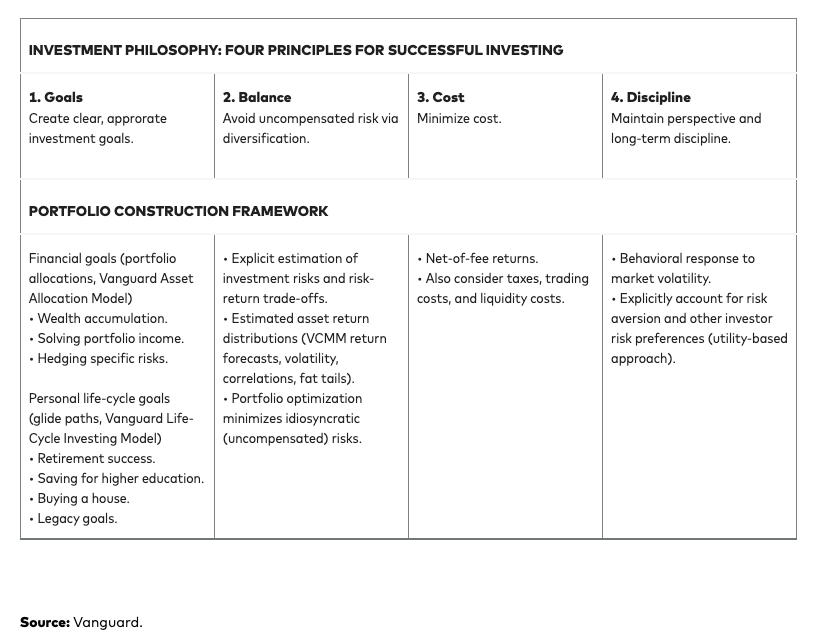
Vanguard has developed a set of investment principles that we believe are important to long-term investment success: having clear and appropriate investment goals; developing a suitable asset allocation using broadly diversified, or balanced, funds; minimizing costs; and maintaining perspective and long-term discipline (Figure 1). In designing a solution for the wide range of TDF investors, we strongly believe in balancing risk aversion and other investor risk preferences with return expectations that appropriately compensate for those risks. As such, strategic asset allocation is a core part of the portfolio construction framework that underpins this investment philosophy and our approach to TDF design.
Figure 1. Vanguard’s investment principles

Conversely, as our study shows, short-term tactical investment decisions, market-timing, and security selection had relatively little impact on return variability over longer time periods. The primary reason for this is that within broadly diversified portfolios, it is extremely difficult to consistently replicate over a multidecade time horizon, which is what TDFs are specifically designed for.
In order for each tactical move to succeed, portfolio managers need to be right in not just one but all of the following areas:
- Identifying a reliable indicator of short-term future market returns.
- Timing the exit from an asset class or the market down to the precise day.
- Timing reentry to an asset class or the market down to the precise day.
- Deciding on the size of the allocation and how to fund the trade.
- Executing the trade at a cost less than the expected benefit (reflecting transaction costs, spreads, and taxes).
Even if a portfolio manager can get these steps right most of the time, the long-term value is marginal. Vanguard previously conducted an analysis of the incremental benefits of market-timing based on how frequently a hypothetical investor might be successful in anticipating economic surprises and found the following: An investor would have to be correct at least 75% of the time to get a return only slightly higher than that of the traditional baseline 60/40 portfolio. While there are professional asset managers who demonstrate such skill, very few can consistently achieve a 75% hit rate, especially in a globally diversified portfolio.
Strategic asset allocation still matters
Over the past 18 months, investors have been inundated with articles proclaiming the “death” of the 60/40 portfolio, the de facto balanced portfolio.1 This is largely due to the losses experienced in 2022 when both stocks and bonds ended the year in negative territory, driven in part by historically high stock-bond correlations. However, while increases in stock-bond correlations may have garnered a lot of attention, when viewed through a longer performance lens, the impact on retirement savings outcomes is less significant in its broader contextOpens in a new tab than short-term analyses may imply.
As is often the case, the idea that both the 60/40 portfolio and the underlying strategic asset allocation that guides it are dead is greatly exaggerated.1 In contrast, we would argue that defining an appropriate strategic asset allocation remains as important as ever for achieving long-term investing success.
Strategic asset allocation has endured for a reason. Not only has it been reaffirmed by research, but it has also outlasted multiple market cycles, which is why the strategic approach remains a key investment principle behind Vanguard Target Retirement Funds. While participants and plan sponsors may sometimes feel that this approach is overly passive, it is certainly not without careful deliberation. It has proven to be a reliable driver of long-term return variability and remains as effective as ever in helping TDF investors seek lifelong financial well-being.
Strategic oversight: Meet the SAAC
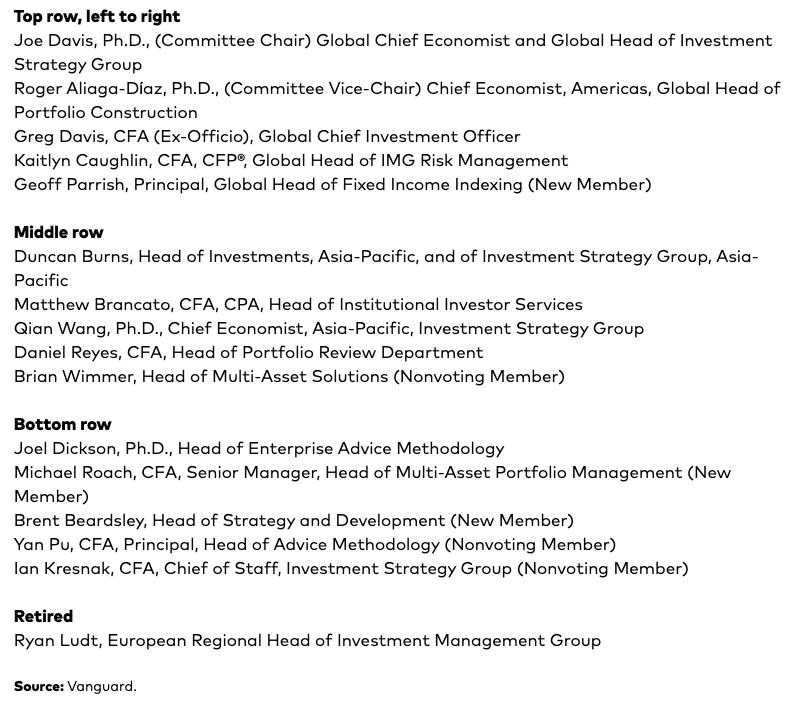
While the concept of strategic asset allocation may seem straightforward on the surface, it takes considerable time and resources to ensure that it is effectively meeting the evolving needs of our TDF investors. In addition to the ongoing rigor that is applied to our Target Retirement Funds and portfolio construction methodology, strategic asset allocation methodology and related decisions are governed by Vanguard’s Strategic Asset Allocation Committee, an executive oversight committee composed of investment experts sitting in key leadership roles across investment research, behavioral research, portfolio management, and portfolio construction (Figure 2). Heading the committee are co-chairs Joseph Davis, our global chief economist and global head of Vanguard’s Investment Strategy Group (ISG), and Roger Aliaga-Dίaz, global head of portfolio construction, chief economist for the Americas, and co-portfolio manager of the Target Retirement Funds.
Figure 2. Vanguard Strategic Asset Allocation Committee
The SAAC meets regularly to discuss research and recommendations made by specialists from across the firm, but it does not operate alone. Experts within ISG, the Portfolio Review Department, and trading functions within the Investment Management Group partner on the creation of research and other content that it reviews. For example, Vanguard conducts an annual comprehensive review of our glide path and strategic asset allocation to ensure that Vanguard’s latest and best thinking is reflected in our Target Retirement Funds and that they continue to meet the evolving needs of our investors. During this process, Vanguard considers new asset classes, currency exposures, home bias, regulatory impacts, investment costs, investor behaviors, and implementation factors, among other things. While these considerations may result in recommendations for glide-path changes, such changes require debate and are not always accepted. Regardless of the outcome, this valuable process results in a collection of research that is later published for external consumption or leveraged internally for future analyses.
Importantly, the SAAC is a role-based committee. This means that the focus is on ensuring that the viewpoints from critical roles in multiasset portfolio construction and the management process are represented rather than the viewpoints of a specific individual. Given Vanguard’s rotational culture, this also means that turnover on the committee can be more frequent, but we find that this allows fresh approaches to be introduced and lends itself to more robust discussion and decision-making.
The SAAC in action
We are often asked how changes to the glide path or underlying asset allocation are made and what that process looks like in practice. To bring this to life, we provide a previous case study as an example: the decision to allocate to currency-hedged international bonds in our Target Retirement Funds.
The process began with research spearheaded by ISG, which showed considerable benefits for including international bonds, such as improved portfolio diversification by providing access to the largest part of the global fixed income market. The research was presented to the SAAC, and while it was met with a positive reception, there was some concern about the volatility of international bonds compared with U.S. bonds.
This feedback resulted in a deeper dive, which showed that the higher relative volatility level could be almost entirely attributed to the currency risk associated with the underlying bond exposures. The resulting recommendation was to mitigate this currency risk by hedging the international bond allocation to the U.S. dollar. By hedging the currency risk entirely, the volatility level of an international bond allocation falls below that of an equivalent investment-grade U.S. bond allocation. This allows the international bond allocation to function as intended in the overall portfolio mix by improving diversification while also helping to reduce the overall portfolio risk level.
This deeper dive led to the research making its second trip to the SAAC. With the refreshed recommendation being approved, it paved the way for the inclusion of the asset class in our Target Retirement Funds in 2013. We increased our currency-hedged international bond exposure in 2015 to its current level (30% of the total fixed income allocation). Recently, we reaffirmed our research on why international bonds continue to add value for investors.
Designed to meet long-term objectives
Our conviction in setting a prudent strategic asset allocation as a key foundation for long-term investing success remains strong. Our TDFs, on average, have performed in the top quartile among their peer groups for 10-year returns,2 which have helped give investors a better chance for lasting income through retirement. The care and rigor that are applied to determining and revalidating our strategic asset allocation have been the primary driver of this success. We remain committed to this approach, as we believe our investors will benefit from it for years to come.
1 Time to move on from the 60/40 debate.Opens in a new tab Vanguard, 2023.
2 Vanguard and Morningstar, Inc., as of December 31, 2024. Our Target Retirement Funds with a 10-year track record or longer (2060 and earlier vintages), on average, ranked in the 76th percentile among peer groups for 10-year returns through 2024. Vanguard Target Retirement Income Fund ranked 37th out of 108 peers; 2020 Fund, 34th out of 96; 2025 Fund, 18th out of 139; 2030 Fund, 33rd out of 143; 2035 Fund, 52nd out of 145; 2040 Fund, 56th out of 143; 2045 Fund, 45th out of 145; 2050 Fund, 40th out of 143; 2055 Fund, 46th out of 139; and 2060 Fund, 24th out of 43. Only competing funds with a 10-year history were included. Results will vary in other time periods.
Note that the competitive performance data shown represent past performance, which is not a guarantee of future results, and that all investments are subject to risks. For the most recent performance, visit our website at www.vanguard.com/performance.
Notes:
- For more information about Vanguard funds, visit vanguard.com or call 800-662-2739 to obtain a prospectus or, if available, a summary prospectus. Investment objectives, risks, charges, expenses, and other important information about a fund are contained in the prospectus; read and consider it carefully before investing.
- Investments in Target Retirement Funds are subject to the risks of their underlying funds. The year in the fund name refers to the approximate year (the target date) when an investor in the fund would retire and leave the workforce. The fund will gradually shift its emphasis from more aggressive investments to more conservative ones based on its target date. An investment in a Target Retirement Fund is not guaranteed at any time, including on or after the target date.
- Vanguard is responsible only for selecting the underlying funds and periodically rebalancing the holdings of target-date investments. The asset allocations Vanguard has selected for the Target Retirement Funds are based on our investment experience and are geared to the average investor. Regularly check the asset mix of the option you choose to ensure it is appropriate for your current situation.
- All investing is subject to risk, including the possible loss of the money you invest. There is no guarantee that any particular asset allocation or mix of funds will meet your investment objectives or provide you with a given level of income. Diversification does not ensure a profit or protect against a loss.
- Investments in bonds are subject to interest rate, credit, and inflation risk. Investments in stocks or bonds issued by non-U.S. companies are subject to risks including country/regional risk and currency risk.
A message from Advisor Perspectives and VettaFi: To learn more about this and other topics, check out some of our webcasts.
Vanguard funds not held in a brokerage account are held by The Vanguard Group, Inc., and are not protected by SIPC. Brokerage assets are held by Vanguard Brokerage Services, a division of Vanguard Marketing Corporation, member FINRA and SIPC.
For additional financial information on Vanguard Marketing Corporation, see its Statement of Financial Condition: Audited and Unaudited
Broker-Dealer Form Client Relationship Summary (Form CRS) and Investment Advisor Form Client Relationship Summary (Form CRS)
© 1995–2025 The Vanguard Group, Inc. All rights reserved. Vanguard Marketing Corporation, Distributor of the Vanguard Funds. Your use of this site signifies that you accept our terms & conditions of use.
© Vanguard
Read more commentaries by Vanguard