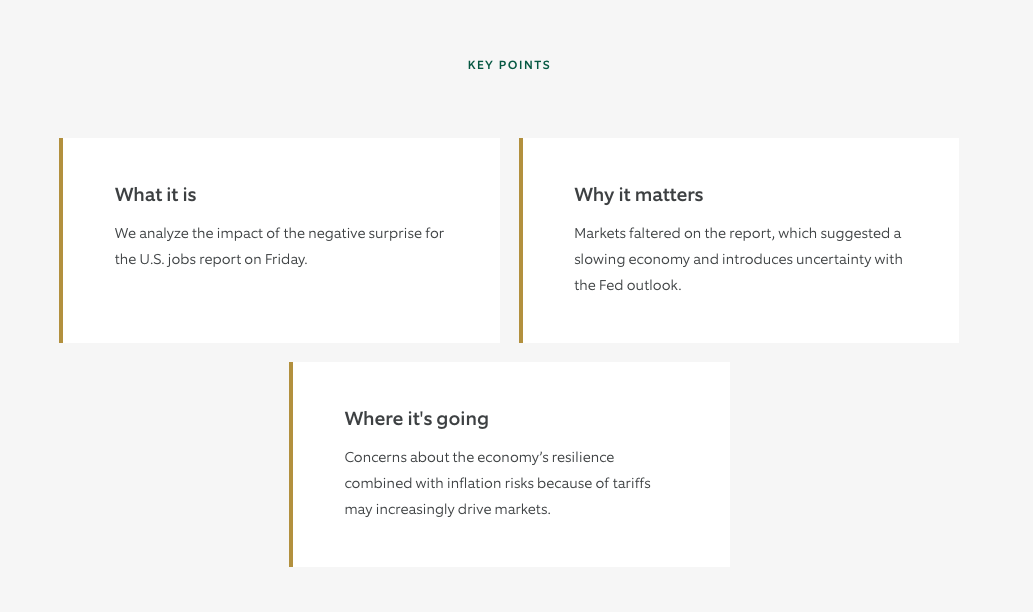
The labor market data for July was weaker than expected. While 73,000 payrolls were added and the unemployment rate came in at 4.2%, underlying details were less encouraging. Sharp downward revisions to the prior two months brought the three-month average payroll gain down to just 35,000.
Most job gains were concentrated in education and healthcare, and excluding those sectors, private payrolls have actually declined by an average of 15,000 per month over the past three months. Additionally, the foreign-born labor force participation rate fell again, suggesting that immigration trends are weighing on employment. While it’s important not to overreact to a single report, these developments point to rising downside risks for growth.
Implications for the Fed
This evolving macro backdrop presents a challenge for the Federal Reserve. A weakening labor market alongside inflation pressures complicates the Fed’s dual mandate. At the Federal Open Market Committee’s (FOMC) post-meeting press conference, Federal Reserve Chair Jerome Powell emphasized the unemployment rate as a key metric for assessing full employment.
As long as slower job growth is matched by reduced labor supply, the Fed may still view its employment mandate as intact. Therefore, we do not believe the labor data significantly shifts the Fed’s perceived balance between inflation and employment risks—especially with inflation expected to rise further above its target in the upcoming months.
Implications for Financial Markets
Market expectations for the Fed policy path have shifted. Prior to Friday’s payrolls report, markets were pricing in a 40% chance of a rate cut in September. That probability has now surged to around 90%, indicating that investors are increasingly focused on growth risks rather than inflation surprises.
This shift could lead to heightened volatility in fixed income markets, particularly as there are several major events ahead of the meeting that could reshape expectations—including two Consumer Price Index prints, another employment report and the Jackson Hole symposium. We believe that policymakers would prefer a more balanced expectation for a potential rate cut in September to allow for greater policy flexibility, which could be reinforced through upcoming Fed speak.
Equity markets, which have rallied strongly, may be vulnerable to a pullback. Inflation concerns that prompt a hawkish repricing of Fed policy could be a key risk. At the same time, the equity losses following the U.S. jobs data show that a dovish repricing can also be unfavorable if it’s driven by concerns on economic resilience that is supporting corporate earnings growth.
Finally, while the macro backdrop is important, we also note that the tech sector remains a dominant force in U.S. equity performance. To the extent that changes in the economic landscape do not disrupt some of the structural tech growth drivers, we could see lower impacts than in other areas such as fixed income markets.
What We’ll Be Watching
We expect plenty of Fed speakers to hit the tape in the coming days to provide further guidance. The most recent FOMC meeting was notable for featuring two dissenting votes—something not seen since the 1990s—suggesting we should be prepared for a diversity of views.
One of the central questions for investors and the FOMC is whether growth concerns will outweigh tariff-induced inflation. While the economic calendar is light in the coming week, incoming Purchasing Managers’ Index data and jobless claims will be important indicators. Additionally, U.S. President Donald Trump’s announcement that he is firing the commissioner of the Bureau of Labor Statistics raises concerns about the independence of labor data. In light of this, we will be paying close attention to alternative indicators such as jobless claims, third-party data sources, and private surveys.
Finally, despite this week’s trade developments, the tariff story is far from over. We expect continued updates on U.S.-China negotiations, new sector-specific tariffs, and ongoing negotiations with countries that missed the latest trade deadline, including India and Canada.
A message from Advisor Perspectives and VettaFi: To learn more about this and other topics, check out some of our webcasts.
IMPORTANT INFORMATION
Northern Trust Asset Management (NTAM) is composed of Northern Trust Investments, Inc., Northern Trust Global Investments Limited, Northern Trust Fund Managers (Ireland) Limited, Northern Trust Global Investments Japan, K.K., NT Global Advisors, Inc., 50 South Capital Advisors, LLC, Northern Trust Asset Management Australia Pty Ltd, and investment personnel of The Northern Trust Company of Hong Kong Limited and The Northern Trust Company.
Issued in the United Kingdom by Northern Trust Global Investments Limited, issued in the European Economic Association (“EEA”) by Northern Trust Fund Managers (Ireland) Limited, issued in Australia by Northern Trust Asset Management (Australia) Limited (ACN 648 476 019) which holds an Australian Financial Services Licence (License Number: 529895) and is regulated by the Australian Securities and Investments Commission (ASIC), and issued in Hong Kong by The Northern Trust Company of Hong Kong Limited which is regulated by the Hong Kong Securities and Futures Commission.
For Asia-Pacific (APAC) and Europe, Middle East and Africa (EMEA) markets, this information is directed to institutional, professional and wholesale clients or investors only and should not be relied upon by retail clients or investors. This information may not be edited, altered, revised, paraphrased, or otherwise modified without the prior written permission of NTAM. The information is not intended for distribution or use by any person in any jurisdiction where such distribution would be contrary to local law or regulation. NTAM may have positions in and may effect transactions in the markets, contracts and related investments different than described in this information. This information is obtained from sources believed to be reliable, its accuracy and completeness are not guaranteed, and is subject to change. Information does not constitute a recommendation of any investment strategy, is not intended as investment advice and does not take into account all the circumstances of each investor.
This report is provided for informational purposes only and is not intended to be, and should not be construed as, an offer, solicitation or recommendation with respect to any transaction and should not be treated as legal advice, investment advice or tax advice. Recipients should not rely upon this information as a substitute for obtaining specific legal or tax advice from their own professional legal or tax advisors. References to specific securities and their issuers are for illustrative purposes only and are not intended and should not be interpreted as recommendations to purchase or sell such securities. Indices and trademarks are the property of their respective owners. Information is subject to change based on market or other conditions.
All securities investing and trading activities risk the loss of capital. Each portfolio is subject to substantial risks including market risks, strategy risks, advisor risk, and risks with respect to its investment in other structures. There can be no assurance that any portfolio investment objectives will be achieved, or that any investment will achieve profits or avoid incurring substantial losses. No investment strategy or risk management technique can guarantee returns or eliminate risk in any market environment. Risk controls and models do not promise any level of performance or guarantee against loss of principal. Any discussion of risk management is intended to describe NTAM’s efforts to monitor and manage risk but does not imply low risk.
Past performance is not a guarantee of future results. Performance returns and the principal value of an investment will fluctuate. Performance returns contained herein are subject to revision by NTAM. Comparative indices shown are provided as an indication of the performance of a particular segment of the capital markets and/or alternative strategies in general. Index performance returns do not reflect any management fees, transaction costs or expenses. It is not possible to invest directly in any index. Net performance returns are reduced by investment management fees and other expenses relating to the management of the account. Gross performance returns contained herein include reinvestment of dividends and other earnings, transaction costs, and all fees and expenses other than investment management fees, unless indicated otherwise. For U.S. NTI prospects or clients, please refer to Part 2a of the Form ADV or consult an NTI representative for additional information on fees.
Forward-looking statements and assumptions are NTAM’s current estimates or expectations of future events or future results based upon proprietary research and should not be construed as an estimate or promise of results that a portfolio may achieve. Actual results could differ materially from the results indicated by this information.
Not FDIC insured | May lose value | No bank guarantee
© Northern Trust
Read more commentaries by Northern Trust