The ETF wrapper provides a number of benefits for investors, combining tax-efficiency with cost savings. In more complex asset classes such as international equities, investors potentially compound the benefits of ETFs with those of active management.
ETFs provide a number of benefits for portfolios. They are often more accessible to a broader range of investors, as mutual funds typically require minimum amounts to purchase. What’s more, the ability to trade ETFs intraday provides investors with flexibility and the ability to capture prices in real time. Mutual funds are constrained to end-of-day pricing and trading.
The ETF structure also creates the potential for greater tax-efficiency. The creation and redemption mechanism on the primary market does not trigger capital gains, as the trades are considered in-kind. Additionally, because ETF shares trade in the secondary market between investors, the fund is generally insulated from direct involvement. Mutual funds, on the other hand, must often sell assets or use the cash within the fund to satisfy redemptions. Should they sell assets, this can trigger a capital gain for other investors of the fund.
These benefits compound in active ETFs, which combine active manager insights, expertise, and research with the cost savings and tax-efficiency of the ETF. Though the proliferation of active ETFs continues, they still lag passive peers in numbers, particularly in international (ex-U.S.) strategies.
Ryan Gemmell, CFA, investment specialist, international equities, Christopher Murphy, CIMA, head of ETF specialists, and Brian Navin, CFA, investment specialist, global equities at T. Rowe Price noted in a recent insights piece that, as of June 2025, only 48 active international ETFs were on the market. Mutual funds still dominate the space, with 585 active strategies over the same period.
Why Active Matters When Investing Internationally
In a category such as international investing, discernment matters. Passive equity indexes often include a wide swathe of companies, particularly when looking beyond the U.S. The authors noted that while U.S. benchmarks such as the S&P 500 include stipulations around positive performance and financial stability, international benchmarks may lack these same types of requirements.
By including less financially sound companies, passive international strategies often underperform significantly during market crises. In 2020, at the onset of the COVID pandemic, nearly a quarter (24%) of companies within the MSCI EAFE Index reported negative earnings. For reference, the S&P 500 contained just 15% over the same period. What’s more, active international strategies typically rebound faster than passive peers.
“This quality discrepancy underscores the potential value of active management in international markets, where passive options may be more likely to reflect the lower-quality financial characteristics of their respective benchmarks,” explained the authors.
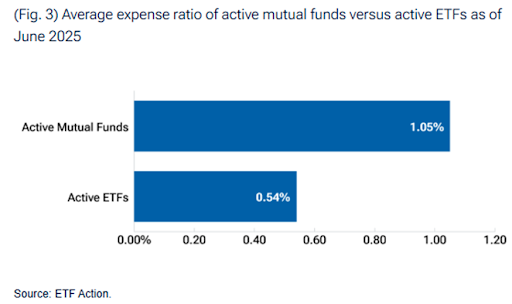
Investors looking to actively managed ETFs enjoy one final, fundamental benefit: cost. Active international ETFs cost approximately half what similar active mutual funds cost. The authors noted that active international ETFs have an average expense ratio of 0.54% compared to active mutual funds’ 1.05% as of June 2025 according to data sourced from ETF Action.

Image source: T. Rowe Price
International Active ETF Investing With T. Rowe Price
Advisors and investors wanting to harness opportunities in actively managed international ETFs would do well to consider the T. Rowe Price International Equity ETF (TOUS) and the T. Rowe Price International Equity Research ETF (TIER). TOUS invests across the market-cap spectrum but generally focuses on large-caps in developed markets. The fund managers evaluate a company’s fundamentals, earnings potential, and relative valuation to peers when constructing the portfolio. This results in a portfolio that may offer both value and growth exposures at any given time, with an expense ratio of 0.50%.
The recently launched TIER offers similar characteristics to the MSCI ACWI ex USA Index. TIER retains fairly similar country, sector, and industry weights as the Index, but may differ due to individual stock weights. The weights are determined using research from dedicated T. Rowe Price equity analysts. These analysts select the stocks and their weights from within each industry. The portfolio managers and oversight team then determine the overall portfolio composition while maintaining sector neutrality compared to the benchmark. TIER carries an expense ratio of 0.38%.
For more news, information, and strategy, visit the Active ETF Content Hub.
A message from Advisor Perspectives and VettaFi: To learn more about this and other topics, check out some of our webcasts.
Read more commentaries by VettaFi