The Swiss are known for their precision craftmanship, artisanal techniques and finest quality – just ask their watchmakers. But despite their reputation for keeping perfect time, the Swiss are struggling to recalibrate their trade strategy in this age of deglobalization.
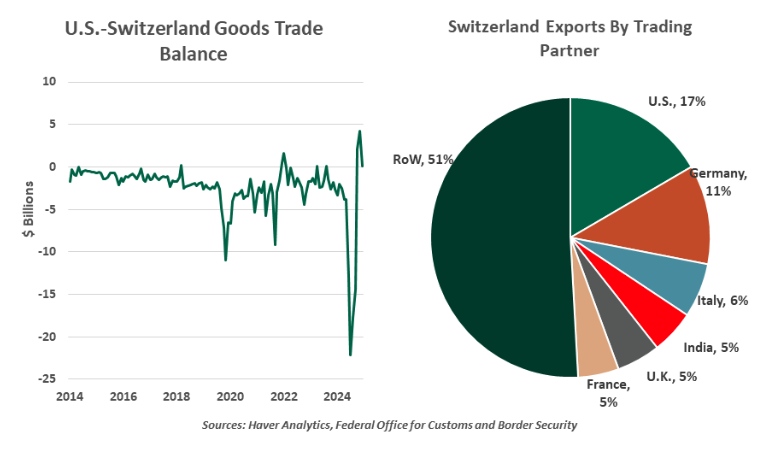
With a goods trade surplus of about $40 billion with the United States in 2024, Switzerland was always likely to find itself in the crosshairs of the new U.S. administration. But few expected that Swiss exports would be hit with a flat 39% tariff, the highest in the developed world.
What makes America’s penalties so notable is that the rate is more than double that levied on the European Union (EU), and far steeper than those applied to other comparable non-EU nations like the U.K. and Australia. Countries with larger trade surpluses with the U.S. have faced lower tariffs.
Few economies are as dependent on U.S. trade as Switzerland, with shipments across the Atlantic accounting for around 7% of the country’s gross domestic product (GDP). In Germany, the figure is under 4% of GDP. America is the top single market for Switzerland’s exports, accounting for about one-sixth of total outbound trade, dominated by a handful of industries. Pharmaceuticals and gold are among the nation’s top exports to America.

A trade deal seemed achievable, as Switzerland had already abolished virtually all industrial tariffs on imports in January 2024. Increased stockpiling of gold and pharmaceuticals in the U.S. since the turn of the year has significantly widened Switzerland’s trade surplus, triggering a more aggressive response from the U.S. administration.
Much to Switzerland’s relief, pharma and gold are currently exempt from U.S. levies. As a result, the country faces an effective average tariff of just over 12%. However, this still leaves over a third of their exports exposed, including high-value-added goods such as precision machinery, medical devices, chocolates and cheese. The import duties could lead to a sizable drop in shipments. As long as pharmaceuticals are exempted, the direct impact on economic growth may be limited.
Pharmaceuticals have historically been excluded from trade disputes due to the potential implications for public health. American households pay significantly higher prescription medicine costs compared to other advanced economies. Swiss drug imports, often high-value and specialized treatments, play a vital role in the U.S. healthcare system. While the administration aims to reduce its reliance on foreign medical imports, concerns over possible disruptions to this critical sector could prompt more enduring exemptions for the Swiss pharmaceutical industry.
Switzerland lacks the economic heft and soft power to influence trade outcomes. Unlike major markets like the EU or Japan, it lacks the scale to retaliate effectively or meaningfully boost American imports. Switzerland could increase purchases of U.S. liquefied natural gas to help reduce the trade imbalance. However, the country does not possess the necessary import infrastructure and is not a major gas consumer. Opening agricultural markets, another potential lever, is politically sensitive and would almost certainly provoke backlash from Swiss farmers.
Without a customs union and a free trade agreement with the U.S., Switzerland may have to weather this tariff storm alone, with limited leverage to reverse the 39% duty. The country’s most viable path forward may lie in further diversifying its export base to reduce vulnerability.
Mechanical watches need to be regularly wound to keep telling precise time. Swiss policymakers must maintain robust engagement with the U.S. to prevent trade relations from coming to a stop.
Information is not intended to be and should not be construed as an offer, solicitation or recommendation with respect to any transaction and should not be treated as legal advice, investment advice or tax advice. Under no circumstances should you rely upon this information as a substitute for obtaining specific legal or tax advice from your own professional legal or tax advisors. Information is subject to change based on market or other conditions and is not intended to influence your investment decisions.
© 2025 Northern Trust Corporation. Head Office: 50 South La Salle Street, Chicago, Illinois 60603 U.S.A. Incorporated with limited liability in the U.S. Products and services provided by subsidiaries of Northern Trust Corporation may vary in different markets and are offered in accordance with local regulation. For legal and regulatory information about individual market offices, visit northerntrust.com/terms-and-conditions.
A message from Advisor Perspectives and VettaFi: To learn more about this and other topics, check out some of our webcasts.
© Northern Trust
Read more commentaries by Northern Trust