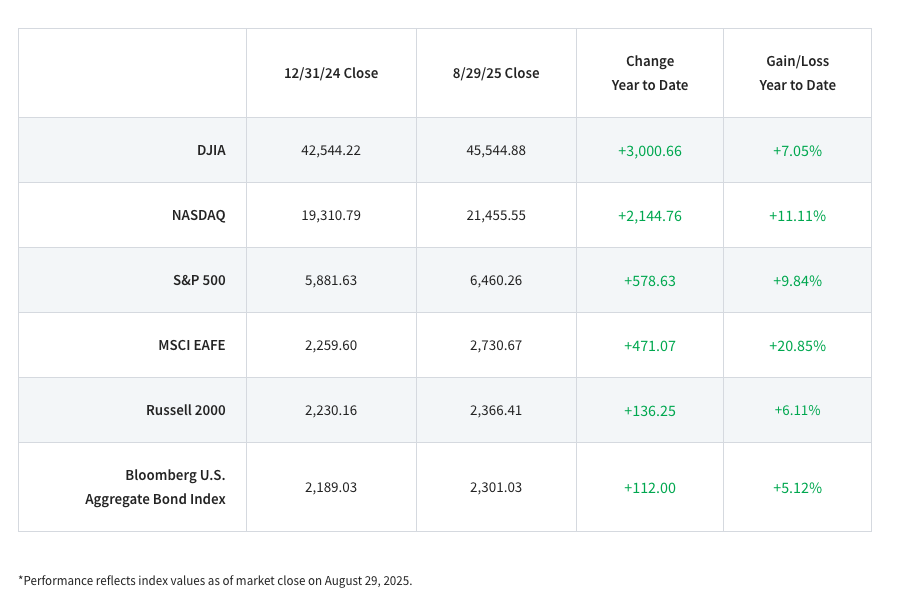
The financial markets stood strong against tariff pressures last month, with the S&P 500 hitting its 20th record high so far this year. That performance was driven largely by earnings surpassing expectations for the third consecutive quarter and resulting in widespread gains.
Small-cap stocks were the top performer in August, thanks in part to Fed Chairman Jerome Powell’s speech in Jackson Hole, where he hinted at a possible interest rate cut in September. This signaled upcoming relaxation of monetary policy in response to less-than-stellar jobs numbers, with inflation caused by tariffs determined to be the lesser of two evils against stagnation of economic growth.
Displaying broad performance, nine of 11 sectors were positive for the month of August. According to Raymond James Chief Investment Officer Larry Adam, “The difference in sector returns is the narrowest it’s been since 1995. Looking ahead, we expect that the full effects of tariffs will be felt, and we expect to see greater dispersion amongst sectors as leaders and laggards emerge.”
Bond yields declined in August, with the policy-sensitive two-year Treasury yield falling 31 basis points to 3.64%. This is, of course, in response to overall expectations for upcoming Fed rate cuts, impacting the short end of the yield curve first with the long end less sensitive to day-to-day speculation.
We’ll dive into the details shortly, but first: a look at the numbers year-to-date.

Jobs down and inflation data mixed
The July employment report showed 73,000 new jobs – much lower than expected – while revised June and May jobs numbers were lowered by more than 100,000 jobs each. This could change for better or worse as the data continues to develop. Layoffs in the government sector have also yet to be counted, which could spell trouble for the US labor market. Manufacturing continued to contract in July with none of the major industries reporting expansion compared to four the previous month. Headline inflation held steady thanks to declining energy prices while core inflation was higher than expected, largely driven by increases in airline fares as well as used vehicle prices.
Fed hints at easing monetary policy
Fed Chairman Powell’s speech in Jackson Hole, Wyoming, helped close out the month with a bounce to near highs for the S&P 500. Current expectations point toward the conclusion of the FOMC meeting on September 17 as the likely date for an interest rate cut. The Fed’s dual mandate of maximizing jobs while minimizing inflation often requires picking a side. For now, long-term inflation expectations resulting from tariffs are below 2.5%, making poor jobs numbers the larger threat.
Bond prices reinforce Fed expectations
Intermediate and short-term Treasury prices rallied in August as yields fell. The 10-year Treasury fell 10 basis points, while the 2- and 5-year fell 31 and 23 points respectively. The 30-year Treasury yield increased by 5 basis points, which is in line with historical trends that put more emphasis on other market factors when influencing long-term bond rates. Investment-grade corporate spreads remained historically tight, and the municipal curve stayed steep.
Familiar topics dominated headlines
Tariffs and concerns surrounding the independence of the Fed both had their time in the spotlight in August. President Donald Trump suggested that pending tariffs on semiconductors could be as high as 300%, with a carveout granted to companies dedicated to manufacturing inside the US. Trump also sought to fire Federal Reserve Board of Governors member Lisa Cook on the grounds of alleged mortgage fraud. This sparked discussion over the independence of the Fed amid persistent pressure from the executive branch to cut rates. Earlier in the year, the Supreme Court had commented that the Fed is likely exempt from firings by the president, but left open question marks for future cases.
Ukraine-Russia peace talks unlikely to yield a quick result
August saw a pickup of diplomacy surrounding the war in Ukraine, but major sticking points remain between the two sides. Most prominent is Russia’s insistence on territorial gains resulting from the war, which are extremely politically unpopular for Ukraine. Although a peace deal could open the door for international mining companies to begin operating in the region, progress is expected to be slow.
International outlook
The Bank of England cut rates from 4.25% to 4.00% in August, a decision made only by the slimmest of margins after an unprecedented second vote. Future rate cuts are doubtful despite the UK economy’s sluggish growth, as inflation remains problematic. Japanese stocks hit another milestone last month, with the Nikkei 225 achieving an all-time high closing above 43,000 for the first time. Chinese equity markets made progress as the Shanghai Composite registered its highest levels in a decade thanks to the technology sector.
The bottom line
While tariffs continue to be a source of unease for many investors, the strong indication of upcoming rate cuts by the Fed presents an opportunity for economic growth in the near term. While nothing is guaranteed, Chairman Powell’s comments alongside short-term bond activity paint a rather clear picture of what’s to come.
With the markets continuing to hit all-time highs even in the face of significant headwinds, the outlook is positive overall.
A message from Advisor Perspectives and VettaFi: To learn more about this and other topics, check out some of our webcasts.
Investing involves risk, and investors may incur a profit or a loss. All expressions of opinion reflect the judgment of the Raymond James Chief Investment Officer and are subject to change. There is no assurance the trends mentioned will continue or that the forecasts discussed will be realized. Past performance may not be indicative of future results. Economic and market conditions are subject to change. Diversification does not guarantee a profit nor protect against loss. The Dow Jones Industrial Average is an unmanaged index of 30 widely held stocks. The NASDAQ Composite Index is an unmanaged index of all common stocks listed on the NASDAQ National Stock Market. The S&P 500 is an unmanaged index of 500 widely held stocks. The MSCI EAFE (Europe, Australasia and Far East) index is an unmanaged index that is generally considered representative of the international stock market. The Russell 2000 is an unmanaged index of small-cap securities. The Bloomberg Barclays US Aggregate Bond Index is a broad-based flagship benchmark that measures the investment grade, U.S. dollar-denominated, fixed-rate taxable bond market. An investment cannot be made in these indexes. The performance mentioned does not include fees and charges, which would reduce an investor’s returns. Companies engaged in business related to a specific sector are subject to fierce competition and their products and services may be subject to rapid obsolescence. There are additional risks associated with investing in an individual sector, including limited diversification. A credit rating of a security is not a recommendation to buy, sell or hold the security and may be subject to review, revision, suspension, reduction or withdrawal at any time by the assigning Rating Agency. Bond prices and yields are subject to change based upon market conditions and availability. If bonds are sold prior to maturity, you may receive more or less than your initial investment. Income from municipal bonds is not subject to federal income taxation; however, it may be subject to state and local taxes and, for certain investors, to the alternative minimum tax. Income from taxable municipal bonds is subject to federal income taxation, and it may be subject to state and local taxes. Investing in commodities is generally considered speculative because of the significant potential for investment loss. Their markets are likely to be volatile and there may be sharp price fluctuations even during periods when prices overall are rising. International investing involves special risks, including currency fluctuations, differing financial accounting standards, and possible political and economic volatility. Investing in small-cap stocks generally involves greater risks, and therefore, may not be appropriate for every investor. The prices of small company stocks may be subject to more volatility than those of large company stocks.
Material created by Raymond James for use by its advisors.
J.D. Power 2025 U.S. Investor Satisfaction Study, which measures overall investor satisfaction with investment firms, was released 3/20/25, based on investors surveyed 1/24-12/24, who may be working with a financial advisor. Based on 7,876 responses from Advised Investors, 1 company out of 24 was chosen as the winner. The award is not representative of any one client’s experience, is not an endorsement, and is not indicative of an advisor’s future performance. The study is independently conducted, and the participating firms do not pay to participate. Use of study results in promotional materials is subject to a license fee. J.D. Power is not affiliated with Raymond James. For J.D. Power 2025 award information, visit jdpower.com/awards.
Links are being provided for information purposes only. Raymond James is not affiliated with and does not endorse, authorize or sponsor any of the listed websites or their respective sponsors. Raymond James is not responsible for the content of any website or the collection or use of information regarding any website's users and/or members.
© 2025 Raymond James Financial, Inc. All rights reserved.
Raymond James & Associates, Inc., member New York Stock Exchange / SIPC, and Raymond James Financial Services, Inc., member FINRA / SIPC, are subsidiaries of Raymond James Financial, Inc.
Raymond James® and Raymond James Financial® are registered trademarks of Raymond James Financial, Inc.
Raymond James & Associates Statement of Financial Condition - March 2025 (PDF)
© Raymond James
Read more commentaries by Raymond James