Signed on July 4 by President Trump, the OBBBA preserved the municipal bond tax exemption, while expanding private activity bonds to include issuance to finance spaceports. Understanding how state legislatures will respond and adapt is a key area of focus for our municipal research team.
Backdrop for state budgeting
US state budgets are facing headwinds from ongoing economic uncertainty and trade disputes. At the same time, significant shifts in federal policy are impeding accurate revenue and expenditure forecasts.
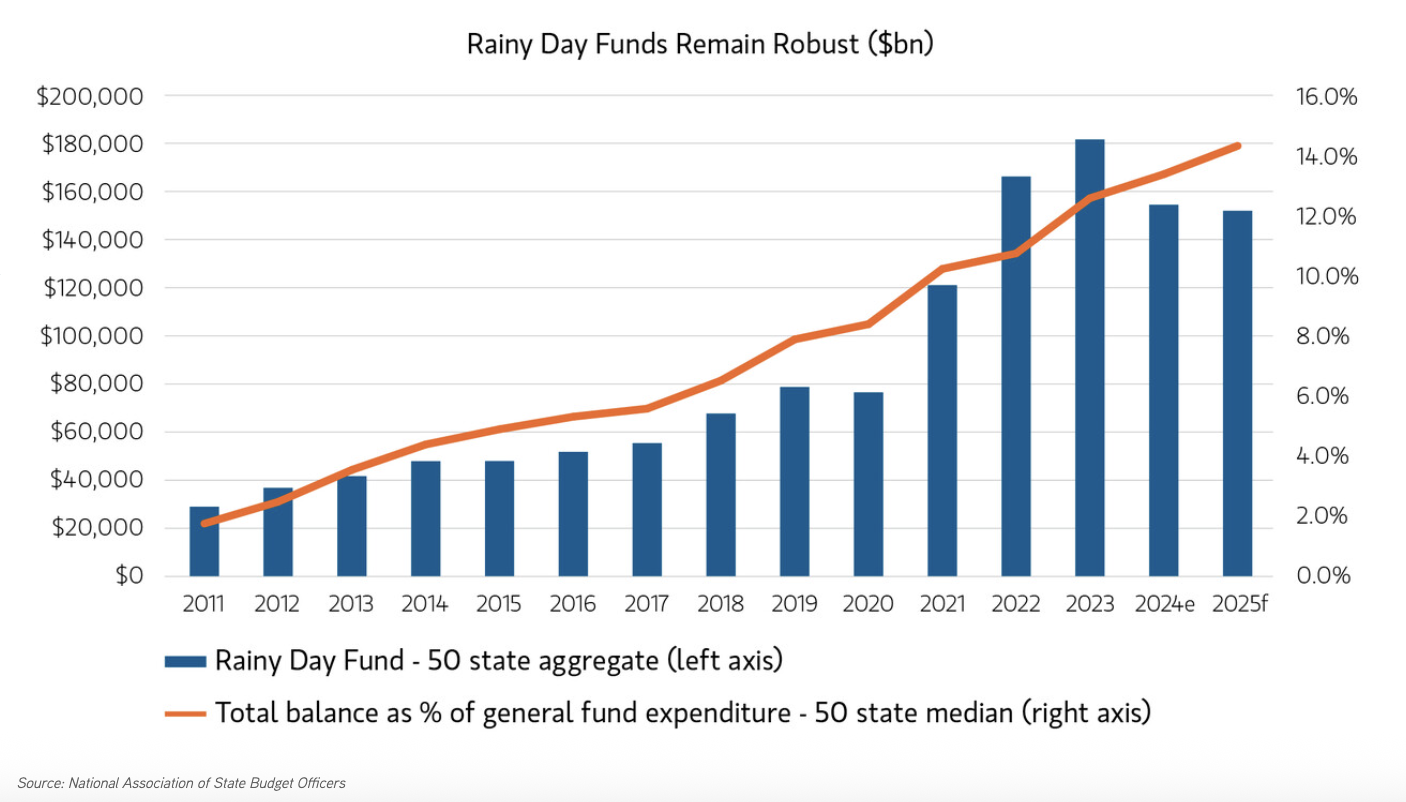
Yet states are in a strong position to address these concerns following years of solid financial management and robust reserve levels. They also have the experience of weathering past fiscal pressures, with solid debt capacity for the future after low levels of issuance in recent years.

Losing Medicaid coverage will be credit negative for hospitals
Medicaid is generally the largest expenditure in state budgets and a critical revenue source for hospitals, especially rural and critical access hospitals.1 Major reforms to Medicaid could be the most significant impact of the bill. Cutting federal Medicaid spending by approximately $990 billion over 10 years beginning in 2026 will terminate Medicaid coverage for approximately 10 million individuals by 2034, according to the Congressional Budget Office (CBO).
Stringent eligibility requirements going into effect in December 2026 will increase costs for states to perform more administrative tasks on employment verification and required audits. The OBBBA also significantly restricts the use of provider taxes and state-directed payments to support the Medicaid population’s health needs and to compensate hospitals for care provided to this population.
Smaller, rural hospitals will face the most pain
Many changes related to provider taxes and directed payments are scheduled to phase in between 2026 and 2032. According to CBO estimates, provider tax reform will reduce the federal share of Medicaid funding to states by almost $219 billion over the next decade.
Before reform really picks up in 2027 and 2028, states may have ample time to make the necessary adjustments to fill any budget gaps that may arise. While hospitals will be more directly affected, larger hospital systems may be better prepared to weather a sector downturn—thanks to their geographic footprint, broad array of service lines and revenue levers and, most importantly, solid balance sheet cushion.
Rural standalone hospitals will be more pressured by the revised legislation, because these providers are highly reliant on Medicaid reimbursements from the states due to their service area demographics. Funding cuts to Medicaid at the federal level will ultimately decrease the amount each state has to support its hospitals—amplifying the uncertain outlook for some providers within the hospital sector.
Our healthcare team prefers larger hospital systems that serve growing primary service areas, with a solid mix of payors and standalone operational stability regardless of state directed payments.
Policy changes will test higher education
Higher education is another sector where we anticipate negative impacts from the federal policy change to increase the endowment tax rate from 1.4% to 8.0% for universities with endowments per student of $2 million or more. The rate will increase to 4% for universities with endowments per student of $750,000 to $2 million and remain unchanged for any schools below that $750,000 threshold.
While this policy change will increase pressure on universities, we believe the highest endowment bracket may have enough financial flexibility to weather the higher tax rate. Our research team actively seeks university credits that are well positioned to address these headwinds.
The bottom line
While the OBBBA may impact rural and specialized hospitals, and universities with mid-size endowments, we see opportunity and resilience among larger institutions that may be better positioned to overcome the sweeping policy reforms.
A message from Advisor Perspectives and VettaFi: To learn more about this and other topics, check out some of our webcasts.
A version of this Insight, What’s the Impact of ‘One Big Beautiful Bill’ on Munis?, was originally published by Eaton Vance on Jul 25, 2025. The Municipals team is one of the largest municipal bond-focused teams in the industry, with decades of experience. They strive to meet the income and return goals of investors by offering strategies spanning the entire yield curve and credit spectrum.
1 Critical Access Hospitals (CAHs) are rural hospitals, designated by Centers for Medicare & Medicaid Services (CMS), to ensure that essential healthcare services are available in geographically isolated areas.
A version of this Insight, What’s the Impact of ‘One Big Beautiful Bill’ on Munis?, was originally published by Eaton Vance on Jul 25, 2025. The Municipals team is one of the largest municipal bond-focused teams in the industry, with decades of experience. They strive to meet the income and return goals of investors by offering strategies spanning the entire yield curve and credit spectrum.
The views expressed in these posts are those of the authors and are current only through the date stated. These views are subject to change at any time based upon market or other conditions, and Parametric and its affiliates disclaim any responsibility to update such views. These views may not be relied upon as investment advice and, because investment decisions for Parametric are based on many factors, may not be relied upon as an indication of trading intent on behalf of any Parametric strategy. The discussion herein is general in nature and is provided for informational purposes only. There is no guarantee as to its accuracy or completeness. Past performance is no guarantee of future results. All investments are subject to the risk of loss. Prospective investors should consult with a tax or legal advisor before making any investment decision. Please refer to the Disclosure page on our website for important information about investments and risks.
09.03.2026 | RO 4787341
© Parametric
Read more commentaries by Parametric