Over the summer, Carl revisited an essay detailing the array of challenges facing the U.S. healthcare system. The picture hadn’t changed much. But as the system limps along, costs have risen continually, and even higher prices are in sight.
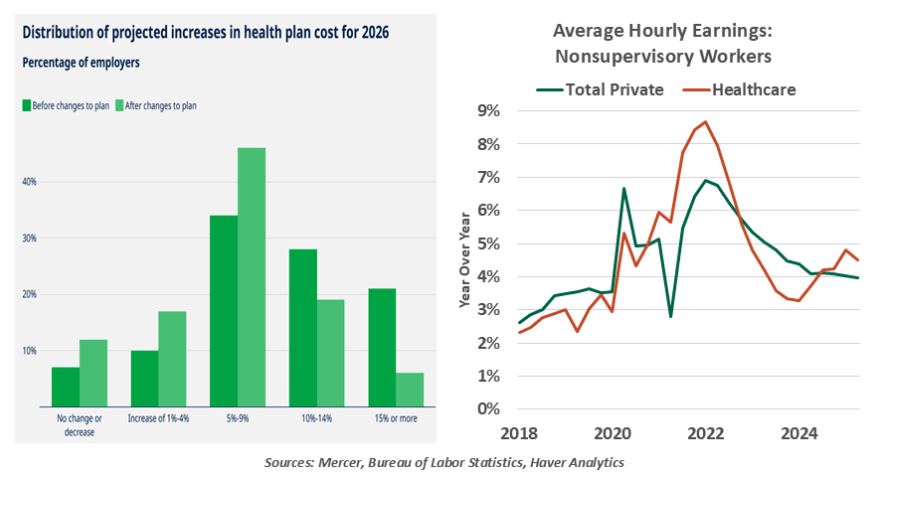
Insurance broker Aon projects U.S. employer health care costs to rise 9.5% in 2026, exceeding $17,000 per employee. A survey by consultancy Mercer forecast that a 6.5% cost increase is in store next year. Both reports pointed to a greater rate of chronic diseases and higher price pressures from new treatments, like advanced weight-loss medications. Also, more employees are using healthcare services, a lingering outcome of deferred care during the pandemic.
 Personal consumption data shows that healthcare (including insurance premiums) accounts for 17% of household spending. Roughly half the U.S. population gets health insurance through an employer policy. Employers will be challenged to design compensation plans that accommodate the cost of healthcare. The Bureau of Labor Statistics’ Employment Cost Index shows both wages and benefits have increased over time at a consistent rate. Employees take note of wage raises but may not be aware of the greater cost of insurance that their employers are absorbing.
The entire healthcare system lacks transparency, with consumers often unaware of their cost of insurance, nor the prices charged and collected for medical services. Opacity is an obstacle to reform. The insurance sector has tried to find efficiencies with constructs like health management organizations and high-deductible health plans. Past legislative efforts at broader reform met strong resistance. Congress’ only recent action was to reduce future funding for Medicaid and health exchanges in the reconciliation bill, which will push more costs onto the insurance sector.
Price pressures abound. Like many services, healthcare costs are driven by wages. Wage gains in the sector grew disproportionately in the pandemic; they are still rising. Healthcare is highly dependent on immigrant labor, and shortages may return amid tighter border policy.
Sometimes, the cure for high prices is high prices: Greater costs could compel greater reform. But inertia is difficult to overcome. We expect rising healthcare costs to be a recurring theme in our coverage for years ahead.Throughout the process, LFS updates have upheld the importance of credible public statistics. Changes have been slow, but the end result should be a more reliable product. We hope any other modifications to government data around the world are informed by this experience.
Information is not intended to be and should not be construed as an offer, solicitation or recommendation with respect to any transaction and should not be treated as legal advice, investment advice or tax advice. Under no circumstances should you rely upon this information as a substitute for obtaining specific legal or tax advice from your own professional legal or tax advisors. Information is subject to change based on market or other conditions and is not intended to influence your investment decisions.
© 2025 Northern Trust Corporation. Head Office: 50 South La Salle Street, Chicago, Illinois 60603 U.S.A. Incorporated with limited liability in the U.S. Products and services provided by subsidiaries of Northern Trust Corporation may vary in different markets and are offered in accordance with local regulation. For legal and regulatory information about individual market offices, visit northerntrust.com/terms-and-conditions.
A message from Advisor Perspectives and VettaFi: Discover something new! Click here to register for our upcoming webcasts.
© Northern Trust
Read more commentaries by Northern Trust
 Personal consumption data shows that healthcare (including insurance premiums) accounts for 17% of household spending. Roughly half the U.S. population gets health insurance through an employer policy. Employers will be challenged to design compensation plans that accommodate the cost of healthcare. The Bureau of Labor Statistics’ Employment Cost Index shows both wages and benefits have increased over time at a consistent rate. Employees take note of wage raises but may not be aware of the greater cost of insurance that their employers are absorbing.