Three Things to Know About Medicare
Membership required
Membership is now required to use this feature. To learn more:
View Membership BenefitsWith Medicare open enrollment coming up next month it's important to have a solid understanding of how the program works.
Medicare is the most important health care resource for those 65 and older, but many seniors find navigating the program and its multiple plan choices confusing.
More than 67 million individuals are enrolled in Medicare today, and that number will surpass 80 million in 20 years as more people retire. Since Medicare is a key component of meeting health care needs in retirement, it is important to understand how the program works before enrolling.
Individuals may want to review the key elements of Medicare to get started. There are several components of Medicare that participants need to understand.
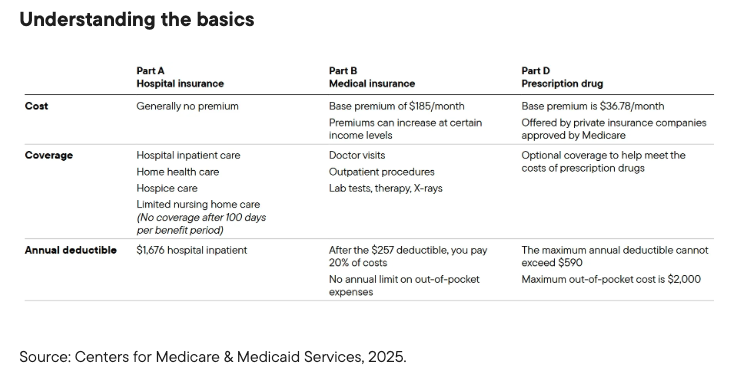
1. Enroll at the right time
To avoid potential penalties and coverage gaps, it’s critical to understand when to enroll. Most individuals should consider enrolling during their initial enrollment period (IEP), which is the seven-month period around their 65th birthday. Those already receiving benefits from Social Security are automatically enrolled in Part A and Part B starting the first day of the month they turn 65.
General enrollment period
If an individual is not automatically enrolled and missed their IEP, they can still apply for Part A and Part B during the general enrollment period, which runs from January 1 to March 31 each year. Coverage would begin in July.
Special enrollment period (SEP)
If an individual is covered under a group health plan through employment, there is a SEP to sign up, as long as they (or their spouse) is still working. This enrollment period is only available if the company has more than 20 employees. The eight-month special enrollment period starts the month after the employment ends or the group health plan insurance based on current employment ends, whichever happens first.
Penalties for missed enrollment deadlines
Medicare imposes late enrollment penalties to encourage retirees to sign up when enrollment is available. Monthly premiums may go up 10% for each full 12-month period that an individual could have had coverage but didn’t sign up for it. Although the Part B premium amount is based on income, the penalty is calculated based on the standard Part B premium regardless of income.
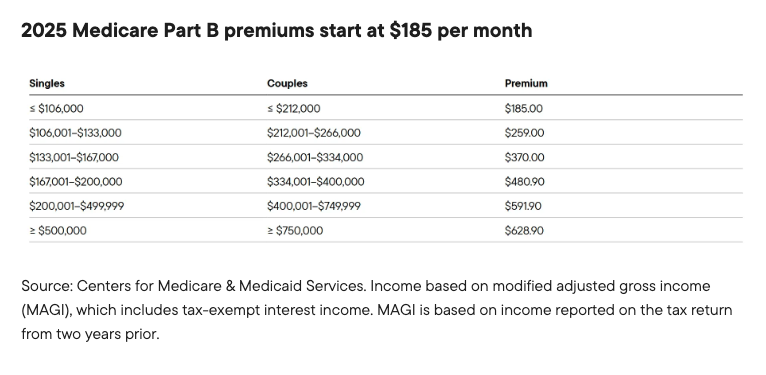
2. You may pay higher monthly premiums depending on income
Those approaching retirement should be aware that at higher income levels, they may pay higher Medicare premiums. This should be factored into planning for income and expenses in retirement.
3. Supplemental coverage is critical
Medicare does not cover everything. Since original Medicare includes deductibles and coinsurance that could lead to significant out-of-pocket expenses in retirement, it’s important to consider supplemental insurance to cover these costs. There are two options to consider—a Medicare Advantage plan (otherwise known as Medicare Part C) or Medigap coverage.
Medicare Advantage plans
Medicare Part A, Part B and often Part D coverage are bundled together in one plan. These private plans generally offer additional benefits such as vision, dental and hearing. Some Medicare co-payments and deductibles are eliminated, and there are also limits on annual out-of-pocket expenses (cannot exceed $9,350 per year). Most plans offer coverage through a health maintenance organization (HMO) or preferred provider organization (PPO). HMO plans generally require the use of health care providers within the plan’s network. PPO plans do not require that individuals see in-network providers or obtain a referral to consult a specialist.
Medigap policies
Private insurance companies offer these plans to cover certain expenses not covered by Medicare such as deductibles, copays and uncovered services. Premiums will vary depending on the area and type of plan and are paid separately from Medicare Part B premiums. Medigap policies do not usually offer prescription drug coverage. Individuals should consider enrolling at age 65 since they cannot be charged a higher premium based on their health situation. If they enroll later, they may be charged a higher premium if there are pre-existing health conditions.
Seek advice and plan for health care in retirement
To understand the basics of how Medicare works, read, “Three key things to understand about Medicare.”
Future health costs are a critical component of a retirement plan. When considering health coverage in retirement, it’s important to assess current health conditions and the potential for significant out-of-pocket expenses. Research available Medicare plans in the area and be mindful of important deadlines. As with any planning decision, securing professional advice from an expert with an understanding of your financial situation can help.
WHAT ARE THE RISKS?
All investments involve risks, including possible loss of principal.
Any information, statement or opinion set forth herein is general in nature, is not directed to or based on the financial situation or needs of any particular investor, and does not constitute, and should not be construed as investment advice, forecast of future events, a guarantee of future results, or a recommendation with respect to any particular security or investment strategy or type of retirement account. Investors seeking financial advice regarding the appropriateness of investing in any securities or investment strategies should consult their financial professional.
Franklin Templeton, its affiliated companies, and its employees are not in the business of providing tax or legal advice to taxpayers. These materials and any tax-related statements are not intended or written to be used, and cannot be used or relied upon by any such taxpayer for the purpose of avoiding tax penalties or complying with any applicable tax laws or regulations. Tax-related statements, if any, may have been written in connection with the “promotion or marketing” of the transaction(s) or matter(s) addressed by these materials, to the extent allowed by applicable law. Any such taxpayer should seek advice based on the taxpayer’s particular circumstances from an independent tax advisor.
A message from Advisor Perspectives and VettaFi: Discover something new! Click here to register for our upcoming webcasts.
IMPORTANT LEGAL INFORMATION
This material is intended to be of general interest only and should not be construed as individual investment advice or a recommendation or solicitation to buy, sell or hold any security or to adopt any investment strategy. It does not constitute legal or tax advice. This material may not be reproduced, distributed or published without prior written permission from Franklin Templeton.
The views expressed are those of the investment manager and the comments, opinions and analyses are rendered as at publication date and may change without notice. The underlying assumptions and these views are subject to change based on market and other conditions and may differ from other portfolio managers or of the firm as a whole. The information provided in this material is not intended as a complete analysis of every material fact regarding any country, region or market. There is no assurance that any prediction, projection or forecast on the economy, stock market, bond market or the economic trends of the markets will be realized. The value of investments and the income from them can go down as well as up and you may not get back the full amount that you invested. Past performance is not necessarily indicative nor a guarantee of future performance. All investments involve risks, including possible loss of principal.
Any research and analysis contained in this material has been procured by Franklin Templeton for its own purposes and may be acted upon in that connection and, as such, is provided to you incidentally. Data from third party sources may have been used in the preparation of this material and Franklin Templeton ("FT") has not independently verified, validated or audited such data. Although information has been obtained from sources that Franklin Templeton believes to be reliable, no guarantee can be given as to its accuracy and such information may be incomplete or condensed and may be subject to change at any time without notice. The mention of any individual securities should neither constitute nor be construed as a recommendation to purchase, hold or sell any securities, and the information provided regarding such individual securities (if any) is not a sufficient basis upon which to make an investment decision. FT accepts no liability whatsoever for any loss arising from use of this information and reliance upon the comments, opinions and analyses in the material is at the sole discretion of the user.
Franklin Templeton has environmental, social and governance (ESG) capabilities; however, not all strategies or products for a strategy consider “ESG” as part of their investment process.
Products, services and information may not be available in all jurisdictions and are offered outside the U.S. by other FT affiliates and/or their distributors as local laws and regulation permits. Please consult your own financial professional or Franklin Templeton institutional contact for further information on availability of products and services in your jurisdiction.
Issued in the U.S. by Franklin Templeton, One Franklin Parkway, San Mateo, California 94403-1906, (800) DIAL BEN/342-5236, franklintempleton.com. Investments are not FDIC insured; may lose value; and are not bank guaranteed.
You need Adobe Acrobat Reader to view and print PDF documents. Download a free version from Adobe's website.
CFA® and Chartered Financial Analyst® are trademarks owned by CFA Institute.
Membership required
Membership is now required to use this feature. To learn more:
View Membership BenefitsSponsored Content
Upcoming Virtual Events View All











