At this point, it’s no longer just a crypto-friendly government propelling movement forward — it’s real regulations that have been created. Previously, I wrote about the passing of the GENIUS Act into law. That legislative milestone established a federal framework for payment stablecoins. But the SEC has also opened up in-kind redemptions for authorized participants — formally approving orders to permit in-kind creations and redemptions for crypto ETFs, moving them closer to commodity ETF norms.
Most recently, the commission adopted generic listing standards so exchanges can list qualifying crypto ETFs without a 19b-4 filing each time, materially shortening timelines. In addition to these significant changes, the SEC has also actively been providing commentary and statements on several clarifying points: for instance, this no-action letter on custody of crypto assets with state-chartered trust companies and a joint statement with the CFTC stating that registered exchanges are not prohibited from facilitating the trading of certain spot commodity products.
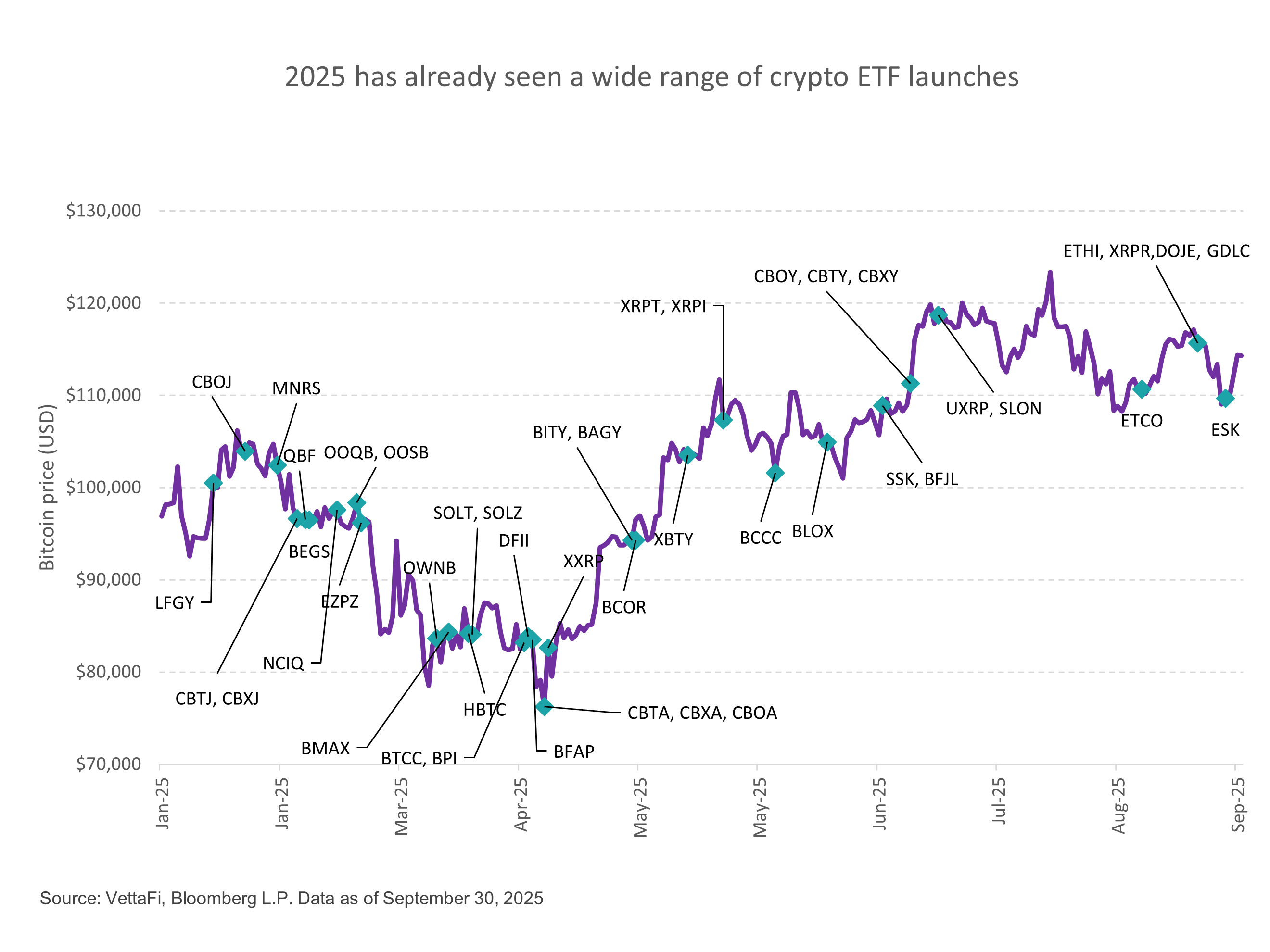
As regulatory clarity continues to take shape, adoption is moving steadily down the curve — first through institutions, then advisors, and ultimately to retail investors. With a wide range of products already in the market, we’re beginning to see a clearer picture of where investor demand is strongest and how different types of investors are choosing to access crypto.

Lower barriers to investing have created opportunities
We recently saw news on the possibility of Vanguard allowing retail investors to access spot bitcoin ETFs through its platform. This would mark a significant inflection point. If those products become available on Vanguard’s retail platform, it effectively normalizes bitcoin exposure for millions of everyday investors. It would also make it easier for advisors to include crypto in retirement accounts and brokerage portfolios. This would push adoption further into the mainstream — shifting the conversation from “if” advisors should add crypto, to “how” they should implement it.
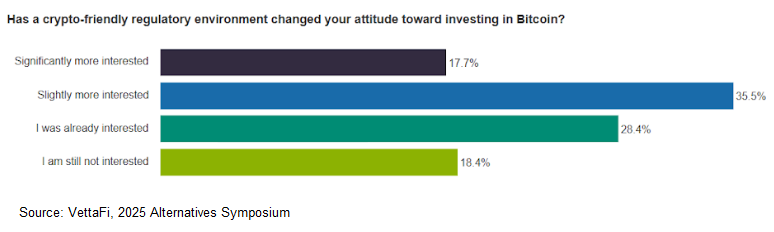
Similarly, a few large wirehouses like JP Morgan have opened up their doors to allowing investment in spot bitcoin ETFs, when previously they were not allowed. With lower barriers from large wirehouses, advisors now have the motivation to learn more about crypto and execute it in portfolios. VettaFi has hosted webinars with crypto ETF issuers where advisor engagement has been strong and pro-crypto. In fact, in a recent poll during our Alternatives Symposium with CoinShares, over half of advisors said they’re either slightly more or significantly more interested in allocating to bitcoin in a more regulatory-friendly environment. Note that this does not include almost 30% who said they were already interested.
Crypto draws the speculation crowd
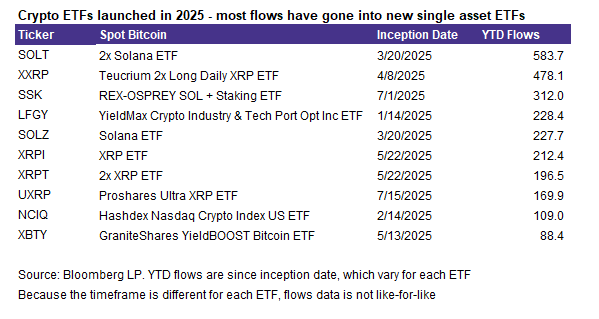
Retail investors have always been the core driver of ETF growth. While bitcoin has moved firmly into the mainstream, adoption of other cryptocurrencies and related strategies has been less certain. What we’ve seen so far is that single-asset ETFs tend to capture attention more quickly — similar to the way retail traders often gravitate toward single-stock bets rather than diversified portfolios. Crypto, for many self-directed investors, still carries a speculative lens and draws a crowd that overlaps with the audience trading leveraged and other single-stock ETFs (often short-term rather than long-term).
Newer products like the 2x Solana ETF (SOLT) and the Teucrium 2x Long Daily XRP ETF (XXRP) along with 1940 Act spot structures from Rex-Osprey (like the REX-Osprey SOL + Staking ETF (SSK)) have been popular with investors. This gives many investors, particularly self-directed retail investors, the tools to explore new potential growth avenues outside of Bitcoin. Notably Rex-Osprey launched the first ether staking ETF — the REX-Osprey ETH +Staking ETF (ESK). It also launched the first XRP and DOGE ETFs — the REX-Osprey XRP ETF (XRPR) and the Rex-Osprey DOGE ETF (DOJE).
Note that these ETFs were able to be approved far ahead of their peers because of their 1940 Act structure (in contrast to a 1933 structure which is common for commodities), which can access crypto exposure in different ways. For example, the Solana ETF gives access to the underlying asset primarily through non-U.S. ETFs. And in the case of the XRP and DOGE products, it also purchases the currency directly on an exchange like Coinbase or Kraken.
Multitoken ETFs remain a nascent category
On the analyst side, there has been a lot of interest surrounding the Grayscale CoinDesk Crypto 5 ETF (GDLC), which recently converted into an ETF structure after seeing some delays from the SEC. GDLC is heavily concentrated in bitcoin, with a 73% weight, along with allocations to ethereum (16%), XRP (6%), Solana (4%), and Cardano (1%). Despite the launch, GDLC has seen outflows since its conversion last week — not completely unexpected, since many existing investors use the conversion as an opportunity to sell the fund. However, I expect investors will understand the value of this product more closely as they start seeing crypto as its own asset class and realize diversification is worth it. But as stated above, many investors aren’t yet thinking long-term with crypto.
Other similar products also exist in this space, which have been gaining some attention. The Hashdex Nasdaq Crypto Index US ETF (NCIQ) was also recently expanded to hold Solana, Cardano, XRP, and Stellar Lumens in addition to bitcoin and ether. Bitwise is also in the process of converting its Bitwise 10 Crypto Index Fund into an ETF. And 21Shares currently has potential filings for two funds — the 21Shares FTSE Crypto 10 Index ETF and the 21Shares FTSE Crypto 10 ex-BTC Index ETF. The latter is particularly interesting because it excludes bitcoin and distributes a more significant weight to the rest of its 10 holdings.
More shifts to strategic allocations in the future
The number of new product launches shows that ETF issuers are leaning in. Around 45 ETFs have already been launched. A large number of filings are in the pipeline (Solana, XRP, Litecoin, Dogecoin, and Cardano among several others). For now, I expect the strongest demand to remain around single-asset ETFs, which allow investors to make tactical moves on specific tokens. But as crypto continues to move further into the mainstream, we could see interest shift toward broader, strategic allocations through multitoken ETFs that provide diversified exposure in a single wrapper.
At the same time, it will be important to watch both the regulatory landscape and investment barriers closely. These factors play a key role in shaping how and when retail investors gain access, and ultimately determine the pace at which crypto ETFs transition from speculative tools to core building blocks within portfolios.
Next week I will be attending the North American Blockchain Summit (NABS) in Dallas where industry experts and policymakers come together to discuss digital assets. For more information (including tickets), visit https://www.northamericanblockchainsummit.com/
For more news, information, and analysis, visit VettaFi | ETF Trends.
A message from Advisor Perspectives and VettaFi: Discover something new! Click here to register for our upcoming webcasts.
Read more commentaries by VettaFi