The fourth quarter is typically – seasonally – positive for U.S. equities. An ongoing government shutdown is not a strong backdrop for markets, but major indices remain close to record highs, waiting for new data for direction. It looks like a good time to be cautiously optimistic, or to get a little defensive, maybe add a little gold, and steer clear of highly valued stocks. And yet, growth as an investment style remains a winning strategy through the market’s ups and downs.
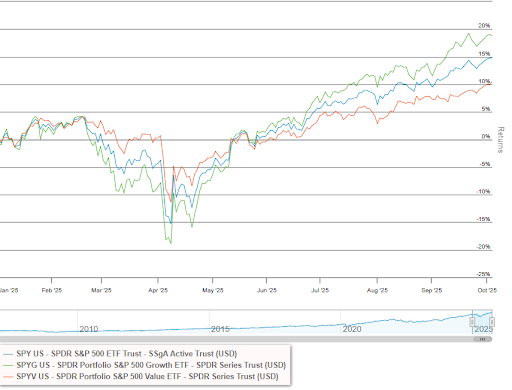
Consider the S&P 500 universe of stocks. If we plot the SPDR S&P 500 Growth ETF (SPYG) against the S&P 500 itself (as measured by SPY), we see that growth outpaced the broader market by more than 2 percentage points in Q3, rising nearly 10%. Relative to value, measured here by the SPDR S&P 500 Value ETF (SPYV), growth’s outperformance exceeded 4 percentage points in the quarter.
Year-to-date, growth’s outperformance has been persistent, beating SPY by at least 4 percentage points and value by roughly 9 points this year.
SPYG’s portfolio is led by all those well-known growth names, like the Magnificent 7, Broadcom, Eli Lilly. About 43% of the portfolio’s sector exposure sits in technology, another 15% in communications services. This is a basket with notable concentration and sector tilts.
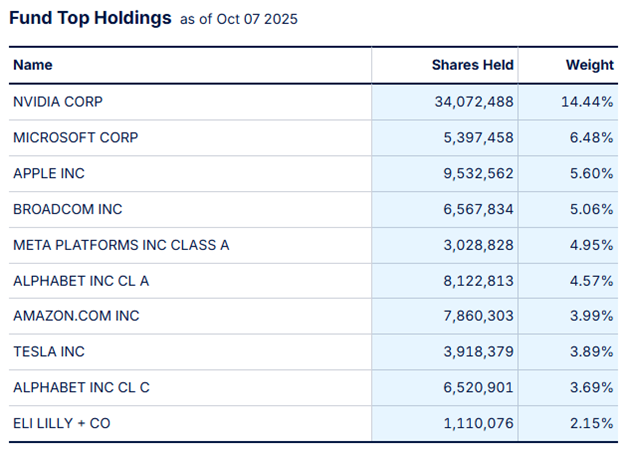
Source: State Street Investment Management
SPYG tracks the S&P 500 Growth Index, holding the growthiest names in the S&P 500 Index, as measured by sales growth, earnings change to price, and momentum, according to the methodology. In a market that has gotten this top heavy, it’s not surprising to see that kind of concentration here.
But there are other ways to access growth. ETFs make it easy to choose other paths. Consider two:
- A growth ETF that uses free cash flow as a leading metric for stock selection, the VictoryShares Free Cash Flow Growth ETF (GFLW).
GFLW looks to capture highly profitable growth companies. The fund screens for profitability by looking at 12- month trailing and 12-month forward FCF, which is a measure of a company’s financial health.
Starting from a universe of about 1000 stocks, GFLW owns about 400 names. The stocks are weighted based on FCF, size and momentum, and individual securities are capped at 4% weight.
By focusing on profitability in a universe of growth stocks, top holdings look different than a traditional market-cap approach. Technology snags about 38% of the portfolio’s sector exposure, but there are a lot more consumer names and twice as much healthcare in this fund.
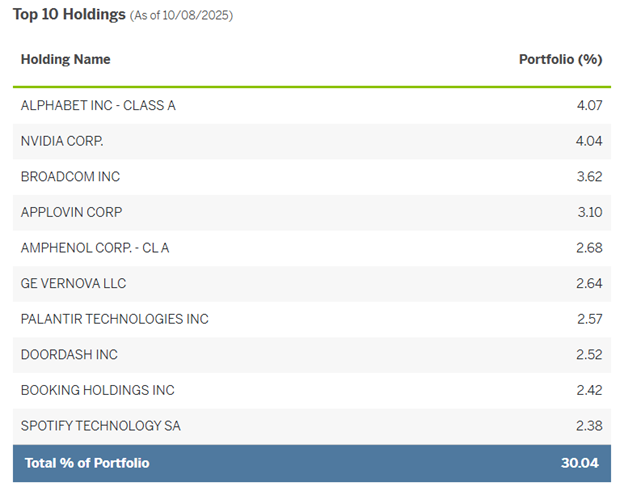
Source: Victory Capital
This provides a holistic look at a company’s financial health while offering a forward-looking approach to FCF investing.
Companies with negative average trailing and forward FCF, or negative FCF growth are removed at each quarterly rebalance. The strategy then selects the top 400 companies by float market cap.
ETF approach, which looks for growing companies that are highly profitable as a way to deliver sustainable, diverse growth and manage concentration risk. Think of quality, stable growth. Funds like GFLW.
2. A growth ETF that looks for companies in hypergrowth mode, the Golden Eagle Dynamic Hypergrowth ETF (HYP).
HYP is a brand new, one-of-a-kind approach in the ETF space. The fund captures the fastest growing companies in the market today by investing only in those that have a revenue growth rate of 40% or more annually. For perspective, according to Marc Zuccaro, Managing Principal and Portfolio Manager, a typical growth company sees annual revenue growth ranging from 7% to 20%.
What’s interesting in this approach is that, perhaps surprisingly, it isn’t tech heavy. Instead, it captures quickly growing companies across all sectors – many of which have benefited from technology disruption and innovation to fuel growth. For that sector diversification alone, HYP offers unique diversification in the growth category.
At the security level, it also offers little overlap to other portfolios. According to the manager, hypergrowth stocks comprise, on average, just 3% of the S&P 500 and 6% of the Nasdaq 100.
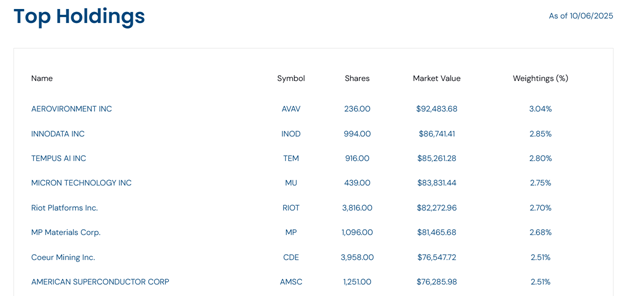
Source: Golden Eagle
HYP is a high turnover portfolio, and it captures topline growth, meaning it may at any time own several unprofitable companies. But the fund looks to potentially capture stock price jumps that can accompany high growth mode, and be an interesting complement to a growth strategy,
As we navigate Q4, still faced with uncertainty and concentration risk, growth – whether traditional, high quality or high octane – may still be an interesting segment for those looking for equity risk.
VettaFi LLC (“VettaFi”) is the index provider for GFLW, for which it receives an index licensing fee. However, [GFLW is not issued, sponsored, endorsed, or sold by VettaFi, and VettaFi has no obligation or liability in connection with the issuance, administration, marketing, or trading of GFLW.
Originally published on ETF Trends
For more news, information, and analysis, visit VettaFi | ETF Trends.
A message from Advisor Perspectives and VettaFi: Discover something new! Click here to register for our upcoming webcasts.
