China’s Trojan Horse Rolls Through Latin America
Membership required
Membership is now required to use this feature. To learn more:
View Membership BenefitsWhen China’s massive Belt and Road Initiative (BRI) launched in 2013, I was a great admirer. On paper, it was—and remains—the most ambitious infrastructure project in human history, a modern-day Silk Road stretching from Asia to Europe, Africa and the Americas.
As the years have passed, however, I’ve come to see the BRI as a Trojan Horse, quietly rolling through emerging markets while Washington looks elsewhere. That’s especially true in Latin America and the Caribbean (LAC).
Today, I believe that unless the U.S. can offer LAC economies credible, long-term alternatives on infrastructure, technology, defense and more, it risks giving up influence in its own backyard, for decades to come.
Chancay Port: A New Era of Chinese Control
In November of last year, Chinese President Xi Jinping was in Peru, cutting the ribbon on the $1.3 billion Chancay deep-water port. As the first “smart port” in South America—boasting a network of highways, railways, data cables and power grids—Chancay was built by Chinese state-owned shipping giant COSCO, which also operates the property.
Beijing claims the port will generate 8,000 jobs and slash shipping costs between China and South America by 20%. It will also cut roughly 10 days off transportation times, giving China an edge in trade and supply chains across the hemisphere.
The Center for Strategic and International Studies (CSIS) estimates that, once fully expanded, Chancay could handle 3.5 million containers per year, potentially making it the third-largest port in Latin America, and the largest controlled entirely by a Chinese state-owned enterprise.
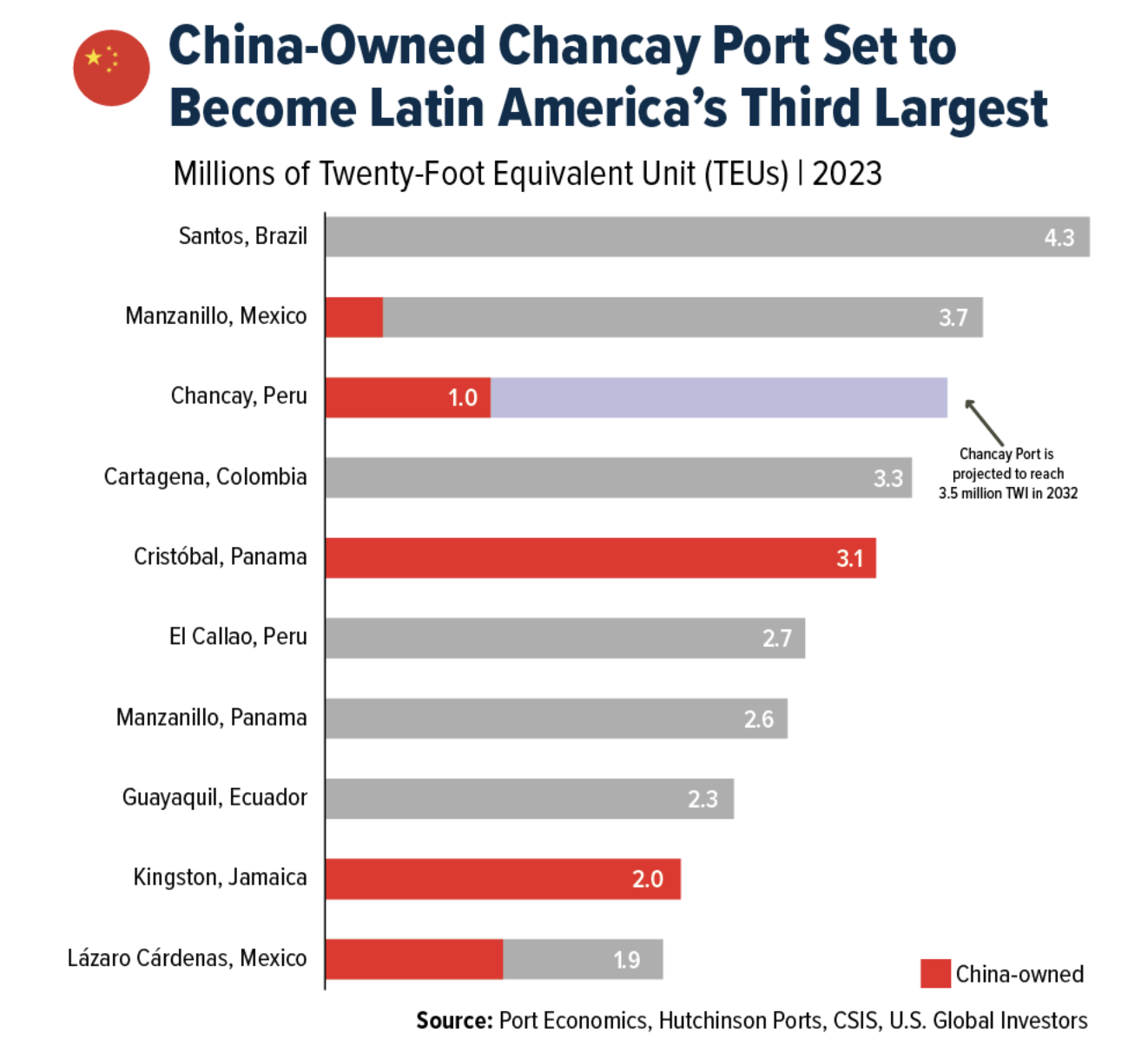
The CSIS, in fact, has identified 37 seaports in LAC with ties to Chinese companies. For comparison’s sake, the U.S. does not operate any ports in the region.
China’s Influence Reaches Every Corner of the Continent
How did we get here? After joining the World Trade Organization (WTO) in 2001, China’s trade with Latin America grew an average of 31% a year for approximately the next decade. In 2024, bilateral trade between the two regions hit $518 billion, overtaking the U.S. as South America’s top trading partner.
Analysts expect that figure to reach $700 billion by 2035. China is the largest buyer of Argentina’s lithium, Venezuela’s crude and Brazil’s soybeans and iron ore.
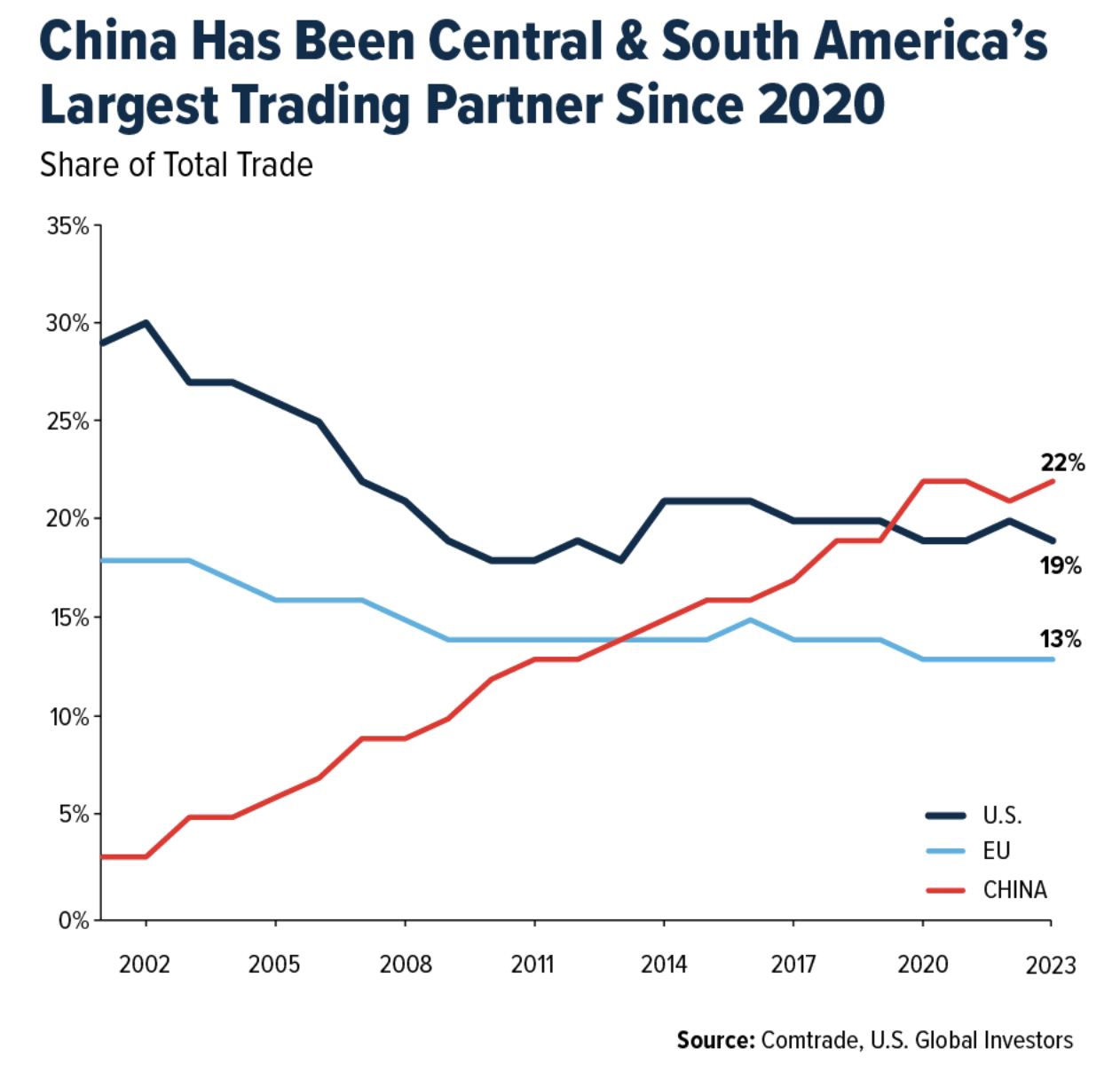
The world’s second-largest economy is also the main builder of infrastructure, from metro stations in Bogotá and Mexico City to hydroelectric dams in Ecuador. In just two decades, Beijing has financed over $286 billion in Latin American projects, approaching its total investment in Africa.
One such example—besides the Chancay seaport—is Chile’s new China-Chile Express submarine cable, which aims to link the Pacific coast directly to Hong Kong. Some experts warn, however, that the project could exposure the continent to China’s 2017 Cybersecurity Law, which could compel companies to cooperate with Chinese state intelligence.
$180 Billion-Per-Year Infrastructure Spending Gap
For the U.S., I believe this is as much a crisis of neglect as it is of strategy.
While Washington has focused more on counterterrorism and short-term aid programs in LAC, China has played the long game, financing ports, railways and power grids. This in turn has helped foster goodwill and shaped its relationship with the region for decades and perhaps generations to come.
Between 2000 and 2021, Beijing financed an estimated $1.5 trillion worth of overseas development projects, 85% of them as loans rather than aid, making the country the largest official creditor to emerging markets.
In contrast, total U.S. foreign assistance, which has averaged around 1% of the federal budget, has barely kept pace with inflation (and, indeed, has been gutted by the second Trump administration.)
This has allowed China to present itself as the only offer on the table. Latin America’s infrastructure deficit is enormous at an estimated $180 billion a year through 2030, according to the Inter-American Development Bank (IDB). As the Heritage Foundation’s Michael Cummingham warned last year: “It’s not like Washington gave [Latin America] a better alternative… The region’s demand for infrastructure makes it ripe for the picking.”
China’s Military and Security Presence
Trade is only part of the story. China is expanding its military and security presence in the region too.
China now operates or co-manages at least eight ground stations in Latin America, including deep-space tracking centers in Argentina, Venezuela, Bolivia, Chila and Brazil. These stations provide the People’s Liberation Army (PLA) with global telemetry coverage and real-time spatial data.
Under the Global Security Initiative (GSI), proposed by Xi in 2022, Beijing has shifted toward domestic security, supplying tactical gear and facial-recognition systems to police forces from Panama to Ecuador. Huawei-built “Safe City” networks can now be found in more than 35 Latin American municipalities, integrating thousands of cameras and emergency centers under Chinese-managed software.
Even the BRI blurs the line between civilian and military use. Peru’s Chancay Port could serve future naval logistics for the PLA, while the Espacio Lejano space station in Neuquén, Argentina, already supports China’s hypersonic and satellite-tracking capabilities.
The Yuan’s Ascent
All of this coincides with the Chinese yuan’s ascent as a foreign reserve asset and settlement currency.
According to the Bank for International Settlements (BIS), the yuan now accounts for 8.5% of global transactions, up from 7% just three years ago and closing in on the British pound’s 10.2% share. The U.S. dollar remains the global leader by far, representing nearly 90% of all transactions, but the yuan has made impressive strides, quadrupling its share of total transactions since 2013.
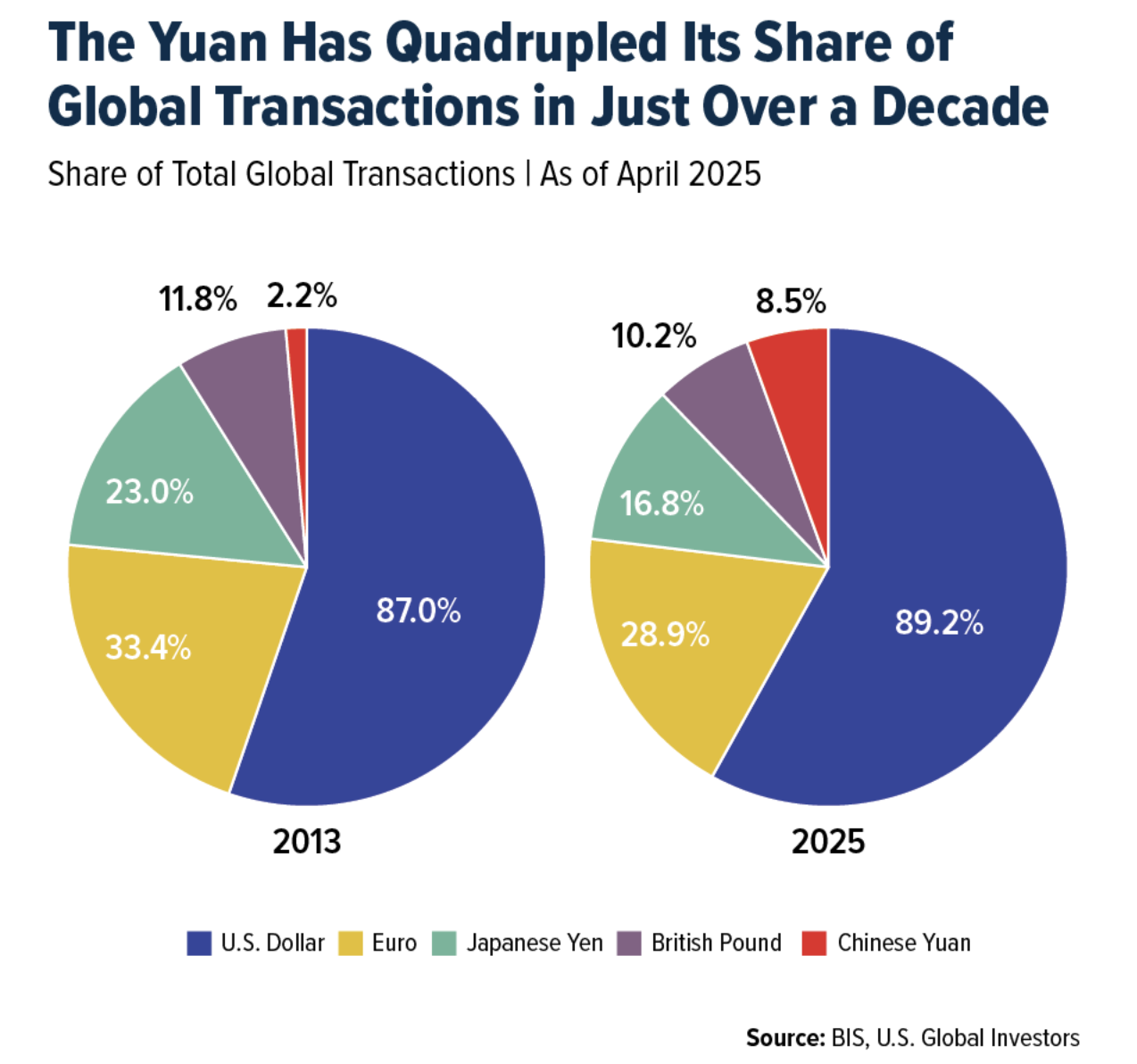
As The Economist put it, China’s leader’s “sense an epic opportunity.” Fiscal deficits and political gridlock in the U.S. have shaken confidence in the greenback, which had its worst start to a year since 1973; meanwhile, Beijing is pushing yuan-denominated trade through its Belt and Road partners.
A Lasting Foothold in the Global South
China’s strategy goes far beyond infrastructure projects, of course. It seeks to gain a lasting foothold in the Global South, with the BRI as its Trojan Horse.
This week, Beijing announced it would further tighten export rules on rare earths, minerals that are vital to semiconductors and defense systems. This prompted President Trump to threaten sweeping new tariffs.
At the same time, the People’s Bank of China logged its 11th consecutive month of gold purchases, extending its push to de-dollarize and insulate its economy from U.S. sanctions and currency shocks.
Taken together, these moves reveal China’s imperial ambitions, which include a network of ports, power grids and rails—all designed not only to move goods but also exert influence.
Index Summary
- The major market indices finished down this week. The Dow Jones Industrial Average lost 2.73%. The S&P 500 Stock Index fell 2.43%, while the Nasdaq Composite fell 2.53%. The Russell 2000 small capitalization index lost 3.29% this week.
- The Hang Seng Composite lost 3.40% this week; while Taiwan was up 2.02% and the KOSPI rose 1.73%.
- The 10-year Treasury bond yield fell 6 basis points to 4.06%.
Airlines and Shipping
Strengths
- The best-performing airline stock for the week was International Consolidated Airlines, up 4.8%. RBC reports Airbus delivered 73 aircraft in September, up 46% year-over-year. This included 59 A320 family jets, 9 A220s, 4 A330s, and 1 A350. Third-quarter 2025 deliveries reached 201, up 16% year-over-year.
- Crude tanker ton-mile demand rose 14% year-over-year in September 2025, driven by higher exports from the Middle East and U.S. Bank of America notes little disruption so far to Russian crude flows. VLCC spot rates dipped below $70,000/day as tight ship availability eased during China’s holiday period.
- Delta’s third-quarter EPS of $1.71 beat consensus of $1.52, according to Raymond James. Corporate sales rose 8% year-over-year. Domestic RASM turned positive, from -5% in the second quarter to +2% in the third. Premium sales rose 9%, while main cabin fell 4%. Loyalty revenues also rose 9%.
Weaknesses
- The worst-performing airline stock for the week was Frontier, down 13.8%. In India, according to J.P. Morgan, domestic air traffic growth remained weak at -1.5% year-over-year in the second quarter of fiscal year 2026, compared to 4% growth in the first quarter. However, higher fares have more than offset the negative impact.
- Clarkson Research reported car carrier charter rates (6,500-unit capacity) at $42,500 per day in September, down 59.5% year-over-year and 5.6% month-over-month, according to Morgan Stanley. This marks the third consecutive monthly decline.
- According to Goldman Sachs, a recent motion regarding Spirit’s agreements with several lessors shows that 87 of 109 leased aircraft listed in the motion will be rejected. In total, the aircraft rejected across both motions represent 53% of Spirit’s fleet.
Opportunities
- According to TD, U.S. passenger throughput had another strong month in September, the second consecutive month that traffic growth outpaced seat supply growth. TD views this as a positive signal for forward pricing trends.
- Morgan Stanley now expects shipping companies to maintain minimum dividends despite declining freight rates, estimating appropriate dividend yields in the 6–7% range.
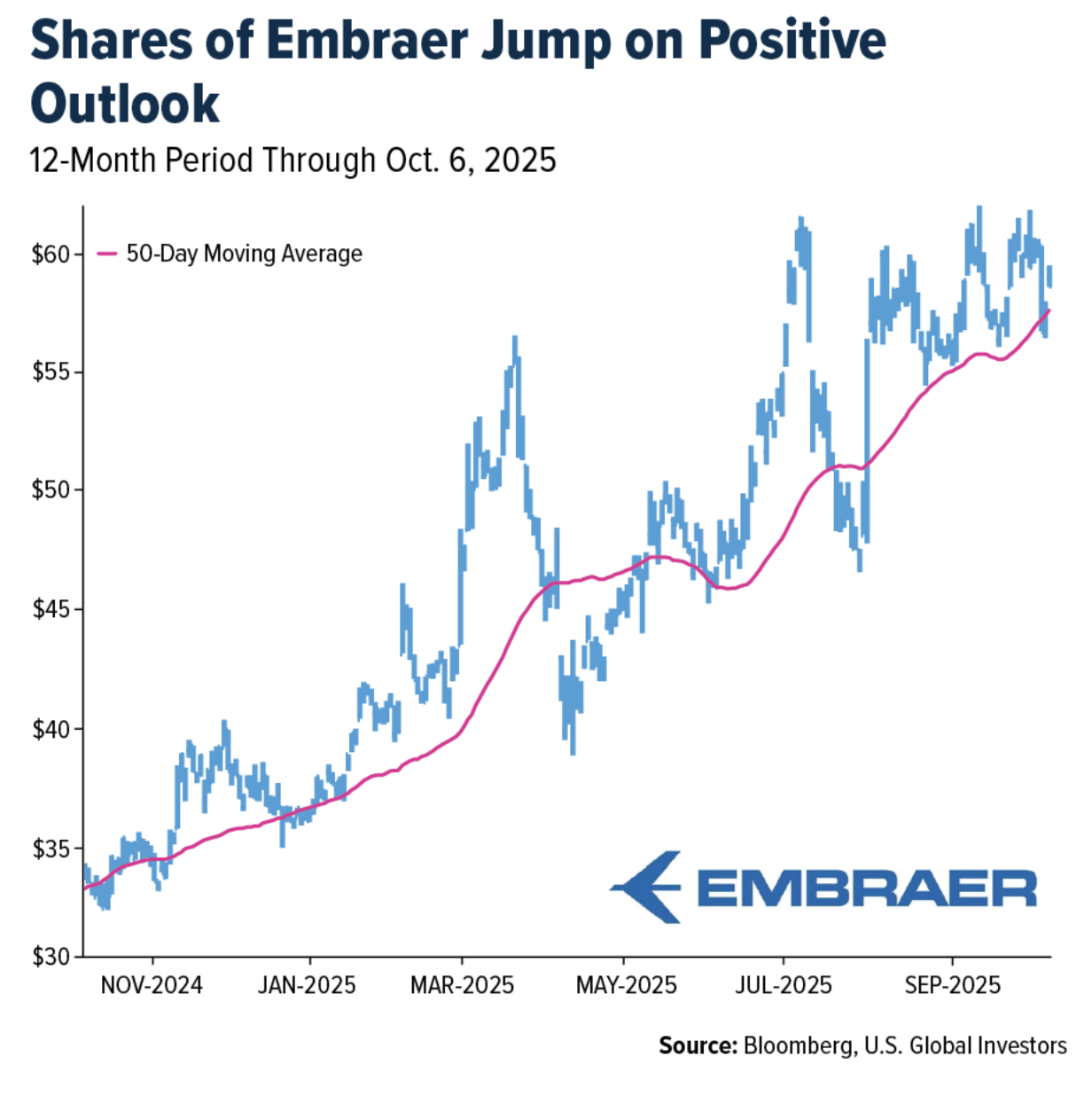
- Key catalysts for Embraer, according to Morgan Stanley, include: 1) incremental E2 orders from flagship carriers; 2) additional firm orders for the KC-390; and 3) full removal of the remaining 10% tariff on Embraer aircraft exported to the U.S
Threats
- The Secretary of Transportation noted on Monday that funding for the country’s Essential Air Service (EAS) program, which subsidizes air service to rural airports, will expire on October 12 if the government shutdown continues. SkyWest has the most exposure among TD’s coverage universe.
- There has been a notable softening in the container shipping market, and Goldman Sachs is lowering its earnings estimates for shipping companies to reflect this. They see few near-term catalysts to improve supply-demand dynamics and believe it’s a time to focus on cash flow levels.
- Ryanair’s CEO believes Wizz Air is in trouble. Looking ahead, he predicts Air France-KLM may acquire easyJet’s operations in Paris and Switzerland, and that British Airways could take over its slots at Gatwick. He added that easyJet is “not growing” due to a limited footprint, while Wizz Air’s “growth has stopped.”
Luxury Goods and International Markets
Strengths
- During China’s Golden Week holiday, the country saw 888 million domestic trips and total spending of 809 billion yuan (about $113.5 billion USD) over the eight-day period. While tourist activity surged, retail sales grew 3.3% year-on-year in the holiday’s early days, although slightly weaker than expected.
- The DAX Index reached a new record high this week, supported by renewed optimism over Germany’s decision to ease its strict fiscal rules and increase public investment. Strong performances from industrial and technology stocks added further momentum, reflecting improving business confidence and expectations of a mild recovery across Europe’s largest economy.
- Star Entertainment, the Australian casino, hospitality and entertainment operator, led the S&P Global Luxury Index with a 17.6% gain. The company secured a covenant waiver from its lenders, easing near-term liquidity pressure.
Weaknesses
- Porsche’s sales in China dropped by about 21% in the third quarter. The weakness reflects slowing demand in China’s premium car market, where increased competition from local electric vehicle brands and cautious consumer spending have weighed on performance.
- France is now on its fifth prime minister in two years. Political instability could lead to tougher taxation or regulatory shifts, weaker growth expectations, and renewed investor caution. French luxury players like LVMH, Hermès and Kering sold off this week on news of the new incoming Prime Minister.
- Aston Martin, the British luxury automaker that designs, manufactures, and sells high-end sports cars, was the worst-performing stock in the S&P Global Luxury Index, plunging 27.35% this week. Aston Martin’s shares plunged because the company issued a surprise profit warning, citing weak demand (especially in the U.S. and China) and rising costs from tariffs.
Opportunities
- The cruise industry continues to see strong demand, and in response, many lines are building new ships and adding new routes. For example, Norwegian Line has contracted with Fincantieri to build four major new vessels worth around €9 billion. At the same time, cruise operators are expanding deployment in high-demand regions like the Caribbean, increasing the number of ships dedicated to those routes.
- Donald Trump is reportedly considering extending tariff relief for U.S. carmakers that produce vehicles domestically, which could benefit companies like Ford, GM, Tesla, Toyota and Honda. Under the proposal, automakers would receive a tariff offset (currently set at 3.75%) on U.S.-assembled vehicles for up to five years, and eligibility might be expanded to include U.S.-made engines. This relief would lower production costs and improve profit margins for those with strong domestic manufacturing footprints.
- Hilton is expanding aggressively across the U.S. and Canada to capitalize on strong travel demand. It recently surpassed 200 hotels in Canada and has over 100 properties in development across multiple brands there. The company is also launching a new lifestyle brand, Outset Collection, with plans for more than 60 properties in development in North America. By increasing its footprint and diversifying its brand offerings, Hilton is positioning itself to capture more of the rising flow of travelers.
Threats
- Tesla reported record sales in the third quarter of 2025. However, sales in the fourth quarter of 2025 may experience a slowdown following the expiration of the $7,500 federal EV tax credit on September 30, 2025. The loss of this incentive could reduce near-term consumer demand, as many buyers accelerated purchases ahead of the deadline, potentially leading to a softer delivery outlook heading into year-end.
- Ferrari has become more volatile, sometimes gaining or losing more than 10% in a single day, largely because of surprises in its strategy or financial guidance. For example, at its recent Capital Markets Day, the company cut its long-term electric-vehicle targets, issued conservative 2030 growth projections, and disappointed investors who had higher expectations.
-
Mercedes-Benz’s 27% drop in sales in China during the third quarter of 2025 poses a threat to the company’s future growth. With China being one of its largest markets, continued weakness and rising competition from local EV makers could pressure sales and profitability in the coming quarters, making it harder for Mercedes to sustain its global momentum.
Energy and Natural Resources
Strengths
-
Aluminum was the best-performing commodity last week, up 3.72%. Rio Tinto is in emergency talks with Australian officials to keep its Tomago smelter running beyond 2028, as soaring electricity costs threaten to shut down the country’s largest facility, currently using over 10% of New South Wales’ power. A taxpayer-backed rescue may be needed, underscoring challenges for Australia’s energy-intensive metals sector amid rising costs and Chinese competition.
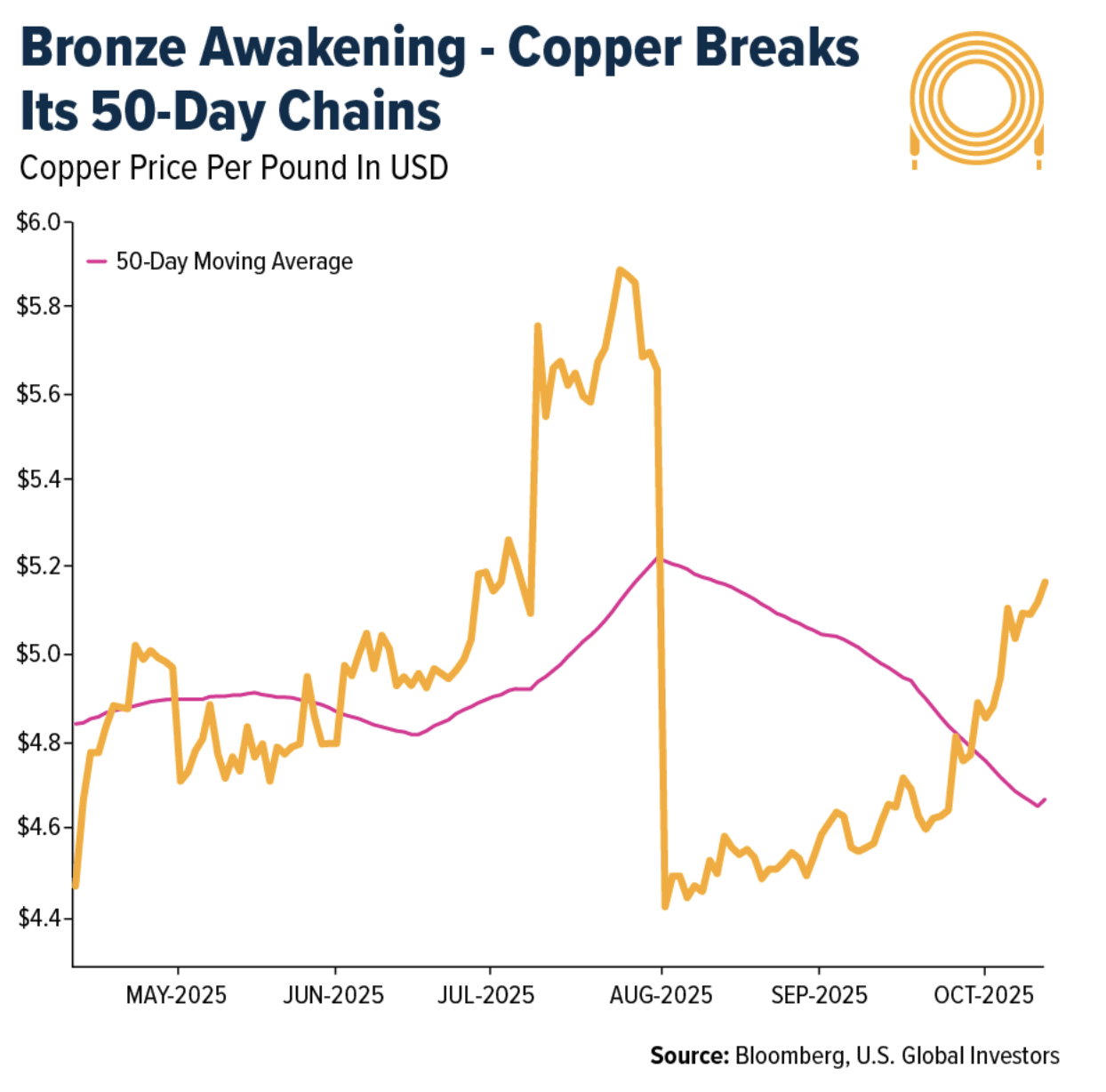
- Copper briefly topped $11,000 per ton last week, driven by tight supply as ESG hurdles, politics, and operational issues disrupt nearly 25% of global output. While Chile and Peru struggle with red tape, Zambia is emerging as a growth leader, aiming to triple production by 2030. However, prices fell over 4% Friday after President Trump said he’s considering major tariffs on China over its dominance in rare earth metals.
- The S&P Global Clean Energy Transition Index has surged nearly 50% since April, outperforming the S&P 500 and gold. Growth is fueled by rising demand for renewables to power AI, lower U.S. interest rates, and strong capital flows into climate-focused funds from firms like Brookfield and Resolution Investors—despite pushback on green policies.
Weaknesses
- Natural gas was the worst-performing commodity last week, down 5.57%. Oil also fell 3.25% as easing Middle East tensions and a looming supply surplus pushed West Texas Intermediate below $60 and Brent under $64—both at their lowest since June. The postponxement of Putin’s Russia–Arab summit added to bearish sentiment, exposing cracks in the OPEC+ alliance just as members agreed to raise output, raising concerns over weakening coordination amid U.S. sanctions, Chinese refinery crackdowns, and Gaza ceasefire progress.
- Ford has canceled lithium deliveries from Liontown’s Kathleen Valley project for 2027–2028, cutting total supply in half to 256,250 tons. The revised deal reflects broader EV supply chain issues and Ford’s reevaluation of its EV strategy amid weak sales.
- Teck Resources cut its 2025 copper production forecast to 170,000–190,000 tonnes due to continued setbacks at the Quebrada Blanca mine, with disruptions likely into 2026. Despite delays, Teck and Anglo American reaffirm confidence in their merger and the long-term potential of the project.
Opportunities
- Turkey is exploring a partnership with the U.S. to develop rare-earth reserves in western Anatolia, shifting away from slower talks with China and Russia over tech transfer issues. The move could weaken China’s dominance in rare-earth processing and align Turkey with Western supply chain diversification efforts.
- U.S.-listed rare earth and critical mineral stocks rallied ahead of a Trump-Xi summit, as China imposed new export restrictions requiring licenses for products using trace rare earths. The news sparked expectations of tighter supply and rising prices, lifting shares in both the U.S. and Asia.
- Nano One Materials was prequalified by Rio Tinto for lithium raw materials and continues to expand its lithium iron phosphate (LFP) cathode tech. Sumitomo and Rio Tinto, its two largest shareholders, are backing its growth and commercial deployment.
Threats
- China controls around 70% of the world’s rare-earth refining capacity, giving it significant influence over global supply. This has drawn criticism from Trump, who threatened new tariffs on Friday. China has also imposed export restrictions on other key tech metals like gallium and germanium. Meanwhile, it continues to build its gold reserves—now estimated at over 2,000 tons—as a hedge against U.S. dollar risk and to boost its influence in global currency and commodity markets.
- Nano Nuclear Energy Inc., despite having no revenue, licenses, or operational power plants, has reached a valuation above $2.3 billion—fueled by optimism around AI’s rising energy demands and nuclear’s potential role. While investor interest in nuclear startups like Oklo, NuScale, and Centrus reflects clean energy momentum, analysts caution that long timelines, regulatory barriers, and supply chain risks may make current valuations overly optimistic in the near term.
- Egypt has requested to delay at least 20 LNG shipments originally scheduled through December, rescheduling them for the first quarter of 2026 due to weaker-than-expected demand. The move aims to redirect supply to European buyers and ease LNG prices amid a recent surge in Egypt’s imports.
Bitcoin and Digital Assets
Strengths
- Of the cryptocurrencies tracked by CoinMarketCap, the best performer for the week was Zcash, rising 68.74%.
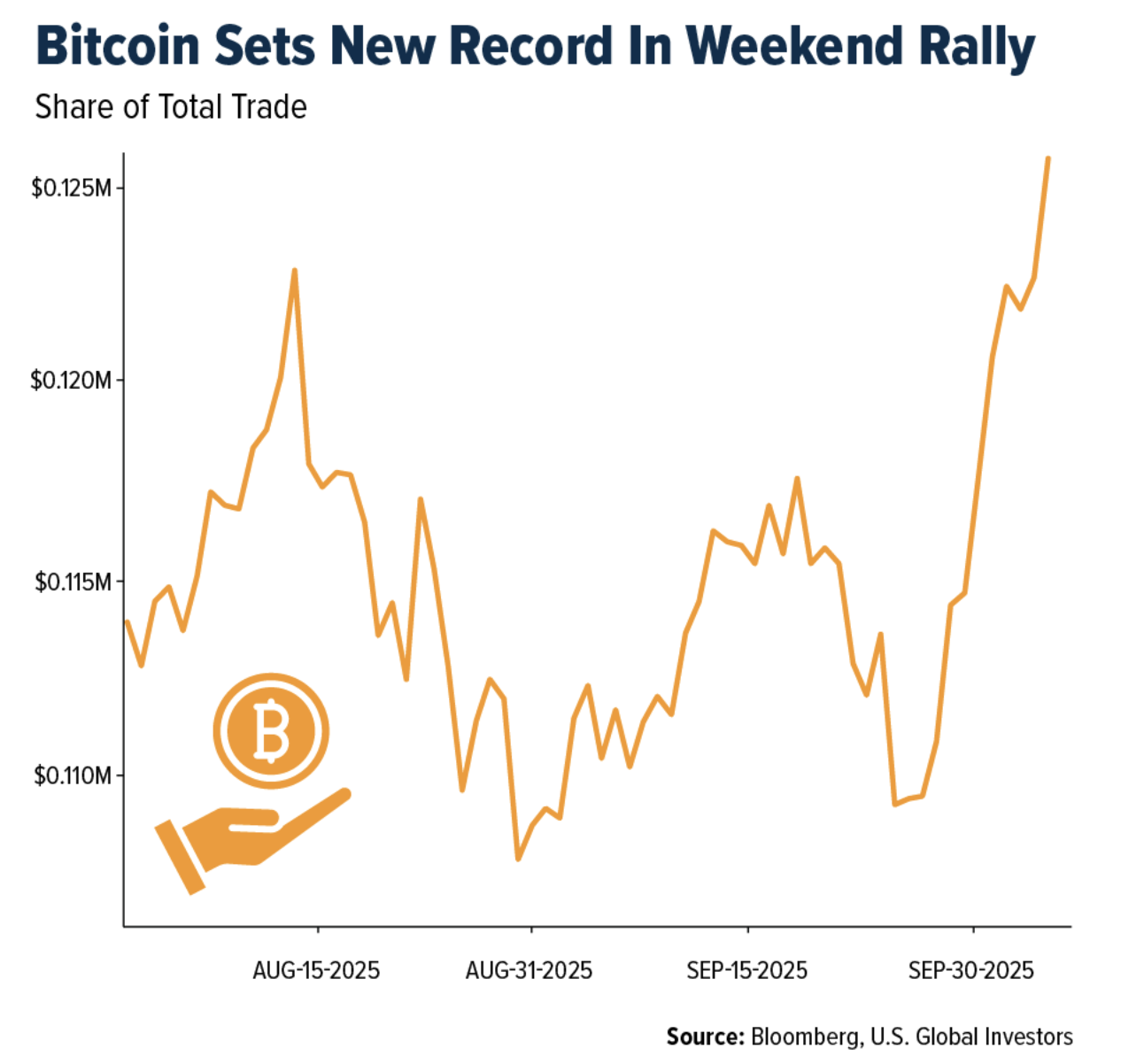
- Bitcoin (BTC) hit a new all-time high on Sunday, climbing to $125,689 as investors sought safe-haven assets amid the ongoing U.S. government shutdown. Traders see potential resistance at $135,000, with $150,000 in sight if the rally continues, according to Bloomberg.
- A Winklevoss-backed crypto firm, OranjeBTC, announced plans to expand in Brazil following its public listing on the Brazilian stock exchange. The company aims to increase its Bitcoin holdings and launch new educational programs to promote broader adoption of digital assets. Its education arm will offer courses, events, and training to help grow Brazil’s crypto ecosystem.
Weaknesses
- Of the cryptocurrencies tracked by CoinMarketCap, the worst performing for the week was MYX Finance, down 45.74%.
- In the Trump administration’s latest move to scale back cryptocurrency enforcement, Roger Ver, a well-known crypto investor, agreed to pay about $48 million to settle a tax fraud case with the U.S. Department of Justice.
- Shares of BitMine Immersion Technologies were volatile in early trading, falling as much as 3.5% before recovering to a 1% gain. The stock initially dropped after Kerrisdale Capital released a short report on the company, which is focused on Ethereum (ETH) treasury operations. BitMine counts Fundstrat Global Advisors founder Thomas Lee as its board chairman, Bloomberg reports.
Opportunities
- HashKey Group, operator of Hong Kong’s largest licensed crypto exchange, has confidentially filed for an IPO in the city, according to Bloomberg. The listing could occur as soon as this year, signaling growing institutional interest in Asia’s regulated crypto markets.
- Deutsche Bank analysts predict that by 2030, central banks could hold significant amounts of Bitcoin and gold as reserve assets, citing the weakening U.S. dollar and the rising institutional acceptance of cryptocurrencies.
- Morgan Stanley announced it will expand access to crypto investments for all of its clients, including those with retirement accounts. Starting October 15, financial advisors will be permitted to offer crypto funds to any client, not just those with an aggressive risk tolerance or over $1.5 million in assets, according to Bloomberg.
Threats
- Stablecoin issuers operating in California face uncertainty over which regulations to follow amid overlapping state and federal frameworks. Depending on how the federal government interprets the Genius Act, firms may have to choose between state licensing or a federal pathway, according to Bloomberg.
- Ethereum (ETH) traded near $4,100 on Friday after a sharp selloff from $4,700, triggered by renewed U.S. regulatory concerns. Technical indicators suggest that momentum currently favors sellers.
- The European Union (EU) has proposed sanctions on A7A5, a ruble-backed stablecoin allegedly tied to sanctioned Russian actors. The proposed measures would ban EU-based entities from conducting any transactions involving the token.
Defense and Cybersecurity
Strengths
- AMD surged this week after announcing a multi-year partnership with OpenAI to supply AI chips, alongside new collaborations with IBM and Zyphra, to build next-generation infrastructure on IBM Cloud. These alliances significantly enhance AMD’s competitive standing against Nvidia and reaffirm investor confidence in its long-term AI strategy.
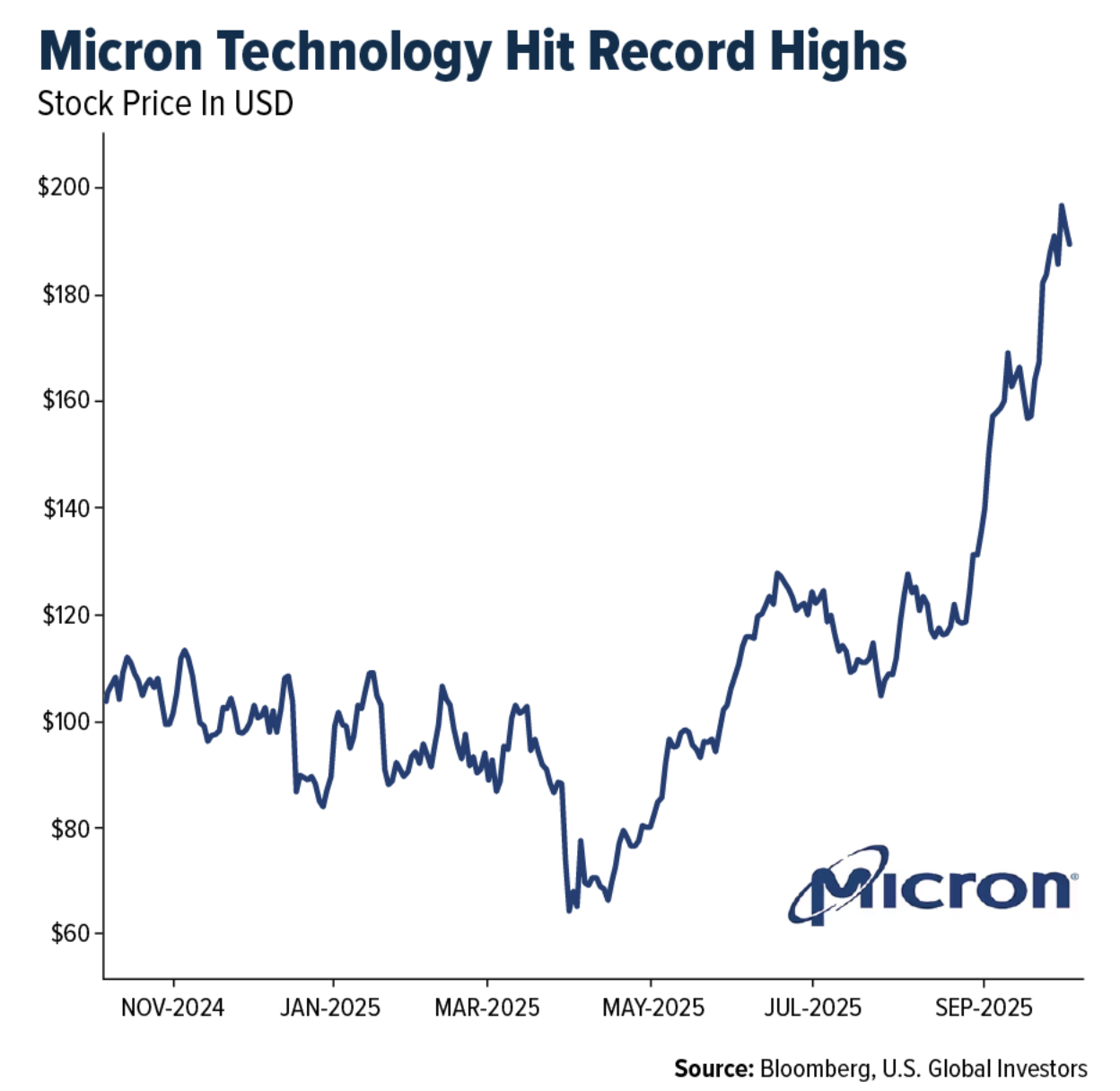
- Micron Technology hit record highs as it unveiled its next-generation HBM4 chips, delivering 2.8 TB/s bandwidth and outperforming rivals Samsung and SK Hynix in the race to power AI infrastructure.
- The best performing stock for this week was Byrna Technologies. The company rose 16.64% after reporting strong fiscal Q3 results with 35% year-over-year revenue growth, driven by a new celebrity-endorsed marketing strategy and expanding retail presence that boosted brand visibility and sales momentum.
Weaknesses
- Russia continues to launch near-daily, large-scale strikes on Ukraine’s energy infrastructure, crippling power generation and grid stability ahead of winter. The escalation is further fueled by Putin’s announcement of an upcoming new weapon and Donald Trump’s remarks suggesting the possible transfer of Tomahawk missiles to Ukraine, intensifying fears of a broader confrontation.
- Microsoft continues to face a severe data center shortage, limiting Azure capacity in key regions until at least 2026. The shortage highlights the strain of AI workloads and underscores the urgency of scaling global infrastructure faster.
- The worst performing stock this week was Redwire. Shares fell 18.55% after the company announced a $200 million secondary stock offering and a major insider sale, which raised concerns about share dilution and triggered a sell-off among investors.
Opportunities
- Nvidia’s $2 billion investment in Elon Musk’s xAI and priority GPU supply for the $18 billion Colossus 2 data center near Memphis, reinforces its leadership in AI infrastructure and deepened integration across next-generation computing platforms.
- Rheinmetall ramped up drone production in Sardinia, securing over €200 million in new orders for reconnaissance and counter-drone systems. The expansion positions the company as a major European supplier in the rapidly growing unmanned systems market.
- Oracle’s NATO partnership to build secure private 5G networks strengthens its role in defense communications and cybersecurity, opening new avenues for long-term government contracts and technological influence.
Threats
- Chinese state-linked hackers have targeted major U.S. law firms such as Williams & Connolly, prompting FBI involvement. The attack underscores escalating cyber-espionage risks in sectors tied to national security and defense contracting.
- The U.S. Department of Transportation’s proposed ban on Chinese airlines flying over Russian airspace could disrupt trade and jeopardize negotiations for the sale of up to 500 jets to China, posing risks to the global aerospace industry.
- AI-related corporate debt has surged to $1.2 trillion, becoming the largest segment in the investment-grade market. The rapid buildup raises concerns of financial overextension across highly leveraged tech companies exposed to the AI boom.
Gold Market
This week gold futures closed at $4,030.30, up $121.40 per ounce, or 3.11%. Gold stocks, as measured by the NYSE Arca Gold Miners Index, ended the week lower by 2.02%. The S&P/TSX Venture Index came in up 1.74%. The U.S. Trade-Weighted Dollar surged 1.25%.
Strengths
- Palladium was the best-performing precious metal of the week, up 13.65%. Generation Mining improved its outlook as palladium surged nearly 10%—its biggest gain since May 2023—thanks to gold’s record-breaking move above $4,000 per ounce. The rally signaled renewed investor interest in precious metals. Generation Mining’s appointment of Clinton Swemmer as Vice President of Projects adds over 25 years of experience to help advance the Marathon Copper-Palladium Project with discipline and strong exposure to rising palladium prices.
- According to Canaccord, K92 Mining reported quarterly production of 44,300 ounces of gold from its Kainantu Gold Mine in Papua New Guinea, a 30% increase from the previous quarter. Having already produced more than 80% of its annual target in the first three quarters, K92 appears on track to meet its 2025 guidance of 160,000 to 185,000 ounces of gold.
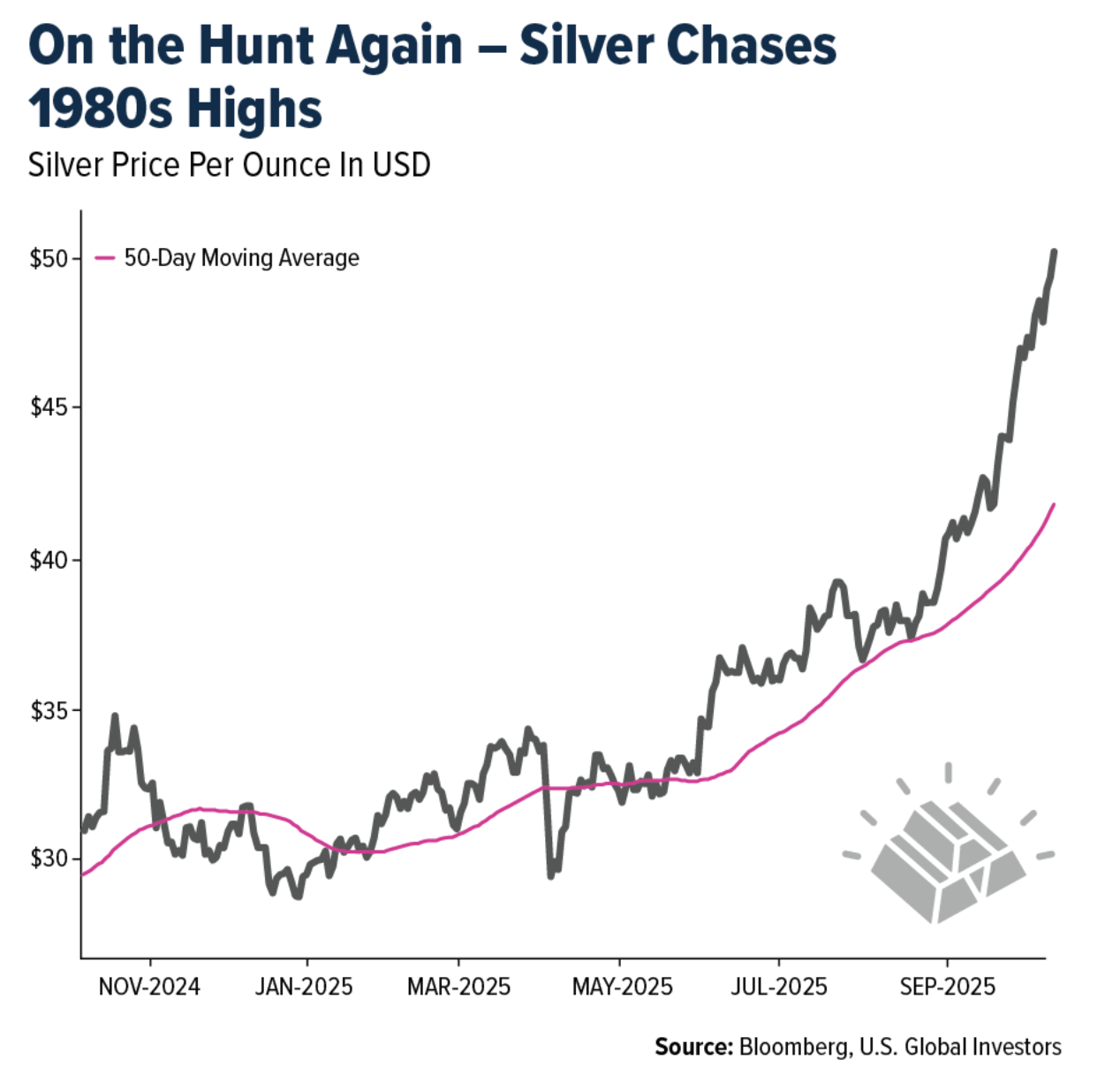
- Spot silver prices jumped to their highest level in decades as strong demand for safe-haven assets worsened supply shortages in the London bullion market. Silver climbed as much as 2.3% past $50 an ounce on Thursday, the highest since the Hunt brothers’ historic squeeze in the 1980s, according to Bloomberg.
Weaknesses
- Silver was the worst-performing precious metal of the week, down just 0.48%. Despite the modest dip, silver’s rally remains impressive: prices have surged past $50 for the first time since the Hunt brothers’ infamous 1980 cornering attempt, up 66% year-to-date and outpacing gold’s record-breaking run. A growing physical shortage—reflected in one-month lease rates spiking to 35%—along with booming industrial demand from China’s electric vehicle (EV) and solar sectors, has fueled what some are calling a “New Silver Hunt.” ETF inflows and bullish forecasts suggest the rally could continue.
- Barrick Gold announced the sale of its Tongon Mine in Côte d’Ivoire to a private Ivorian company for up to $305 million. While the sale was expected, the price came in below estimates—BMO’s $529 million net asset value (NAV) and the consensus estimate of $488 million.
- Dundee Precious Metals faced challenges after the Ecuadorian government revoked the environmental license for its Loma Larga gold project. Government spokesperson Carolina Jaramillo said the decision was based on studies by local authorities but emphasized that mining companies complying with their contracts have no reason to fear losing their licenses.
Opportunities
- Bank of America projects that strong free cash flow (FCF) generation in 2025 will lead to higher shareholder returns. Total capital returns among North American precious metal producers are forecast to rise 67% to $9.7 billion, including $5.7 billion in share buybacks and $4.0 billion in dividends.
- The Wall Street Journal published a story titled “Gold Is a Hedge Against Central Banks.” Interestingly, it wasn’t about central banks buying gold at all, focusing instead on Japan’s new leader, Sanae Takaichi, who advocates for policies to make national debt more manageable, likely through lower interest rates. Her stance suggests a shift toward government-led economic direction, similar to President Donald Trump’s interventionist approach. If Japan, one of the world’s largest economies, pursues such a policy, it could fuel global inflation, further supporting gold.
- UBS analysts noted that if spot gold holds above $4,000 per ounce, they would raise their fiscal-year 2026 and 2027 forecasts by 7% and 11%, respectively, while consensus forecasts could rise 9% and 13%. Although cost inflation has largely caught up to the industry, continued production growth and free cash flow generation should keep gold miners attractive. UBS expects strong balance sheets and healthy cash generation to support ongoing shareholder returns.
Threats
- Gold’s rapid climb toward $4,000 per ounce has been driven by political instability, falling bond yields, and strong central bank buying. Analysts warn that prices may soon consolidate. Events such as a potential U.S. government shutdown, unrest in France, and leadership changes in Japan have all contributed to the rally, while the People’s Bank of China continues expanding its gold reserves, according to Bloomberg.
- Bank of America also warns that several technical indicators suggest gold’s uptrend may be losing steam. Historically, after seven straight weekly gains, gold has fallen within the following month 100% of the time since 1983.
- The bank further notes that gold is currently 70% above its 200-week simple moving average (SMA)—a condition seen only three times before (September 2011, March 2008, and May 2006), each marking major peaks followed by 20%–33% corrections. Gold is also 140% above its 200-month SMA, another signal that corrections may be due.
U.S. Global Investors, Inc. is an investment adviser registered with the Securities and Exchange Commission (“SEC”). This does not mean that we are sponsored, recommended, or approved by the SEC, or that our abilities or qualifications in any respect have been passed upon by the SEC or any officer of the SEC.
This commentary should not be considered a solicitation or offering of any investment product. Certain materials in this commentary may contain dated information. The information provided was current at the time of publication. Some links above may be directed to third-party websites. U.S. Global Investors does not endorse all information supplied by these websites and is not responsible for their content. All opinions expressed and data provided are subject to change without notice. Some of these opinions may not be appropriate to every investor.
Holdings may change daily. Holdings are reported as of the most recent quarter-end. The following securities mentioned in the article were held by one or more accounts managed by U.S. Global Investors as of (09/30/2025):
Ferrari
Mercedes-Benz
Tesla
Hilton
LVMH
Hermes
Kering
Porsche
Airbus
Delta Air Lines
Embraer
Wizz Air Holdings
SkyWest Inc.
Air France KLM
Micron Technology
Teck Resources
Nano One Materials
K92
Barrick Mining
*The above-mentioned indices are not total returns. These returns reflect simple appreciation only and do not reflect dividend reinvestment.
The Dow Jones Industrial Average is a price-weighted average of 30 blue chip stocks that are generally leaders in their industry. The S&P 500 Stock Index is a widely recognized capitalization-weighted index of 500 common stock prices in U.S. companies. The Nasdaq Composite Index is a capitalization-weighted index of all Nasdaq National Market and SmallCap stocks. The Russell 2000 Index® is a U.S. equity index measuring the performance of the 2,000 smallest companies in the Russell 3000®, a widely recognized small-cap index.
The Hang Seng Composite Index is a market capitalization-weighted index that comprises the top 200 companies listed on Stock Exchange of Hong Kong, based on average market cap for the 12 months. The Taiwan Stock Exchange Index is a capitalization-weighted index of all listed common shares traded on the Taiwan Stock Exchange. The Korea Stock Price Index is a capitalization-weighted index of all common shares and preferred shares on the Korean Stock Exchanges.
The Philadelphia Stock Exchange Gold and Silver Index (XAU) is a capitalization-weighted index that includes the leading companies involved in the mining of gold and silver. The U.S. Trade Weighted Dollar Index provides a general indication of the international value of the U.S. dollar. The S&P/TSX Canadian Gold Capped Sector Index is a modified capitalization-weighted index, whose equity weights are capped 25 percent and index constituents are derived from a subset stock pool of S&P/TSX Composite Index stocks. The NYSE Arca Gold Miners Index is a modified market capitalization weighted index comprised of publicly traded companies involved primarily in the mining for gold and silver. The S&P/TSX Venture Composite Index is a broad market indicator for the Canadian venture capital market. The index is market capitalization weighted and, at its inception, included 531 companies. A quarterly revision process is used to remove companies that comprise less than 0.05% of the weight of the index, and add companies whose weight, when included, will be greater than 0.05% of the index.
The S&P 500 Energy Index is a capitalization-weighted index that tracks the companies in the energy sector as a subset of the S&P 500. The S&P 500 Materials Index is a capitalization-weighted index that tracks the companies in the material sector as a subset of the S&P 500. The S&P 500 Financials Index is a capitalization-weighted index. The index was developed with a base level of 10 for the 1941-43 base period. The S&P 500 Industrials Index is a Materials Index is a capitalization-weighted index that tracks the companies in the industrial sector as a subset of the S&P 500. The S&P 500 Consumer Discretionary Index is a capitalization-weighted index that tracks the companies in the consumer discretionary sector as a subset of the S&P 500. The S&P 500 Information Technology Index is a capitalization-weighted index that tracks the companies in the information technology sector as a subset of the S&P 500. The S&P 500 Consumer Staples Index is a Materials Index is a capitalization-weighted index that tracks the companies in the consumer staples sector as a subset of the S&P 500. The S&P 500 Utilities Index is a capitalization-weighted index that tracks the companies in the utilities sector as a subset of the S&P 500. The S&P 500 Healthcare Index is a capitalization-weighted index that tracks the companies in the healthcare sector as a subset of the S&P 500. The S&P 500 Telecom Index is a Materials Index is a capitalization-weighted index that tracks the companies in the telecom sector as a subset of the S&P 500.
The Consumer Price Index (CPI) is one of the most widely recognized price measures for tracking the price of a market basket of goods and services purchased by individuals. The weights of components are based on consumer spending patterns. The Purchasing Manager’s Index is an indicator of the economic health of the manufacturing sector. The PMI index is based on five major indicators: new orders, inventory levels, production, supplier deliveries and the employment environment. Gross domestic product (GDP) is the monetary value of all the finished goods and services produced within a country’s borders in a specific time period, though GDP is usually calculated on an annual basis. It includes all private and public consumption, government outlays, investments and exports less imports that occur within a defined territory.
The S&P Global Luxury Index is comprised of 80 of the largest publicly traded companies engaged in the production or distribution of luxury goods or the provision of luxury services that meet specific investibility requirements.
The DAX Index is Germany’s benchmark stock market index, tracking the performance of the 40 largest publicly traded companies listed on the Frankfurt Stock Exchange.
The S&P 500 Equal Weight Index is a version of the S&P 500 index where each of its approximately 500 constituent companies holds an equal dollar value, unlike the traditional market-cap weighted S&P 500 where larger companies have a greater impact.
A basis point (bp) is a standard unit of measurement in finance equal to 0.01% or 1/100th of 1 percent.
Standard deviation measures how spread out a set of data is from its average (mean).
The Relative Strength Index (RSI) is a popular technical indicator that measures the speed and magnitude of recent price changes to identify overbought or oversold conditions in a security, oscillating between 0 and 100.
A message from Advisor Perspectives and VettaFi: Discover something new! Click here to register for our upcoming webcasts.
Membership required
Membership is now required to use this feature. To learn more:
View Membership BenefitsSponsored Content
Upcoming Virtual Events View All













