Summary
- The U.S. has become the largest global exporter of natural gas liquids (NGLs) due to robust cost-advantaged supply and rising global demand for plastics, capturing 46% of the seaborne propane and butane market in 2024.
- Midstream companies have been investing in NGL infrastructure across the value chain, to connect the output from wells to coastal export facilities.
- Export capacity continues to grow, with incumbents expanding their footprints and new players entering the export business.
The U.S. has become the world’s top producer of natural gas liquids (NGLs) thanks to abundant supplies. Rising worldwide demand for plastics and clean fuels has sent U.S. NGL exports soaring, establishing a compelling long-term growth story for midstream players. Learn more below about the NGL value chain, infrastructure projects being built to support export growth, and how investors can gain exposure to the sector.
Understanding the NGL Value Chain
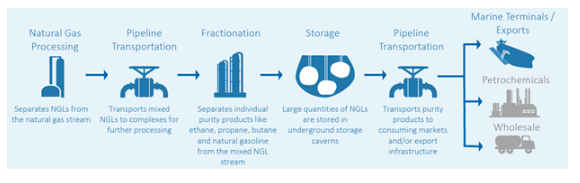
NGLs are produced at the wellhead along with oil and raw natural gas. The combined natural gas stream is then sent to a processing plant to separate mixed NGLs from the dry gas. This separate stream of “y-grade” mixed NGLs is transported through pipelines to a fractionation facility, where the NGLs get separated into individual “purity products” (ethane, propane, butane, isobutane, and natural gasoline). After separation, these purity products are stored or transported to their final destinations.

Source: Enterprise Products Partners (EPD) Investor Deck, 8/11/25
These purity products are essential commodities with their own distinct demand drivers. Ethane is the most abundant NGL. It serves as a feedstock to produce ethylene, the building block for plastics and industrial products. Propane is widely used as a cooking or heating fuel but is less known for its role in drying crops and producing propylene, which is another plastic building block. Heavier NGLs like butane and natural gasoline are blended into motor gasoline. Isobutane is often grouped with butane and is used as a feedstock to produce alkylate, another gasoline component. It’s common for propane, butane, and isobutane to be combined as liquefied petroleum gas (LPG).
Domestic NGL consumption, measured as product supplied, rose 6.8% in 2024 to a record 3.7 million barrels per day (MMBpd) according to the U.S. Energy Information Administration (EIA). Ethane consumption led the growth, rising 9.3% as existing petrochemical plants (which turn ethane into ethylene) ran at higher rates. The EIA forecasts that 2025 will average 3.8 MMBpd, a stable level of NGL demand that is expected to hold steady through 2026. For context, the EIA forecasts U.S. NGL production of 7.3 MMBpd for 2025 and 7.5 MMBpd for 2026, with excess supply directed to the export market.
U.S. Dominates Global NGL Exports
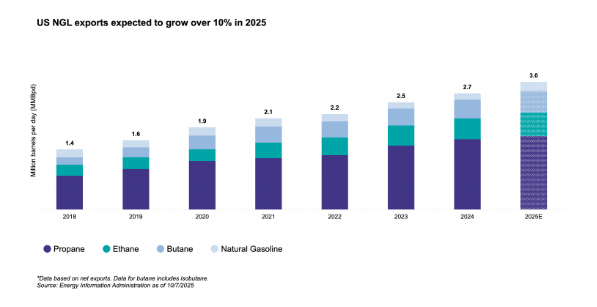
The U.S. has become the world’s leading low-cost supplier of NGLs, creating a massive and growing export business. Immense production from the shale boom has created a significant price advantage over international competitors, which has allowed the U.S. to capture 46% of the global seaborne LPG market, up from 29% in 2016. Led by propane, which accounts for most shipments, total U.S. NGL exports are on track to exceed 3.0 MMBpd in 2025. Growth in ethane exports has also been a key story. The EIA expects U.S. ethane net exports to grow 14% in 2025 and 16% in 2026 due to growing global demand from international plastics manufacturers, U.S. export capacity expansions, and larger ethane tankers.
The outlook for continued export growth is rooted in the Permian Basin. Enterprise Products Partners (EPD) projects that the Permian will represent 85% of the total 1.3 MMBpd of U.S. NGL production growth by 2030. This growing Permian supply is well-positioned to meet international needs. The International Energy Agency (IEA) forecasts that overall LPG consumption will increase by 1.3 MMBpd to 11.8 MMBpd from 2024 to 2030, and that global ethane demand will grow by 0.6 MMBpd to 5.2 MMBpd in the same time frame.
Amid ongoing trade tensions, it bears noting that China has been a large buyer of U.S. ethane, as well as LPGs to a lesser extent. In 2024, China bought 47% of U.S. ethane exports. This trade is anchored by Energy Transfer (ET)’s long-term agreement to supply Satellite Chemical, a China petrochemical giant, with 150 thousand barrels per day (MBpd), representing ~58% of all U.S. ethane sent to China in 2024. China received a much smaller share of U.S. LPG exports at 16% in 2024, with a varied customer base being led by Japan (26%).
Midstream Expansion Projects Support NGL Export Growth
A significant wave of midstream investment is underway, with numerous projects designed to support rising U.S. NGL production and strong international demand. In the Permian Basin, ET, Enterprise Products Partners (EPD), MPLX (MPLX), ONEOK (OKE), and Targa Resources (TRGP) are in total building at least 2.9 billion cubic feet per day (Bcf/d) of new natural gas processing capacity. TRGP accounts for the largest portion of this expansion with nearly 1.4 Bcf/d under construction across five new plants.
To transport raw NGLs from the Permian to fractionation facilities on the Gulf Coast, operators are strategically adding significant y-grade pipeline capacity through both new builds and expansions. New projects include EPD’s 600-MBpd Bahia Pipeline, expected online in late 2025, and TRGP’s recently announced Speedway NGL Pipeline, with an initial 500 MBpd of capacity expected online in 3Q27. Meanwhile, existing pipelines are also being upgraded. For example, ET is adding over 90 MBpd of capacity to its Lone Star Express Pipeline, while MPLX is expanding total capacity for its BANGL Pipeline from 250 to 300 MBpd by 2H26.
Capacity additions may feel large relative to growth expectations in the short term, with some concern of overbuild. However, production and takeaway capacity rarely align perfectly. It can take time for lines to fill, but midstream companies want to ensure they have sufficient capacity to keep volumes on their systems from the wellhead all the way to the coast.
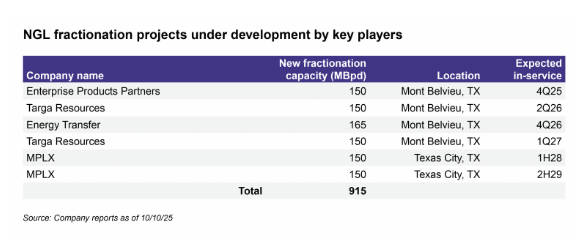
Most U.S. NGL fractionation occurs at the Mont Belvieu hub east of Houston, which is seeing a continued wave of investment from EPD, ET, MPLX, and TRGP. As the below chart shows, these key players are set to add over 900 MBpd in total fractionation capacity on the Gulf Coast by 2030.
From the Mont Belvieu hub, NGL purity products move from fractionation facilities and underground storage caverns to their final destinations. These products are transported to nearby petrochemical plants and coastal export terminals through pipelines.
The NGL export landscape has traditionally been led by incumbents EPD, ET, and TRGP, which are expanding their collective 2.6 MMBpd export capacity. At the same time, new players MPLX and OKE are entering the market by jointly constructing a new 0.4 MMBpd LPG export terminal at Texas City, expected to be completed in 1H28. The project includes the construction of a new pipeline to transport NGLs from Mont Belvieu to the facility.
How to Gain Exposure to NGLs
The key NGL players (EPD, ET, MPLX, OKE, and TRGP) are all in the Alerian Midstream Energy Select Index (AMEI), which is ~75% U.S. and Canadian midstream corporations and ~25% MLPs. The MLPs among them (EPD, ET, and MPLX) are top-five constituents in the Alerian MLP Infrastructure Index (AMZI). These indexes provide direct exposure to the NGL growth story.
For an informative 30-minute discussion with Energy Transfer (ET), don’t miss our webcast on Wednesday, November 12, at 12:30 p.m. ET. Follow the link here to register.
Looking for midstream insights in your inbox? Subscribe here to keep a pulse on midstream investing through our weekly updates.
AMZI is the underlying index for the Alerian MLP ETF (AMLP) and the ETRACS Alerian MLP Infrastructure Index ETN Series B (MLPB). AMEI is the underlying index for the Alerian Energy Infrastructure ETF (ENFR) and the ALPS Alerian Energy Infrastructure Portfolio (ALEFX).
Related Research:
Targa Resources Announces New Permian Investments
Energy Transfer Announces Earnings, Arizona Pipeline
It’s July 1 & US Liquids Pipelines Are Raising Rates
NGLs: The Other Growth Driver for Midstream
NGLs 101 With VettaFi’s Head of Energy Research
vettafi.com is owned by VettaFi LLC (“VettaFi”). VettaFi is the index provider for AMLP, MLPB, ENFR, and ALEFX, for which it receives an index licensing fee. However, AMLP, MLPB, ENFR, and ALEFX are not issued, sponsored, endorsed, or sold by VettaFi. VettaFi has no obligation or liability in connection with the issuance, administration, marketing, or trading of AMLP, MLPB, ENFR, and ALEFX.
Originally published on ETF Trends
For more news, information, and analysis, visit the Energy Infrastructure Content Hub.
A message from Advisor Perspectives and VettaFi: Discover something new! Click here to register for our upcoming webcasts.
Read more commentaries by VettaFi