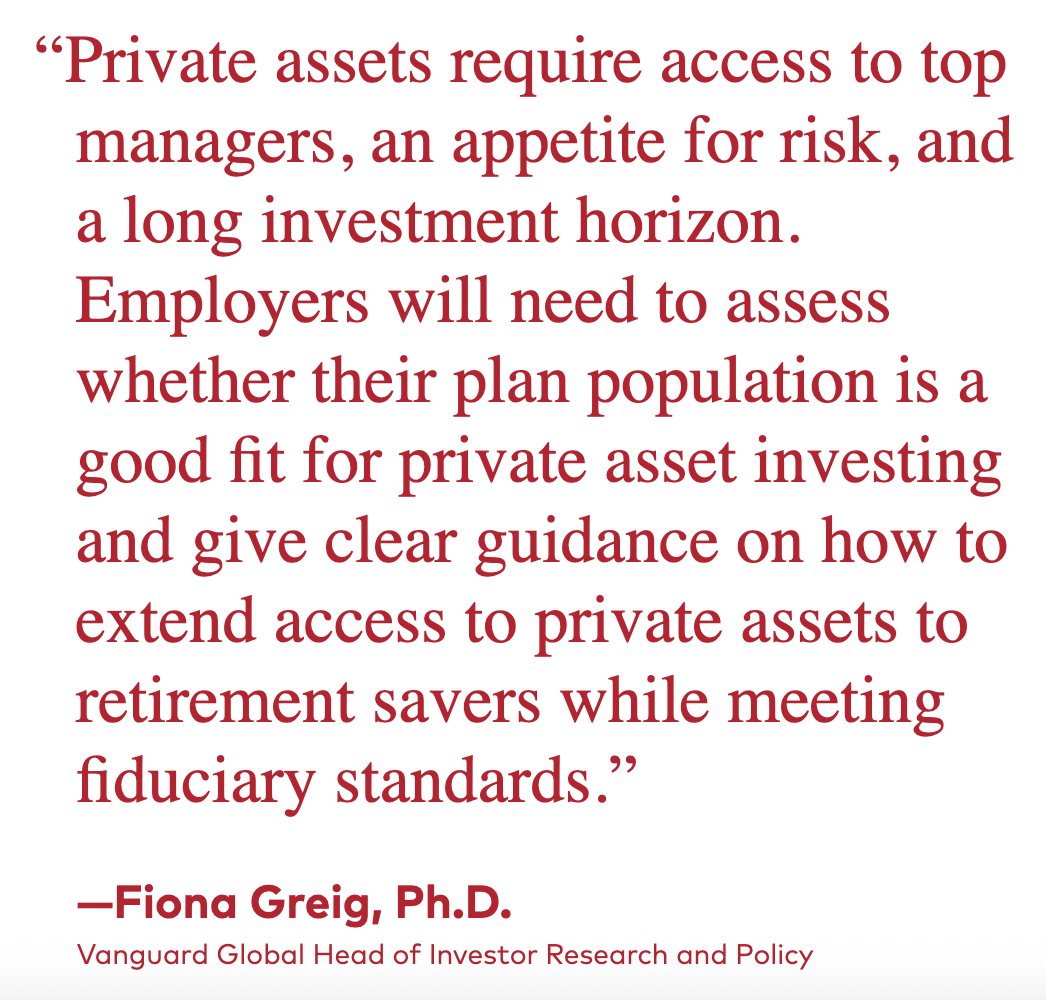
Public interest in including private assets in defined contribution (DC) plans has increased, and policymakers and plan sponsors are evaluating their investment merits and exploring pathways to implementation. According to Fiona Greig, global head of Investor Research and Policy at Vanguard, private assets can boost retirement savings, but they may not be appropriate for all investors.

Private assets in DC plans: Why manager skill matters
The investment case for private assets in DC plans hinges on choosing high-performing managers—specifically those in the top third of the performance spectrum, committing to long holding periods, and accepting the risk of underperformance over time.
“Private asset returns exhibit wide dispersion, making manager selection critical,” Greig said. She added that private equity funds, for example, show a much wider performance spread than public active funds (26 percentage points versus 7 percentage points), highlighting the importance of identifying skilled managers.1
Vanguard research shows that hypothetical portfolios incorporating private assets (using a 10%–20% allocation split between private equity and private debt) within target-date funds (TDFs), assuming top-tier managers, could improve retirement wealth by 7%–22% and retirement income by 5%–15% (after fees) over 40 years. Given that the typical U.S. worker faces a projected 13% shortfall in retirement income relative to spending needs, this potential increase in wealth could play a meaningful role in closing the gap for many savers. For example, a worker earning $52,000 annually might gain an additional $108,000 to $325,000 in retirement wealth, or $500 to $1,500 more per month in retirement income.2
Greig noted that private assets, such as private equity, private credit, private infrastructure, and real estate, have grown substantially over the past two decades, with private equity alone rising from 1% to 8% of global equity. “This expansion underscores the increasing relevance of private markets and, under the right conditions, can offer broader diversification opportunities within retirement portfolios,” Greig said.
Access to private assets has traditionally been limited to institutional or wealthy investors due to their complexity, illiquidity, and long investment horizons. But Greig points out that new fund structures with improved liquidity and transparency, such as interval and tender offer funds, are emerging, increasing the possibility for DC plan participants to access them.
What plan sponsors must consider with private assets
While private assets may offer compelling investment benefits, plan sponsors face critical challenges in offering them within DC plans, starting with significantly higher fees. Private asset fees typically range from 1.5% to 5%, compared to 0.06% to 0.60% for typical TDFs.3 As fiduciaries, plan sponsors must be able to identify and access high-quality managers at reasonable costs and demonstrate that the benefits outweigh the costs and risks.
“Manager due diligence for private assets is more complex and resource-intensive than for public assets, and top managers may have limited capacity or charge higher fees,” Greig said. “Clear communication of risks, fees, and investment merits to participants is essential to mitigate litigation risks.”
Employers must also assess whether private asset investing is appropriate for their plan population. This kind of investing requires patience because of its relative illiquidity and potential for extended periods of underperformance. The median TDF holding period across plans is about four years, with only one-third of plans having median holding periods exceeding five years.4 Worker turnover often shortens holding periods, because participants tend to cash out or roll over assets when changing jobs.
“Plans with longer holding periods may be a better fit for private assets,” Greig said. “Plan design can encourage longer holding periods by enrolling workers in the plans immediately upon hire and allowing them to remain invested in the plan even as they switch jobs or retire. Making plans more of a destination for all of a worker’s retirement assets could help participants realize the benefits of private assets.”
Offering private assets: Default versus standalone options
Greig added that plan sponsors have two primary pathways to introduce private assets into DC plans: either within default TDFs or as standalone investment options. Including these assets in default TDFs can ensure broad participation (about 59% of participants hold TDFs), professional risk management, and liquidity pooling, thereby mitigating liquidity risks.5 Standalone options or managed accounts require active participant choice, leading to lower adoption rates—just 7% for managed accounts—and greater liquidity risk because participants must manage their own allocations.6
Aggregate market effects and policy considerations
Expanding access to private assets in DC plans offers the potential to enhance retirement outcomes, particularly for participants with long investment horizons and sponsors capable of identifying top-tier managers at reasonable fees. But private assets also come with higher costs, greater return dispersion, and liquidity constraints.
“Not all plan populations are a good fit for private asset integration, particularly those with shorter holding periods, lower incomes, or high turnover participants,” Greig added. “As regulatory standards evolve, clear and actionable guidance will be essential to help plan sponsors navigate the complexities of integrating private assets in DC plans.”
1 Sources: Vanguard calculations, using data from Morningstar, Inc., and MSCI.
2 Retirement wealth is based on a worker starting to save at age 25 with $52,000 in earnings, which grow based on the average wage index published by the Social Security administration, and retiring at age 65. We assume a saving rate of 8.8% at age 25 increasing to 12% by age 65. The retirement income result is based on spending 5% of the balance annually starting at age 66 and includes $43,333 per year in Social Security income. This is based on the last 10 years of performance using the retirement income vintage of the TDF series from Morningstar, as of December 2024. It is also based on interquartile fee ranges for institutional share classes from the 25th to the 75th percentile in the Morningstar universe of passive and active TDF as of December 31, 2024. Source: Vanguard, 2025.
3 Sources: Vanguard calculations, using data from Morningstar, Inc.; 2024 Private Equity Fees and Terms Study (Ashley Kahn, 2024), available at callan.com/blog-archive/2024-private-equity-fees/; Exclusive Callan Study Examines Fees for Real Assets Funds (Aaron Quach, 2024), available at callan.com/blog-archive/real-assets-fees-2024; and A Survey of Private Debt Funds (Joern Block, Young Soo Jang, Stephen Kaplan, and Anna Schulze, 2024), available at academic.oup.com/rcfs/article-abstract/13/2/335/7609046.
4 Vanguard calculation based on recordkeeping data.
5 Based on Vanguard recordkeeping data.
6 Based on Vanguard recordkeeping data.
A message from Advisor Perspectives and VettaFi: Discover something new! Click here to register for our upcoming webcasts.
Notes:
All investing is subject to risk, including the possible loss of the money you invest. Be aware that fluctuations in the financial markets and other factors may cause declines in the value of your account. There is no guarantee that any particular asset allocation or mix of funds will meet your investment objectives or provide you with a given level of income.
Diversification does not ensure a profit or protect against a loss.
Private investments involve a high degree of risk and, therefore, should be undertaken only by prospective investors capable of evaluating and bearing the risks such an investment represents. Investors in private equity generally must meet certain minimum financial qualifications that may make it unsuitable for specific market participants.
Vanguard funds not held in a brokerage account are held by The Vanguard Group, Inc., and are not protected by SIPC. Brokerage assets are held by Vanguard Brokerage Services, a division of Vanguard Marketing Corporation, member FINRA and SIPC.
For additional financial information on Vanguard Marketing Corporation, see its Statement of Financial Condition: Audited and Unaudited
Broker-Dealer Form Client Relationship Summary (Form CRS) and Investment Advisor Form Client Relationship Summary (Form CRS)
© 1995–2025 The Vanguard Group, Inc. All rights reserved. Vanguard Marketing Corporation, Distributor of the Vanguard Funds. Your use of this site signifies that you accept our terms & conditions of use.
© Vanguard
Read more commentaries by Vanguard