Recently, I attended the North American Blockchain Summit 2025, a digital asset conference in Dallas. Last year’s agenda leaned heavily on legislation and policy. This year broadened into real-world use cases — payments, tokenization, custody, and market structure — without losing the regulatory thread. My three biggest takeaways relevant to ETF advisors and investors focus on tokenization, stablecoins, and digital asset policy.
Tokenization Becomes More Tangible
Tokenization has been a popular topic for a while, but the concept has turned more tangible in recent years. Tokenization refers to turning ownership of something (like cash, stocks, or real estate) into a digital token on a blockchain. It makes the asset easier to move, split into fractions, and settle quickly (often 24/7).
Tokenized real estate, for example, has brought tokenization to real-world assets. This has led to more potential innovation and efficiencies in the real estate space. But it has limited use cases for mainstream advisors and investors. A more immediate use case lies in banks tokenizing traditional deposits and assets. HSBC has launched tokenized deposit services that enable cross-border USD payments. JPMorgan is piloting USD deposit tokens (JPMD) on Base for institutions. And Citi teamed up with SDX to bring tokenized private market assets to clients.
That idea also extends to ETFs and other funds. Several issuers already offer tokenized funds, including Franklin Templeton (the Franklin OnChain U.S. Government Money Fund (FOBXX)), BlackRock (the BlackRock USD Institutional Digital Liquidity Fund (BUIDL)), and WisdomTree (tokenized 1940 Act funds). After unconfirmed news spread that BlackRock may explore tokenization through its iShares retail brand, BlackRock reaffirmed it’s interested in exploring tokenization in its most recent earnings call on October 14.
Stablecoins Mature Under Regulatory Oversight
One of the most interesting panels was on banking and stablecoins. A stablecoin is a cryptocurrency designed to keep a steady value — usually pegged to $1 or another currency. It holds that peg by being backed with reserves (like cash and Treasuries) or using mechanisms that adjust supply and demand. A lot of this activity still runs on ethereum. This potentially means more payments and settlements touching the ethereum ecosystem.
In the U.S., stablecoin rules are getting clearer post-GENIUS Act, which establishes a federal framework for stablecoin issuers (including banks) and sets reserve and oversight requirements. In Europe, the Markets in Crypto-Assets Regulation (MiCA) lets licensed banks issue “e-money token” stablecoins. We are already seeing real and potential products: Societe Generale’s EURCV runs on public blockchains, and a nine-bank group plans a MiCA-compliant euro stablecoin for cross-border payments across the region. These efforts aim to offer 24/7, low-cost transfers under bank-grade oversight.
Innovation & Regulation Intersect
Previously two opposing forces, regulation and innovation now work hand-in-hand. Former CFTC Chairman Christopher Giancarlo stated in his morning session that no one will likely be appointed to any government agencies if they aren’t pro digital asset innovation. I discussed much of that government support here. But the main point worth reiterating for ETF investors is the generic listing standards. This change simplifies the crypto ETF approval process without the previous step of exchanges filing a 19b-4 each time as long as certain criteria are met — for example, having CFTC regulated futures. That would reduce the maximum approval time from around nine months to 75 days. This is a significant time frame change for both investors and issuers.
With these promising regulations, crypto ETFs in 2025 seem imminent; however, the government shutdown has thrown a wrench into any immediate plans. As of October 22, the U.S. government has been shut down for 22 days — the second-longest shutdown in history (after 35 days in 2018-2019). During a government shutdown, nonessential functions are paused. This includes approval of new ETFs. Currently, there are 100+ ETFs in the pipeline awaiting approval by the SEC. Many of these are likely to be approved this year, including Solana and XRP. That timeline, however, is uncertain until normal government operations resume. I expect we’ll see healthy inflows into these new products (not like spot bitcoin, but closer to what we’ve seen in existing leveraged/futures crypto ETFs that were launched this year).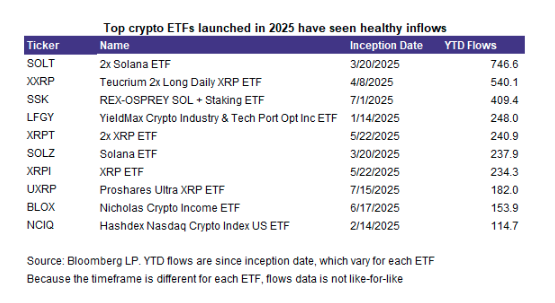
Bottom Line:
Stablecoins are becoming more widely accepted, while tokenization broadens to real-world assets and funds — shifting the conversation from “if” to “how fast.” For ETF investors, the opportunity is accelerating. But execution will continue to depend on regulatory implementation and government efficiency.
Originally published on ETF Trends
For more news, information, and analysis, visit VettaFi | ETF Trends.
